Finding Fiber in Columbia, MO, providing data access for 400 megawatt of power, Mike Manos kicks the dirt again

I've blogged about the 400 megawatt of power in Columbia, Missouri, and an obvious next question is what is the fiber like.  Last year's information was "there isn't enough fiber."

Research the site and the common knowledge is three providers - AT&T, Level3, and CenturyLink/Lightcore.  That's not enough.  But look at where the data comes from, the salesperson who is ready to take the order.

Mike Manos wrote an entertaining post on kicking the dirt.

Mike Manos discusses data center site selection, you need to “kick the dirt” to find what is real

At Gartner’s Data Center Conference, Mike Manos made an excellent point that “75% of the data center costs are effected by site selection.” Great architecture is designed to a site characteristics.  But, the status quo is to design data centers that are built based on past experiences.  Green data centers need to be designed to fit with site characteristics.

Mike wrote a post on site selection.

Kickin’ Dirt

December 21, 2009 by mmanos

mikeatquincy

Mike Manos was out at the Columbia, MO data center site to kick the dirt, and he recalls there not being enough fiber being in Columbia from his past data center research. The team luckily had Mike for a day without his cell phone as he forgot it at home, so they had his undivided attention.

Chicago and Kansas City are midwest centers for cattle which was connected by railway.

image

And Interstate 70 connects Kansas City and St. Louis.

image

There must be more fiber available.  With a little "kickin the dirt" and willingness to spend a bit of more and time, there are 4 more providers few discuss.

Global Crossing

Sprint

XO Communications

MNA - Missouri Network Alliance

Kicking the dirt further, turns out Level 3 has two fiber paths in Columbia - the typical interstate 70, and a little known WillTel's pipeline fiber.

Also the North South path on Highway 63 is available for future growth.

In general, Columbia is a place to take take a piss and fast food break between Kansas City and St. Louis.  There are three fiber trenches running this same path that can be tapped within 30 miles of Columbia.  Note the 30 mile separation helps meet the fiber requirement for geographic diversity.

image

Now that the team has kicked the dirt, it is easy to tell the fiber access story in Columbia, MO.  400 megawatts of power and plenty of available fiber. 

Read more

Green the Data Center with Open and Transparent thinking

This past week I slowed my blog posting.  I wrote 5 posts for the week, and many times I'll write 5 posts in a day as I run across interesting information that is publicly available.  I was down in the bay area and had great conversations with technical friends who I have known for 10 - 20 years.  And, with the announcement of non profit organization partnership with University of Missouri, I have been thinking more about the approach we will use in the partnership.

I leave in a few hours to get on a plane to Missouri, and one of the people we will meet with is the President of the University of Missouri system, Gary Forsee.

Gary Forsee

Gary Forsee

Gary D. Forsee became the 22nd president of the four-campus University of Missouri System Feb.18, 2008. He is the chief executive officer of the university with four campuses in Columbia, Kansas City, Rolla and St. Louis. The system’s annual operating budget is approximately $959 million, with total revenues of $2.5 billion and an endowment of $1 billion.

In his first year as president, Forsee established a comprehensive set of performance objectives, surveyed Missourians on their attitudes of public higher education and focused on conveying the university’s distinctive value to the state.

Prior to his appointment as university president, Forsee spent more than 36 years in the telecommunications industry. Most recently, he served as chairman and CEO of Sprint Nextel in Kansas City, Mo. He also served as CEO of Global One, a joint venture of Sprint, Deutsche Telekom and France Telecom; and in various leadership positions at AT&T and Southwestern Bell.

And, this is forcing me think hard to what does it mean to be a green data center.  Is it a low PUE?  Is it a 100% renewable energy supply? Is it cloud computing?

What is consistently missing from almost all green data center claims is an open and transparent approach to share the knowledge beyond the PR message.

What do I mean by Open and Transparent?  Here is an article that does a very good job of explaining.

Openness

If you are open-minded, not closed, you are open to new ideas, to new thoughts, to new people and to new ways of working. When you come across new things you are curious and eager to explore them. You are non-judgmental and you look to engage other people in conversation – not so much in debate, but more in dialogue.

You deliberately go out of your way to discover new things. You are an explorer!

You ask for criticism from people – not praise. You are not afraid when people challenge your ideas – in fact you welcome it. This is how you learn. You are willing to ‘let things in’. People can ‘come in’. Hence the word ‘open’.

Transparency

If you are transparent, you work in a way which naturally enables people to see what you are doing. You publish your activity and your ‘work in progress’ as a by-product of the way that you work. You deliberately go out of your way to try to be honest and open about who you are. There is no façade, no pretense – with you, people get what they see.

You speak in your own voice. You are authentic. Others can see clearly who you are, what you are doing and why you are doing it.

You do not try to hide things out of fear of being seen to make a mistake. You actually want your mistakes to be seen. And you want others to point them out to you – that way you get to learn and to get even better at what you do. You make it easy for people to find you and to connect with you. You ‘let things out’. People can ‘see in’. Hence the word ‘transparent’.

The article finishes with the signs of if you are open and transparent.

Behaviours

Being open and transparent is a state of mind and more about general behaviour than the use of any specific tools. But if you are open, and transparent the more likely you are to blog; to ‘Twitter’; use wikis and other social-networking tools; give talks; publish papers, articles or newsletters; keep your calendar online; have an online presence indicator; and, write regular status reports on your activity and much more besides.

Being open and transparent are not the only traits of an effective knowledge worker, but I do believe they are two of the core behaviours. So do you think openness and transparency are important? If so, just how open and transparent are you and what might you do to improve?

I have now shared the approach I will take in the discussion with President Forsee and others at the University of Missouri.

If green data centers used an open and transparent approach, the adoption of technologies and methods would be faster. 

Think about what is holding back people and organizations from using this approach.  I am.

Read more

OMG+ Spanish & English Facebook pages promoting 100% renewable energy is 312,216 members

It has been interesting watching the growth of the 100% renewable energy page for Facebook.

Members
6 of 178,408 members

One member pointed out the Spanish page.

Eoin Dubsky Less than a month, and we're ** over 300,000 ** strong: 175,938 members here + 127,696 members in the Spanish language grouphttp://www.facebook.com/group.php?gid=325301129292

The Spanish page is at 133,000.

Members
6 of 133,808 members

178,408 + 133,808 = 312,216

And still growing.

Many discount the power of a Facebook group.  But, there are probably 300,000 more people know knew about this topic before it reached Facebook group. Maybe 312,216 in the data center world.

I am sure Facebook PR is hoping this issue will die away, but Greenpeace is going to work hard to keep this topic going.

Read more

Washington State Data Center bill passes Senate House off to Gov for signature

Washington State's Data Center Bill passed the Senate.

Data center bill passes Senate

DateTuesday, March 16, 2010 at 4:54PM | AuthorWNJ-Editor

We have great news coming out of Olympia today on the second day of special session. SB 6789, the data center tax exemption, passed out of the Senate on a 39-4 vote. This is an exciting development, and now it is on to the House for consideration.

The Associated Press wrote about the bill's passage. Sen. Tom was interviewed in theAP story:

"Sen. Rodney Tom, D-Medina, said the measure would draw companies and jobs to the state.

"The key to this is to incentivize them to build," he said. "Once we get them to make that commitment to go ahead and build, in this difficult economic environment, we can get those good construction jobs."

And House.

Data center bill passes House, off to governor for signature

DateWednesday, March 17, 2010 at 5:31PM | AuthorWNJ-Editor

So happy news to report: the data center legislation passed the House today on a 91-2 vote and now goes to Gov. Gregoire for her expected signature. This is obviously a great development, and we are so happy that people rallied around the legislation, which will help not just rural counties but the entire state.

After the Governor's signature.  We'll see if it gets data center construction started in Washington State.

Here is the pdf for the bill 6789.

13 (2) There is currently an intense competition for data center
14 construction and operation in many states including: Oregon, Arizona,
15 North and South Carolina, North Dakota, Iowa, Virginia, Texas, and
16 Illinois. Unprecedented incentives are available as a result of the
17 desire of these states to attract investments that will serve as a
18 catalyst for additional clusters of economic activity.

Read more

Google Data Centers, a part of their infrastructure advantage

I was talking to a Sr Google guy at a conference and asked what he does.  His response was "I work on Google's Infrastructure."

What is infrastructure as defined by searchdatacenter?

DEFINITION - In information technology and on the Internet, infrastructure is the physical hardware used to interconnect computers and users. Infrastructure includes the transmission media, including telephone lines, cable television lines, and satellites and antennas, and also the routers,aggregators, repeaters, and other devices that control transmission paths. Infrastructure also includes the software used to send, receive, and manage the signals that are transmitted.

In some usages, infrastructure refers to interconnecting hardware and software and not to computers and other devices that are interconnected. However, to some information technology users, infrastructure is viewed as everything that supports the flow and processing of information.

Infrastructure companies play a significant part in evolving the Internet, both in terms of where the interrconnections are placed and made accessible and in terms of how much information can be carried how quickly.

But, the Google guy clarified he works on the search and services infrastructure to support Google services.  Ohh, this is interesting Google defines infrastructure above what most think.

Which fits with a competitive Google has that GigaOm points out as an infrastructure advantage.

Google’s Growing Infrastructure Advantage

By Stacey Higginbotham Mar. 17, 2010, 7:50am PDT 2 Comments

75

Google’s content comprises between 6 and 10 percent of global Internet traffic, making its internal network one of the top three ISPs in the world, according to Arbor Networks. The maker of deep packet inspection equipment, which runs a survey of international ISPs, detailed Google’s traffic in a blog post Tuesday.

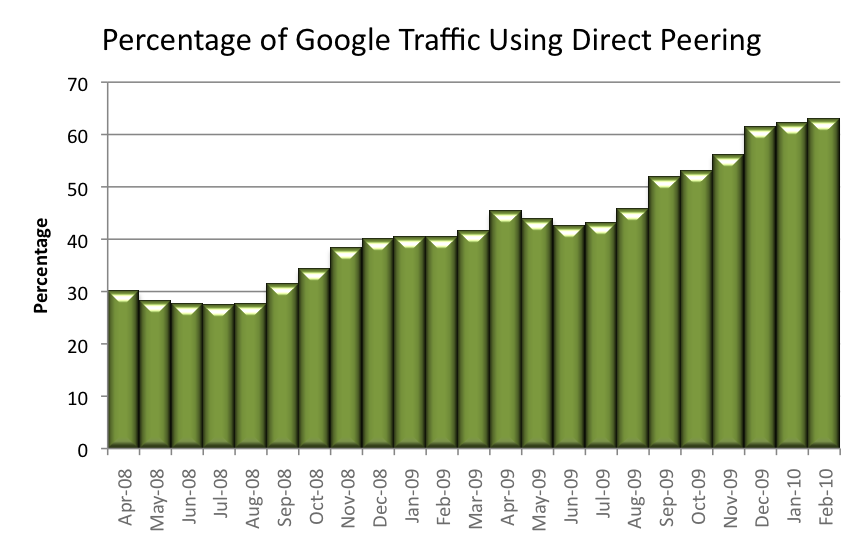
The original information came from here with details on Google's use of direct peering.

The graph below shows an estimate of the average percentage of Google traffic per month using direct interconnection (i.e. not using a transit provider). As before, this estimate is based on anonymous statistics from 110 providers. In 2007, Google required transit for the majority of their traffic. Today, most Google traffic (more than 60%) flows directly between Google and consumer networks.

google_peering

So, even though the data center crowd thinks of data centers as infrastructure, Google has a bigger picture.

But even building out millions of square feet of global data center space, turning up hundreds of peering sessions and co-locating at more than 60 public exchanges is not the end of the story.

Over the last year, Google deployed large numbers of Google Global Cache (GGC) servers within consumer networks around the world. Anecdotal discussions with providers, suggests more than half of all large consumer networks in North America and Europe now have a rack or more of GGC servers.

So, after billions of dollars of data center construction, acquisitions, and creation of a global backbone to deliver content to consumer networks, what’s next for Google?

I am regularly surprised how data center discussions many times only discuss the data center, not the data center as part of the overall system.

Read more