Growth of Biomass energy plants is a new source for a Green/Low Carbon Data Center,

NPR has an article on the growth of Biomass energy generation.

Wood-Powered 'Biomass' Plants Have Critics Barking

by MARTIN KASTE

Listen to the Story

Billions of dollars in tax credits for alternative energy were included in the federal stimulus package. Some of the money is going to encourage Americans to do something man has done for centuries: burn wood.

Plans for electricity-generating "biomass" plants are in the works around the country — and they're under attack from critics who worry that burning more wood may not be as environmentally friendly as other kinds of alternative energy.

I've had multiple conversations with OSIsoft's Pat Kennedy on the opportunity for data centers to locate near pulp and paper mills which have an abundance of biomass, energy, water, and steam to support data centers. 

But, data center site selectors and their customers are risk averse going with safe places.  Google bought a decommissioned pulp and paper mill, and I blogged about biomass power generation here.  I know of an existing pulp mill with 20 megawatts of current renewable biomass power with plenty of steam and space for a data center, but the owner has had a difficult time getting data center developers, engineering and customers interested in his site given there are no other data centers located in the area.

I am constantly amazed at how much money is wasted on data centers.  The number of executives who want to reach out and touch their data center put data centers close to their corporate offices like the bay area.  You don't see Google, Microsoft, Amazon, and Facebook building data centers in the bay area.

If you want to have a competitive advantage in data center services go where the power is cheap and sustainable. 

Keep in mind when you have a $100 million plus budget, the data center con game is on and you can get played.  Mike Manos describes some of this.

Its an industry dominated by boutique firms in specialized niches all in support of the building out of these large technically complex facilities.  For the initiated its a world full of religious arguments like battery versus rotary, air-side economization versus water-side economization, raised floor versus no raised floor.  To the uninitiated its an industry categorized by mysterious wizards of calculus and fluid dynamics and magical electrical energies.  Its an illusion the wizards of the collective cottage industries are well paid and incented to keep up.   They ply their trade in ensuring that each facility’s creation is a one-off event, and likewise, so is the next one.  Its a world of competing General Contractors, architecture firms, competing electrical and mechanical firms, of specialists in all sizes, shapes and colors.   Ultimately – in my mind there is absolutely nothing wrong with this.  Everyone has the right to earn a buck no matter how inefficient the process.

I wonder if it is worthwhile to give tips on the signs of when you are being thrown a lot of BS. 

One of the top tips I would make is don't let your corporate real estate who provides your office space be responsible for data centers.  Data Centers are not office spaces, the people who you want to build your data center most likely are not the people who built your office space.

Due to the money spent on data centers, almost no one says "yeh, I made a bunch of mistakes building mine, and I could have saved a bunch of money if I had made some different decisions.  Let me tell you what I would have done differently."  Because, if he did, he would mostly be fired for admitting he made million dollar mistakes.

This is why people glowingly promote their data centers as being LEED certified and top efficiency, because it directly reflects on how smart they are.  Beware of those who are promoting their data centers, and don't tell you the mistakes made.

No One Builds Perfect Data Centers.

Read my post again on top 9 data center mistakes.

Not Calculating PUE ROI, 1 of 9 Top Data Center Mistakes

Lee Technologies sent over their Top 9 data center mistakes paper, and I liked it right from the start as they made the point people don't calculate an ROI for PUE performance.  PUE is closest to telling an efficiency of a data center which to a layman is the closest we have for data centers for a MPG, but who specifies a high MPG number and doesn't think about how much it costs for the extra MPG above the norm.
image

Read more

Saw Eric Schmidt walking with his Android Phone, made me think who would have thought a Phone made Apple more valuable than Microsoft

I was sitting down at lunch today and Eric Schmidt walked by typing on his Android Phone.  I wonder if I had got my iPhone  out quick enough to take a picture if he would react the way Steve Ballmer does.

Steve Ballmer Will Smash Your iPhone, Mock You

Don't upset Steve Ballmer. You wouldn't like him angry. One Microsoft employee discovered that the hard way at a recent event for the company. As the CEO was making his rounds amongst the employees, the worker pulled out an iPhone to snap a shot of Ballmer. Ballmer grabbed the phone, put it on the ground, and pretended to stomp it. All in good fun, apparently.

What is hilarious is watching Ballmer discussing Google Android in Nov 2007 welcoming the competition.

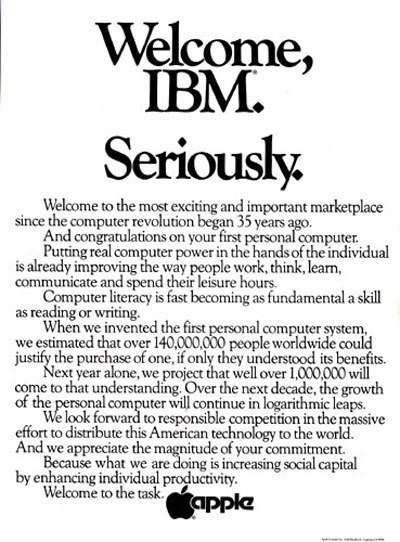
Which reminded me of Apple's welcoming IBM.


And Steve's comment about the iPhone.

But Apple gets the laugh today as they achieved a higher market cap than Microsoft.

May 26 (Bloomberg) -- Apple Inc., the computer maker turned mobile gadgeteer, overtook Microsoft Corp. to become the most valuable technology company on optimism it can keep adding customers for its iPhone, Macintosh computer and iPad.

By 4 p.m. New York time in Nasdaq Stock Market trading, Apple’s market value was at $222.1 billion, higher than Microsoft’s $219.2 billion. That made Apple the most valuable technology firm in the world. It’s also the second-largest U.S. stock by market value, behind oil company Exxon Mobil Corp., valued at $278.6 billion on the New York Stock Exchange.

And IBM has a market cap of $152 billion.  How times change.

Read more

Green the Data Center with a Network Storage Solution, Flash Memory RAID array - 80% less power and 70% less servers

Greening the Data  Center is dominated in marketing messages by the big brands - Intel, HP, IBM, and EMC/VMware.  But, some of the greenest solutions are coming from small companies that introduce disruptive technologies.  As many of you know the Storage Systems can be big power users in the data center, requiring special power distribution for the high power density which then requires extra cooling.  Many of you would like to throw those storage systems out if you could.

How about if for the same cost as an EMC or NetApp storage solution you could consume 80% less power, shrink a rack of storage to 3U of space, and improve the server performance potentially removing 70% of the servers?  Violin memory announced their new storage solution.

image

MOUNTAIN VIEW, Calif. — May 25, 2010 — Violin Memory, Inc., provider of the world’s fastest and most scalable memory arrays, today announced the availability of the Violin Memory 3200 Flash Memory Array. The Violin 3200 is a redundant, modular 3U memory array that scales from 500GB to 10 Terabyte SLC NAND Flash and provides the industry’s best price/performance attributes using patent-pending Flash RAID technology.

...

“We are delighted by the customer response to the Violin 3000 series and our new Memory Array data center equipment category.” said Don Basile, CEO of Violin Memory. “The aggregation of flash modules into a Memory Array allows much higher performance and spike-free latency for enterprise applications – Database, data warehousing, VMware as well as custom applications all benefit from the order of magnitude price/performance improvements of Violin’s flash array technology.”

Versus SSD memory solution that are installed in PCIe slots like Virident and Fusion-IO which are useful for solutions like memcache, the Violin Memory solution looks like a NAS storage device and can improve the performance of a wider range of solutions like good old relational databases. 

Here is a top view of the 3000 Series Violin Memory storage appliance.

image

BTW, a bunch of the exec team at Violin Memory came from Fusion-IO, so if you were looking at Fusion-IO you should think about adding Violin memory to your eval list.  Violin Memory has the potential to be used in a lot more scenarios.

The Violin Memory is disruptive to the Server License model for those who make money on the number of processors, so you can expect resistance to a NAND Flash memory array.

I'll be meeting with Violin Memory tomorrow, so I should have more technical details in a future post.

Read more

Alan Wake XBox Game for Data Center fanatics - Generators, Batteries, Security, and Fear when Energy runs out in a Battle with Darkness

Thanks to Dave Harder convincing my wife that the hottest XBox 360 game is Alan Wake, I have a new game to play late at night. 

After playing the game, I realized it was a game that could be entertaining for people who work in Data Centers.  Bad things happen when the power goes off

During the day in each episode Wake can wander and talk to NPCs, but once the clouds roll in and the moon lights up it's a whole different beast. Shadows flit across the ground at supernatural speed like X-Files black oil when threats are imminent. The lighting effects can be stunning. Moonlight pours from above, streetlamps and construction bulbs indicate the way forward, and Wake's all-important flashlight is a tool for exploration and, more importantly, to vanquish threats. Just because there's such a focus on story and presentation doesn't mean the game lacks a responsive and satisfying combat system.

You have a flashlight to help you see the bad people and find generators to turn the lights on.

You need batteries which are sponsored by Energizer.  The diesel generators could have been sponsored, but they all look pretty beat up, so putting a logo on it isn't worth much.

Here is a video turning on a generator.

Here are some reviews.

Critical Response

Michael Plant from The Independent gave the game a perfect score of 5/5. He praised Alan Wake for its "flawless pacing", which "ensures a compulsive experience". Editing and plot were also received very positively, making the game "the kind of experience the current console generation was made for."[32]

The Daily Telegraph rated the game 9/10 with editor Nick Cowen being impressed by its "stunning" look, stating the town of Bright Falls and its surrounding environment to be "authentic" in terms of architecture, vegetation, weather and lighting. He described the atmosphere as being able to "...turn on a dime from feeling safe and serene to one of choking menace and foreboding...". Combat mechanics and plot were also praised with the first making "the player feel constantly under threat." and the latter being "...one of its [the game's] strongest assets." Criticism included facial animation and shortness in length.[33]

Dirk Lammers said the game kept "players on the edge of their seats", giving a final score of 4 out of 4 in his review for the San Francisco Chronicle.[34]

Enjoy.

Read more

Mike Manos Reflects on Uptime Symposium 2008 - 2010

Mike posted his reflections on Uptime Symposium 2010.  But to start let's go back 2 years ago when Mike gave his first keynote at Uptime in 2008.  Here is my post from 2 years ago.

Apr 27, 2008

Microsoft's Mike Manos Opening Keynote Uptime Institute, Green Enterprise Computing

The opening of the Uptime Institute Symposium started with Pitt Turner, saying "what are we doing here?" Green Enterprise Computing is a timely topic for the industry event. I've seen Mike present before, and here is what I got out of Mike's latest presentation as new information to digest.

  1. Mike's call to action for all was to stop being information hogs, and to share with the industry. He gave numerous example, and here are a few Mike shared.
  2. Mike emphasized that in spite of a focus on technology. Microsoft has found having the right people and processes makes bigger impact than technology . Mike states over 50% of data center outages are caused by human error. This contrasts a common method to invest in multiple layers of infrastructure redundancy to achieve uptime.Mike was proud of Microsoft's ability to have a 100% facilities uptime over 7 years by implementing strong and disciplined maintenance programs. Also, redundant infrastructure creates more energy waste.
  3. Technology is not the only answer to energy efficiency. People are the opportunity. Microsoft achieved a PUE improvement from 2.2 to 1.8 with no new technology just by people making changes to existing systems in one of their older facilities.
  4. Mike didn't say this, but bottom line he emphasizes an Amazon.com approach in getting data on everything, and they'll figure out what to do with it after by giving people the information to do the right thing.

It is amazing thing  to see how Microsoft has risen from nowhere a year ago to be the leader in the Green Enterprise Computing with Mike Manos, delivering the opening keynote.

In Mike's presentation this year he discussed C02K to get people thinking about the carbon impact of the data center.  2 years ago Mike was discussing energy efficiency and PUE, now he is discussing CO2K.  Last year he was discussing containers.

If you look at most keynote speakers, they get the spot due to sponsorship at the event, so the presentation is a strategic positioning slot sold to highest bidder.  This year's Uptime had Jones Lang LaSalle as opening keynote.

image

Mike's keynote was on Tues last of the day.  Nokia was not a sponsor of Uptime.

image

Now you could argue whether the money is worth spending and this is how industry events work.  I would argue Mike definitely got his money's worth.  He didn't have to pay to attend the event or his speaker spot.  As long as people say good things about Mike's presentation Uptime will bring him back as someone to enforce the relevance of Uptime in the industry.

My second key observation this year was the amount of people.  Symposium is truly an international event and their were over 900 attendees for the talks, and if memory serves, about 1300 for the exhibition hall.  I had heard that 20 out of the worlds 30 time-zones had representatives at the conference.  It was especially good for one of the key recurring benefits of this event: Networking.   The networking opportunities were first rate and by the looks of the impromptu meetings and hallways conversations this continued to be an a key driver for the events success.  As fun as making new friends is, it was also refreshing to spend some time and quick catch ups with old friends like Dan Costello and Sean Farney from Microsoft, Andrew Fanara, Dr. Bob Sullivan, and a host of others.

My third observation and perhaps the one I was most pleased with with the diversity of thought in the presentations.  Its a fair to say that I have been critical of Uptime for some time by a seemingly droningly dogmatic recurring set of themes and particular bend of thinking.   While those topics were covered, so too were a myriad of what I will call counter-culture topics.  Sure there were still  a couple of the salesy presentations you find at all of these kinds of events, but the diversity of thought and approach this time around was striking.   Many of them addressed larger business issues, the impact, myths, approach to cloud computing, virtualization, and decidedly non-facilities related material affecting our worlds.   This might have something to do with the purchase by the 451 Group and its related Data Center think tank organization Tier 1, but it was amazingly refreshing and they knocked the ball out of the park.

Mike brings up a problem that many others ran into with the length of the sessions.

My fourth observation was that the amount of time associated with the presentations was too short.   While I have been known to completely abuse any allotted timeslots in my own talks due to my desire to hear myself talk, I found that many presentations had to end due to time just as things were getting interesting.  Many of the hallways conversations were continuations of those presentations and it would have been better to keep the groups in the presentation halls. 

A couple of smart things that were done for Mike's talk - give him a big room to fit the crowd and you know he is going to talk longer than his slot so give the last one in the day.  :-)  Bet you the Uptime Logistics folks were saying "Oh No Mike is going to speak and run over as usual.  Hey let's give the last slot of the day that way he can talk as long as he wants.  And, give him a big room as people like to hear him talk."

Read more