Greenpeace strikes fear in Uptime Symposium, continues No Coal Data Center efforts

I was talking to a friend who was at Uptime Symposium and he asked if  I heard that Greenpeace was there and Greenpeace asked Mike Manos a question in his CO2K presentation.  The fear in the crowd reached levels not typical as they knew they knew Greenpeace has target data centers as the IT polluters like the way Greenpeace has targeted Facebook, and no one knew Greenpeace was attending.  No sane data center event is going to promote that Greenpeace will be there.  See below for Greenpeace's latest move versus Dell.

image

He commented that the Greenpeace question to Mike was a softball question.  I told him of course, Mike is out there discussing issues Greenpeace supports.  They are not going to attack Mike.

Another friend send me a link to the Greenpeace blog post based on Uptime attendance.

Mike was safe.

At the Uptime Institute Symposium last week, speakers discussed the economic impacts that a “carbon tax” or carbon regulation could have on data center operators. Mike Manos of Nokia, pointing to the U.K.’s existing carbon legislation, indicated that the IT sector is ill-equipped to deal with inevitable penalties that will be associated with a heavy reliance on coal when U.S. climate legislation passes.


“Carbon emissions differ for a facility in Washington State and a facility in West Virginia,” said Manos. “Where your data centers are located today is an important criteria.”

I bet the Greenpeace person was looking for Facebook as the "we want Facebook to use 100% renewable energy" is now up to 450,000 users.  Facebook wasn't presenting so Greenpeace reports on eBay.

Unfortunately, a strategy that is still being employed by many IT companies to keep the overhead down is to locate data centers in places where “cheap” coal-fired electricity is available. In January, for example, Facebook commissioned a new data center in Oregon and entered a power service agreement with a utility called PacificCorp, which gets most of its electricity from coal-fired power stations. Just this week, eBay unveiled its new flagship data center, located in South Jordan, Utah, a state that derives 81% of its electricity from coal.

You can tell the Greenpeace reporter was in the audience listening to the presentations.

The Topaz data center, as the new hosting facility for eBay’s Marketplace and Paypal.com is called, is a US$287 million facility with top-of-the-line energy efficiency features, which help to make Topaz 50% less expensive for eBay to operate and 30% more efficient than any of the other data centers it uses. And eBay is very proud of its energy and cost savings accomplishment (as evidenced by the break dancers that performed at the launch party). But, is a diet on which you eat 30% less per meal, but eat MANY more meals than you previously did, AND exclusively live on Twinkies, ultimately going to save you from an untimely and serious health problem?

Who is next?  What is the next data center event Greenpeace will be in the audience?  American Express in North Carolina?

American Express to Build in North Carolina

May 20th, 2010 : Rich Miller

Local economic development officials in North Carolina are confirming that American Express will build a large data center in Guilford County. The financial services company plans to build a $400 million center that would employ up to 150 people and open sometime in 2012, according to the Greensboro News-Record.

I am not worried about Greenpeace as when I am speaking at a data center conference I am in sessions like this. 

Panel: The Greening of the Data Center – Opportunities in Renewable Energy
Understanding the True Value of Renewables: Energy Efficiency, Cost, Redundancy, Availability & Security of Supply
Dave Ohara, President - GreenM3
Paul Harris, Vice President & General Manager - NetRiver International
Tom Schmall, Director of Project Development, Solar and other Renewables - Mortenson Construction

I was talking to another experienced data center engineer and he mentioned how the same stuff gets presented over and over at conferences like Uptime. 

Greenpeace attending data center conferences may drive some of the biggest changes as presenters know Greenpeace is in the audience.

Are you ready for a question from Greenpeace in the audience?

And, you thought being asked a question from media was bad.  Greenpeace has an agenda, and they are looking for the high carbon data centers. 

How about this for a possible change?  The customers who have high carbon data centers no longer will give permission for case studies and public presentations.  The data centers vendors are frustrated and desperate to get reference customers.  The few willing to give permission are those customers who have a Low Carbon data center site, so more and more the end users hear about low carbon data centers and how data centers fit well in a corporate sustainability and environmental strategy. 

Ericsson is one company Greenpeace held up in its blog post.

Some IT companies are starting to get it.  An Ericsson white paper, “Minimizing Carbon Intensity in Telecom Networks Using TCO (Total Cost of Operation) Techniques,” demonstrates the company’s methodology (which gets it second-place ranking on the Cool IT Leaderboard) for understanding both the cost and environmental impacts of its operations, recognizing that the absolute amount of energy consumed by telecom networks is growing, along with carbon emissions, which must be managed. The same is true for cloud computing and the infrastructure that runs it.

And, Greenpeace feels good driving change and keeps going.  Sounds scary doesn't it?
image
Read more

Growth of Biomass energy plants is a new source for a Green/Low Carbon Data Center,

NPR has an article on the growth of Biomass energy generation.

Wood-Powered 'Biomass' Plants Have Critics Barking

by MARTIN KASTE

Listen to the Story

Billions of dollars in tax credits for alternative energy were included in the federal stimulus package. Some of the money is going to encourage Americans to do something man has done for centuries: burn wood.

Plans for electricity-generating "biomass" plants are in the works around the country — and they're under attack from critics who worry that burning more wood may not be as environmentally friendly as other kinds of alternative energy.

I've had multiple conversations with OSIsoft's Pat Kennedy on the opportunity for data centers to locate near pulp and paper mills which have an abundance of biomass, energy, water, and steam to support data centers. 

But, data center site selectors and their customers are risk averse going with safe places.  Google bought a decommissioned pulp and paper mill, and I blogged about biomass power generation here.  I know of an existing pulp mill with 20 megawatts of current renewable biomass power with plenty of steam and space for a data center, but the owner has had a difficult time getting data center developers, engineering and customers interested in his site given there are no other data centers located in the area.

I am constantly amazed at how much money is wasted on data centers.  The number of executives who want to reach out and touch their data center put data centers close to their corporate offices like the bay area.  You don't see Google, Microsoft, Amazon, and Facebook building data centers in the bay area.

If you want to have a competitive advantage in data center services go where the power is cheap and sustainable. 

Keep in mind when you have a $100 million plus budget, the data center con game is on and you can get played.  Mike Manos describes some of this.

Its an industry dominated by boutique firms in specialized niches all in support of the building out of these large technically complex facilities.  For the initiated its a world full of religious arguments like battery versus rotary, air-side economization versus water-side economization, raised floor versus no raised floor.  To the uninitiated its an industry categorized by mysterious wizards of calculus and fluid dynamics and magical electrical energies.  Its an illusion the wizards of the collective cottage industries are well paid and incented to keep up.   They ply their trade in ensuring that each facility’s creation is a one-off event, and likewise, so is the next one.  Its a world of competing General Contractors, architecture firms, competing electrical and mechanical firms, of specialists in all sizes, shapes and colors.   Ultimately – in my mind there is absolutely nothing wrong with this.  Everyone has the right to earn a buck no matter how inefficient the process.

I wonder if it is worthwhile to give tips on the signs of when you are being thrown a lot of BS. 

One of the top tips I would make is don't let your corporate real estate who provides your office space be responsible for data centers.  Data Centers are not office spaces, the people who you want to build your data center most likely are not the people who built your office space.

Due to the money spent on data centers, almost no one says "yeh, I made a bunch of mistakes building mine, and I could have saved a bunch of money if I had made some different decisions.  Let me tell you what I would have done differently."  Because, if he did, he would mostly be fired for admitting he made million dollar mistakes.

This is why people glowingly promote their data centers as being LEED certified and top efficiency, because it directly reflects on how smart they are.  Beware of those who are promoting their data centers, and don't tell you the mistakes made.

No One Builds Perfect Data Centers.

Read my post again on top 9 data center mistakes.

Not Calculating PUE ROI, 1 of 9 Top Data Center Mistakes

Lee Technologies sent over their Top 9 data center mistakes paper, and I liked it right from the start as they made the point people don't calculate an ROI for PUE performance.  PUE is closest to telling an efficiency of a data center which to a layman is the closest we have for data centers for a MPG, but who specifies a high MPG number and doesn't think about how much it costs for the extra MPG above the norm.

image

Read more

Saw Eric Schmidt walking with his Android Phone, made me think who would have thought a Phone made Apple more valuable than Microsoft

I was sitting down at lunch today and Eric Schmidt walked by typing on his Android Phone.  I wonder if I had got my iPhone  out quick enough to take a picture if he would react the way Steve Ballmer does.

Steve Ballmer Will Smash Your iPhone, Mock You

Don't upset Steve Ballmer. You wouldn't like him angry. One Microsoft employee discovered that the hard way at a recent event for the company. As the CEO was making his rounds amongst the employees, the worker pulled out an iPhone to snap a shot of Ballmer. Ballmer grabbed the phone, put it on the ground, and pretended to stomp it. All in good fun, apparently.

What is hilarious is watching Ballmer discussing Google Android in Nov 2007 welcoming the competition.

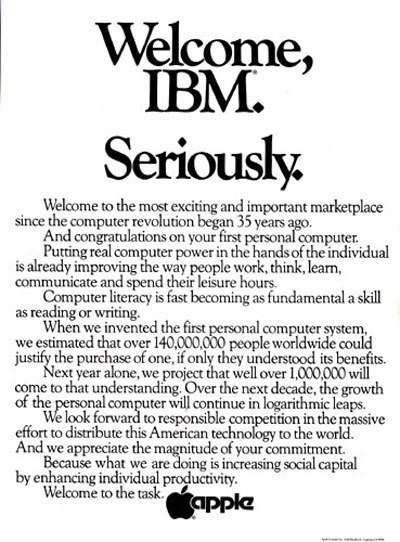
Which reminded me of Apple's welcoming IBM.


And Steve's comment about the iPhone.

But Apple gets the laugh today as they achieved a higher market cap than Microsoft.

May 26 (Bloomberg) -- Apple Inc., the computer maker turned mobile gadgeteer, overtook Microsoft Corp. to become the most valuable technology company on optimism it can keep adding customers for its iPhone, Macintosh computer and iPad.

By 4 p.m. New York time in Nasdaq Stock Market trading, Apple’s market value was at $222.1 billion, higher than Microsoft’s $219.2 billion. That made Apple the most valuable technology firm in the world. It’s also the second-largest U.S. stock by market value, behind oil company Exxon Mobil Corp., valued at $278.6 billion on the New York Stock Exchange.

And IBM has a market cap of $152 billion.  How times change.

Read more

Green the Data Center with a Network Storage Solution, Flash Memory RAID array - 80% less power and 70% less servers

Greening the Data  Center is dominated in marketing messages by the big brands - Intel, HP, IBM, and EMC/VMware.  But, some of the greenest solutions are coming from small companies that introduce disruptive technologies.  As many of you know the Storage Systems can be big power users in the data center, requiring special power distribution for the high power density which then requires extra cooling.  Many of you would like to throw those storage systems out if you could.

How about if for the same cost as an EMC or NetApp storage solution you could consume 80% less power, shrink a rack of storage to 3U of space, and improve the server performance potentially removing 70% of the servers?  Violin memory announced their new storage solution.

image

MOUNTAIN VIEW, Calif. — May 25, 2010 — Violin Memory, Inc., provider of the world’s fastest and most scalable memory arrays, today announced the availability of the Violin Memory 3200 Flash Memory Array. The Violin 3200 is a redundant, modular 3U memory array that scales from 500GB to 10 Terabyte SLC NAND Flash and provides the industry’s best price/performance attributes using patent-pending Flash RAID technology.

...

“We are delighted by the customer response to the Violin 3000 series and our new Memory Array data center equipment category.” said Don Basile, CEO of Violin Memory. “The aggregation of flash modules into a Memory Array allows much higher performance and spike-free latency for enterprise applications – Database, data warehousing, VMware as well as custom applications all benefit from the order of magnitude price/performance improvements of Violin’s flash array technology.”

Versus SSD memory solution that are installed in PCIe slots like Virident and Fusion-IO which are useful for solutions like memcache, the Violin Memory solution looks like a NAS storage device and can improve the performance of a wider range of solutions like good old relational databases. 

Here is a top view of the 3000 Series Violin Memory storage appliance.

image

BTW, a bunch of the exec team at Violin Memory came from Fusion-IO, so if you were looking at Fusion-IO you should think about adding Violin memory to your eval list.  Violin Memory has the potential to be used in a lot more scenarios.

The Violin Memory is disruptive to the Server License model for those who make money on the number of processors, so you can expect resistance to a NAND Flash memory array.

I'll be meeting with Violin Memory tomorrow, so I should have more technical details in a future post.

Read more