When you can’t breath, Green becomes a priority

MSNBC/AP report on a change in twitter post by the US Embassy in Bejing.

U.S. Embassy: Beijing air quality is 'crazy bad'

Twitter post later changed to 'beyond index'


Image: A man walks on a pedestrian overpass on a hazy day at Beijing's Central Business District, China

Alexander F. Yuan  /  AP

A man walks on a pedestrian overpass on a hazy day at Beijing's central business district Friday.

By CHI-CHI ZHANG

BEIJING — Pollution in Beijing was so bad Friday that the U.S. Embassy, which has been independently monitoring air quality, ran out of conventional adjectives to describe it, at one point saying it was "crazy bad."

The embassy, which issues hourly pollution reports via Twitter, later deleted the phrase from a  post, replacing it with "beyond index," and saying it was an "incorrect" description. The embassy said it would also revise the language to use when the air quality index goes above 500, its highest point and a level considered hazardous for all people by U.S. standards

It will be interesting when the health issues get big enough to drive greener behaviors.

"Beijing needs to place more of a priority on the environment. The health of Beijing residents is no less important than the health of those athletes who were here for a few weeks," Ma added. "We can't just expect wind, snow or rain to wipe out the pollution when it gets bad. The city must take pollution more seriously and implement preventive measures."

One Beijing resident said he was suffering breathing difficulties.

"I feel like I'm having some problems with breathing and distress in my chest," said a high school teacher who only gave his surname, Qiao.

Read more

Saudi Aramco Command Center, the ultimate NOC

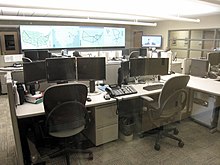
Tours of a data center most of the time end of up on a tour of a NOC.

A network operations center (or NOC, pronounced "nok," like the word "knock") is one or more locations from which control is exercised over a computer, television broadcast, or telecommunications network.

Large organizations may operate more than one NOC, either to manage different networks or to provide geographic redundancy in the event of one site being unavailable or offline.

Check out this video of the Saudi Aramco Command Center, the ultimate NOC.  This is part of 60 minutes special.

Saudi Aramco Command Center from Ben Fry on Vimeo.

What is the hardware behind the Saudi Arabia Command Center?  I would bet Dell and HP based on the use of Dell and HP Hardware used by Saudi Aramco for the Top 500 Super Computers.

Read more

Electricity for a Data Center from Hamsters or Biomass, Missouri Senator Kit Bond votes for Biomass

I just got back from a long 5 days in Missouri, (Mi zoor ah).  Mi zoor ah is in general the pronunciation used by the Republicans in the state and Mi zoor ee is by the Democrats.  Senator Kit Bond is a highly recognized Republican in the state.

"Serving Missouri has been my life's work. I have walked the land, fished its rivers and been humbled by the honesty and hard work of our people. The highest honor is to receive and safeguard the public trust" - Kit Bond.

Christopher S. "Kit" Bond is a sixth generation Missourian, born in St. Louis in 1939. He grew up in Mexico, MO, where he still resides and tends to several groves of trees he planted by hand.

I was on a panel right after Senator Kit Bond's keynote presentation on renewable energy and data centers.  I met the Senator and discussed the idea of the "grass fed data center" fueled by Missouri Biomass.

Below is a video that gives you an idea of the Senator's vision. 

Senator Kit Bond discusses the potential of using Biomass to fuel data centers in Missouri which is getting traction with a lot of potential potential clients as the Senator mentions.

Soon there is going to be a biomass powered data center and with efforts like Senator Kit Bond the momentum continues to build.

One of the humorous parts was the Senator making the point the Internet is not powered by hamsters.  But if you had few billion of these little guys you might get close to a megawatt of power.

Read more

A more enlightened approach to change

To Green the Data Center with lasting sustainable value requires change.  Measuring PUE adds a metric.  Meeting a LEED certification creates a requirement.  Small changes are made to accommodate these needs.  But, many times there is not a fundamental change.

Why change?  Because, if you don't change you do the same things you have done in the past.  Many learn to change labels of what they do, picking up new acronyms and buzz words, but don't fundamentally change.

So, if you are going to change you can take the approach of pick your number, define a timeline, make a plan, get a budget, execute, promote how you were successful, but ultimately fail in making a lasting change that feels good.

Why?  Because you weren't open to ask the tough questions.  You went for the easy answers.  A lower PUE and a LEED certification.

Twitter's Kevin Weil put it well.

image

If you want to change, think about how to ask the right questions.

I think most people are changing to conform to accepted changes.  It's safe.  Which brings up an issue of whether conforming to norms is consider change?

If you want to change to be more competitive you most likely want to innovate.

Are you changing to innovate or changing to conform?

Read more

Facebook is the Poster Child for Carbon in the Data Center Industry

Facebook has 0.5% of the installed base of Servers in World, hosted in about 10 colocation sites mainly in Santa Clara and Ashburn, VA.  Google and Microsoft have more servers in more locations, but Greenpeace and other environmentalists don't find these companies nearly as interesting.  Facebook represents its perception to media like OregonLive.

Q: Right after you announced your plans, Greenpeace and others chimed in about your power source (which includes PacifiCorp coal power). What did you learn about people's perceptions?

Jonathan Heiliger: In some respects it shouldn't be surprising, because we are a growing company and have become a fantastic target for people. That being said, we didn't explain well enough how efficient this site is relative to our current sites (Facebook currently leases data center space from other companies).

Facebook's new North Carolina Data Center is covered by the top technical news with many business journals and regular media picking up the news.  Keep in mind what media is after is traffic.  This isn't big news, and probably more news than Facebook wants as this type of news doesn't provide much business value to Facebook.

image

But this is enough news that Facebook's data center executives are in "damage control" of negative PR and Greenpeace is the top cause of the damage.

GreenFudge.org asks a good question.

Dirty coal and Green on Facebook. What’s the deal? And what should we do about it?

Posted by Murielle in Climate & Change, Science & Technology, Sustainable living, 2 minutes ago, 0

Recently Facebook launched their Green on Facebook page in an effort to green up their image after the big dirty coal data center debacle of earlier this year. According to their Facebook page, the Green on Facebook is

run by Facebook and will highlight our efforts to be a green and sustainable global citizen.

facebook dirty coal greenpeace 300x225 Dirty coal and Green on Facebook. What’s the deal? And what should we do about it?

Image by Library of Congress (source: Flickr)

Together with 56.000 others, I became a fan op the page, and as many others I’m sure I’m pretty disappointed with the content of it. The wall is filled with links to various articles about different environmental topics, but very little information is available about Facebook’s own efforts to be sustainable and green. One article, supposedly from Facebook’s own engineers, discusses the topic of cooling strategies in data centers to increase energy efficiency. I could not stop but wonder if this post has anything to do with the new dirty coal scandal that Facebook is looking at today.

According to Jodie Van Horn, blogger for Greenpeace, Facebook has chosen a new data center location near Forest City, North Carolina that will – again – increase the demand for dirty energy. Greenpeace energy campaigner Gary Cook issued the following statement about this news:

Facebook is becoming a vehicle and poster child for change.

So yes what Facebook is doing is not OK. Greening up their image and at the same time opening a new coal fueled data center. But let’s not kid ourselves, every time we surf the web we are pushing CO2 into the air. And in this story as in any other, we are the customers.

So what should we do about it? Get off the Internet as long as it’s not sustainable? That’s one option but maybe not the smartest one. A better idea might be to make more conscious choices, on and off the Internet, and to become aware that no company, organization or corporation will ever change their ways before we do. So in the end, or for starters, even if we don’t stop using Facebook (which we should eventually do, but hey we’re all human), a good step might be to sign up for Greenpeace’s Unfriend Coal campaign, as long as we understand that signing a petition now and again is not our way to carbon free heaven. It’ll take much, much more than that to get there.

BTW, all this noise and issues with Carbon in Data Centers makes it much easier to discuss Green Data Centers.

Go Facebook!!!

Keep on telling the environmentalist your PUE, LEED building certification, energy efficient servers and your chiller-less cooling system.

People will learn these technical data center details are not what the public cares about.  You can't change world talking about your Hadoop implementation.

Facebook has the world's largest Hadoop cluster!

It is not a secret anymore!


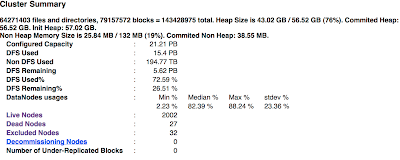
The Datawarehouse Hadoop cluster at Facebook has become the largest known Hadoop storage cluster in the world. Here are some of the details about this single HDFS cluster:

  • 21 PB of storage in a single HDFS cluster
  • 2000 machines
  • 12 TB per machine (a few machines have 24 TB each)
  • 1200 machines with 8 cores each + 800 machines with 16 cores each
  • 32 GB of RAM per machine
  • 15 map-reduce tasks per machine

That's a total of more than 21 PB of configured storage capacity! This is larger than the previously known Yahoo!'s cluster of 14 PB. Here are the cluster statistics from the HDFS cluster at Facebook:
Read more