Visitors Guide to Silicon Valley

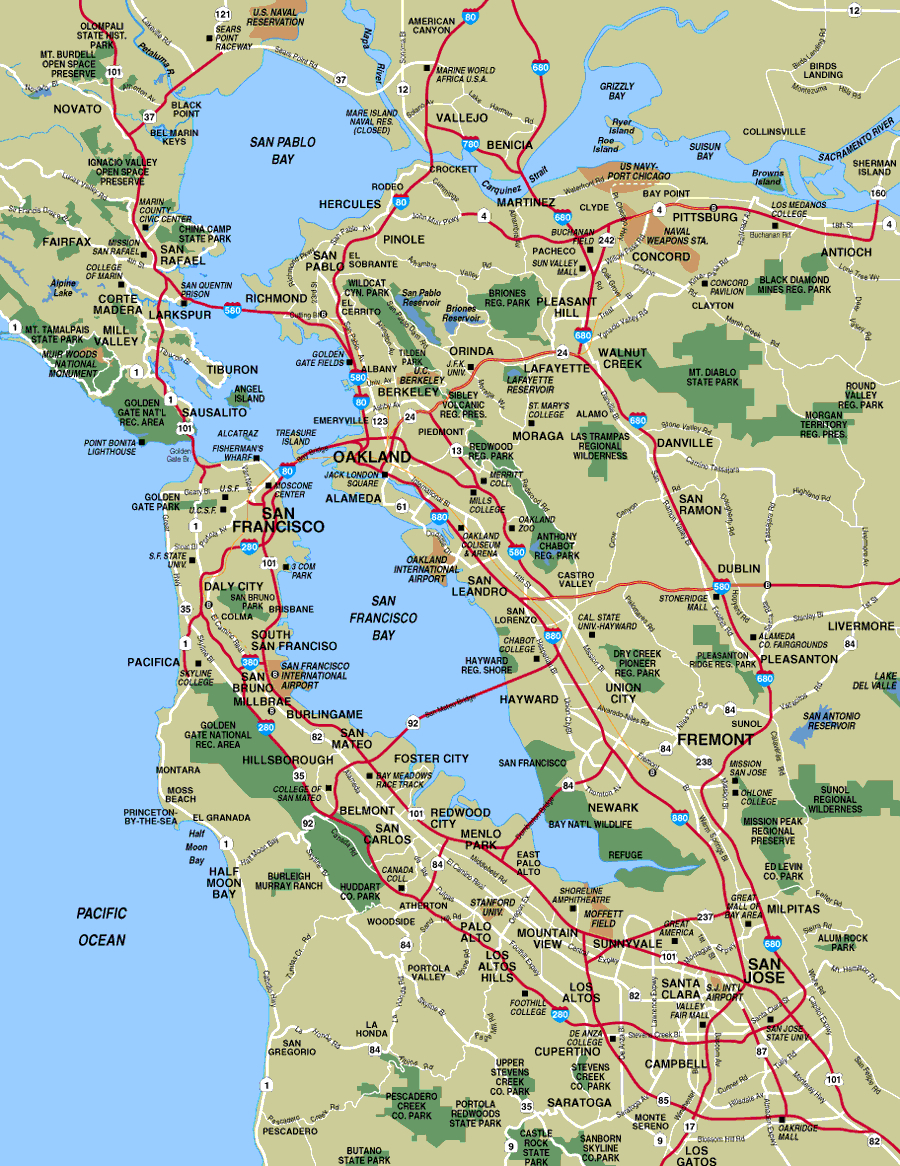
Silicon Valley has the highest concentration of data center decision makers and innovation, and I am sure most of your take regular trips to Silicon Valley.  I am heading down today, and I’ll be back for The Green Grid conference the following week.  Going to the bay area is almost as easy as a bus ride, a 2 hr flight.  This trip I am taking my kids to see grandma. Being raised in Cupertino/Saratoga getting around is not a problem.

Steve Blank writes a post that would be useful for those who want to see some highlights of Silicon Valley.  One area that Steve hits the mark and why I go to the bay area so much for clients and friends.

The Valley is about the Interactions Not the Buildings
Like the great centers of innovation, Silicon Valley is about the people and their interactions. It’s something you really can’t get a feel of from inside your car or even walking down the street. You need to get inside of those building and deeper inside those conversations. Here’s a few suggestions of how to do so.

Steven has humor in his post.

Hackers’ Guide to Silicon Valley
Silicon Valley is more of a state of mind than a physical location. It has no large monuments, magnificent buildings or ancient heritage. There are no tours of companies or venture capital firms. From Santa Clara to South San Francisco it’s 45 miles of one bedroom community after another. Yet what’s been occurring for the last 50 years within this tight cluster of suburban towns is nothing short of an “entrepreneurial explosion” on par with classic Athens, renaissance Florence or 1920’s Paris.
 

And, pokes fun at many aspects of the valley.

A Visitors Guide to Silicon Valley

Posted on February 22, 2011 by steveblank

If you’re a visiting dignitary whose country has a Gross National Product equal to or greater than the State of California, your visit to Silicon Valley consists of a lunch/dinner with some combination of the founders of Google, Facebook, Apple and Twitter and several brand name venture capitalists. If you have time, the President of Stanford will throw in a tour, and then you can drive by Intel or some Clean Tech firm for a photo op standing in front of an impressive looking piece of equipment.

The “official dignitary” tour of Silicon Valley is like taking the jungle cruise at Disneyland and saying you’ve been to Africa. Because you and your entourage don’t know the difference between large innovative companies who once were startups(Google, Facebook, et al) and a real startup, you never really get to see what makes the valley tick.

If you didn’t come in your own 747, here’s a guide to what to see in the valley (which for the sake of this post, extends from Santa Clara to San Francisco.) This post offers things to see/do for two types of visitors: I’m just visiting and want a “tourist experience” (i.e. a drive by the Facebook / Google / Zynga / Apple building) or “I want to work in the valley” visitor who wants to understand what’s going on inside those buildings.


Is VMware a top influencer in server hardware design? Yes

You can’t build data center hardware or software without addressing the cloud.  VMware’s focus on virtualization put them in a key position for the cloud.  Here is an interesting post from VMware office of the CTO’s Richard A. Brunner.

"Day-Zero" Enablement of New Microprocessors and Servers at VMware

Richard A. Brunner
An Office of the CTO Guest Blog
By Richard A. Brunner, Chief Platform Architect, Office of the CTO

In early 2009, my colleagues and I formed an internal server roadmap team, that has been meeting weekly since then, to plan for new microprocessor launches up to two years in advance. By tracking the microprocessor launches, we are generally able to support the launch of new servers, which are usually aligned. In this way we can ensure that we have timely support for the latest and greatest microprocessor and server technologies.

This got me thinking who has the most influence in the server hardware designs.  Here is the process VMware now uses for new processors.

Based on our experience over the last few years, we have developed the process around four phases of availability and maturity of new microprocessor and prototype components (see figure below). The timelines for these phases can be described relative to the day-zero date of a given microprocessor generation. Note that, as mentioned earlier, every new microprocessor generation has its own independent timeline that is seldom aligned with any other. (The timeframes discussed below are for a new major generation, such as the introduction of the Intel "Nehalem" generation; the timeframes for minor generational changes, such as the introduction of the Intel "Westmere" generation is more compressed.)

Drawing.gif


  • 1st Phase CPU Prototypes: this is when VMware gets the very first samples of a new microprocessor (CPU) generation in very fragile platforms directly from AMD and Intel. This phase starts between 10 to 11 months before the day-zero date.
  • 2nd Phase CPU Prototypes: in this phase, VMware receives more mature microprocessor revisions that are adequate for us to finish our development processes. Typically, microprocessors in this phase show up between 7 to 8 months before the day-zero date. The same microprocessors also tend show up a few weeks later in the first phase OEM prototypes.
  • 3rd Phase OEM Prototypes: our server-vendor partners provide us the first prototypes of actual retail servers that will use the new microprocessor technology. This phase starts between 5 to 6.5 months before the day-zero date.
  • 4th Phase OEM Production: this is the final step where VMware validates candidate releases of vSphere on near production-level server platforms. This phase is usually 2 to 3 months before the day-zero date. If we are successful in our final internal testing, the certification window for partners opens soon thereafter.

Note the phase 3 when server OEMs get involved.

At the start of the 3rd phase, a number of the server vendors generously loan us early prototype platforms of their new servers populated with the new microprocessor generation. It is not possible to recognize all of our partners here, but companies such as AMD, Cisco, Dell, Fujitsu, IBM, Intel, HP, and many others have supported VMware in this way. These platforms allow enablement for server-vendor specific features by the vmkernel and I/O Device Driver Engineering teams.

Phase 4 has performance optimization.

One of the last stops for a new microprocessor generation is at the lab of our Performance Engineering team. This team characterizes the performance improvement we can expect to see from a new microprocessor generation. Oftentimes they find performance bottlenecks that require attention in either our code or the microprocessor itself. One of the most critical activities they perform is to run VMware's VMmark benchmark on these prototype systems to ensure that performance expectations have been met. This analysis always happens in the 4th phase and may happen in the 3rd phase if the server vendor platforms are stable enough.

Softbank Telecom joins VMware vCloud data center services group of 7

VMware has a press release on Softbank Telecom joining the group of Singapore-based telecoms operator SingTel and Australian subsidiary Optus, plus Verizon and Colt, as well as Terremark, BlueLock and CSC.

SOFTBANK TELECOM Joins the VMware vCloud® Datacenter Services Program

Organizations in Japan will enjoy the business transformation benefits of true enterprise hybrid cloud computing

SAN FRANCISCO, Calif., – February 21, 2011 – VMware (NYSE: VMW), the global leader in virtualization and cloud infrastructure, today announced that major Japan-based telecommunications operator, SOFTBANK TELECOM Corp., has joined the VMware vCloud® Datacenter Services Program, which delivers globally consistent enterprise-class hybrid cloud computing infrastructure services.

VMware’s strategy for private and public clouds migration looks like it is working with the Telco sector.

Through the partnership, SOFTBANK TELECOM’s private and public sector customers will be able to move workloads seamlessly between their private clouds and SOFTBANK TELECOM’s public cloud. By offering a common infrastructure, VMware vCloud Datacenter Services place full and rapid control in the hands of IT departments, enabling them to monitor, manage and secure their applications across environments.

It looks like VMware is targeting those who find the public clouds like AWS and Rackspace don’t fit the enterprise.

In contrast to the IT industry’s widely-held belief in a “one-cloud-fits-all” approach, VMware’s customer-centric philosophy is that a cloud environment must be tailored to the unique business needs of each enterprise, while enabling organizations to leverage investment in existing IT resources. In addition, migration to cloud should represent incremental and not wholesale change, while offering the flexibility to use on- and off-premise resources in a totally secure fashion.

An example of a feature that enterprises need that they don’t get from public clouds is security.

To help ensure cloud security, SOFTBANK TELECOM’s cloud infrastructure will be built on the secure VMware stack with VMware vShield, Layer 2 isolation, role-based access control and LDAP integration. In addition, the service will add its own auditable security for enterprises through the ISO 27001 security management framework and SAS 70 Type II security compliance.

Google rumored to purchase Data Center site in Taiwan for $34 mil

Digitimes has a post with the rumor that Google has purchased a site for a data center in Taiwan.

Google rumored to set up regional cloud computing data center in Taiwan

Marvin Ma, Taipei; Adam Hwang, DIGITIMES [Tuesday 22 February 2011]

There is a report around the Taiwan bourse that Google will invest NT$1 billion (US$34.1 million) to acquire a 15-hectare site in a government-developed industrial park located in a coastal area of central Taiwan for establishing a regional cloud computing data center. In response, Google's PR representatives in Taiwan declined to comment.

Since this is a rumor, how about if Google set up server design team in Taiwan?  Given the number of hardware engineers Google wants to hire, they may find it is better value to hire Taiwan engineers.  Here is my post on the Google hardware positions open.

Two Security Companies settle, and agree to stop discussing their dirty laundry– Palantir and I2

Security is a must feature for any data center. but when the competitors fight their dirty laundry aired for all to see can be embarrassing for the companies and their customers. It is ironic that security is a must have feature, but what actually happens is not what gets told to the public to maintain security.  I2 Group and Palantir Tech have settled a lawsuit that was proving embarrassing to all.

VentureBeat has the story.

Palantir’s third black eye: i2 lawsuit settled

February 16, 2011 | Owen Thomas

Add a Comment

The not-quite-all-seeing-eye of the PalantirFor a company named after a magical talisman of vision, Palantir didn’t seem to see what was coming these past few weeks.

The secretive data-analysis startup, based in Palo Alto, Calif. and backed by early Facebook investor Peter Thiel, has suffered a number of blows to its public image of late. The most recent is the settlement of a lawsuit filed by rival i2 Group, based in McLean, Va., over accusations that Palantir employees fraudulently obtained i2 software and used it to design competing products.

Embarrassment #2.

Since Palantir touts itself as the product of fraud-detection technologies pioneered at PayPal, the payments startup Thiel cofounded, those charges present ironies, as i2’s lawyers eagerly pointed out in their initial complaint.

Embarrassment #3.

Separately, Palantir CEO Alex Karp issued a public statement apologizing for his company’s role in preparing a plan for Bank of America to strike back at Wikileaks, the Internet-based nonprofit group famed for obtaining and releasing sensitive documents into the public domain. The company also placed employee Matthew Steckman on leave after hackers released emails showing he was involved in preparing a similar plan for the U.S. Chamber of Commerce to damage ThinkProgress, a pro-labor publication.

The joint press release by I2 Group and Palantir Tech agree to stop airing the dirty laundry in a lawsuit.

Joint Statement

i2 Inc., i2 Limited and Palantir Technologies Inc. announce that they have reached an agreement to resolve the litigation between them pending in the United States District Court for the Eastern District of Virginia to the mutual satisfaction of all the parties. They have also agreed that no further statement about the matter shall be made.

Owen Thomas does a good job of citing the original complaints by I2 Group and Palantir tech in his article.

Even with all this being said, there is more than is not being said as security procedures are followed and don’t tell the full story.