Mission Critical Patterns - Hospitals and Data Centers have resistant to change and collaboration

WSJ has an article on The Secret to Fighting Infections.  What got my attention is the following statement.

PETER PRONOVOST: The main barriers are the lack of collaboration and a culture that is resistant to change. There is also a lack of systems integration.

Hospitals and Data Centers have much in common from a building perspective.  Location is critical.  Power back-up is a given.  The buildings are very expensive, but what is in them is just as expensive.  They are a bunch of really smart people using the building, and with the smart people come egos that are not necessarily very collaborative.  Then you add on the risk avoidance.  In hospitals, malpractice/legal types of issues.  In Data Centers, those who make mistakes are many times the first to be fired as fingers of blame point.  Administrators who are looking to cut costs.

Here is the example of the hospital problems.

Nurses and pharmacists work for the hospital, which typically has clear lines of authority and procedures for dealing with failure to follow accepted practices. But physicians are often self-employed, have little training in teamwork and, perhaps like all of us, are often overconfident about the quality of care they provide, believing things will go right rather than wrong. Nurses are often reluctant to question them, and hospitals don't pressure physicians about teamwork for fear of jeopardizing the business they bring to the hospital.

Facility Ops and Sys admins are like the nurses and pharmacists with clear lines of authority and processes.  Developers and business unit are owners are like the Physicians.

The WSJ article focuses on safety and fighting infections in the hospital.

Japanese Nuclear Reactor’s inaccurate monitoring creates embarrassing statements

It is amazing how little time, effort and money is focused on monitoring systems, and to a large extent I have taken a break from focusing on monitoring solutions for data centers as I watch many companies try and sell monitoring to data center users.

One example of the problem of monitoring systems is the current Japan nuclear reactor disaster where engineers and politicians are making decisions and statements based on inaccurate readings. The Guardian joins hundreds of others who discuss the problem in Japan’s nuclear plans.

Japanese nuclear firm admits error on radiation reading

Tokyo Electric Power says initial reports of levels 10m times higher than normal in parts of No 2 reactor were inaccurate

Nuclear power protest in Tokyo

Opponents of nuclear power staged a protest in Tokyo on Sunday. Photograph: Itsuo Inouye/AP

Fresh doubt has been cast on the handling of the Fukushima nuclear crisis after officials admitted wildly overstating levels of radiation, prompting an evacuation of the nuclear site damaged by the 11 March earthquake and tsunami.

Tokyo Electric Power (Tepco) said initial reports of a level 10m times higher than normal in parts of the No 2 reactor were inaccurate, although it could not say by how much.

Tepco said at first that the worker who took the measurement, of a pool of water in the reactor's basement turbine building, had fled before taking a second reading. The discovery prompted another evacuation at the site, halting work to pump and store radioactive water that has built up in the turbine buildings of three of the six reactors.

Tepco later said the pool of water had been contaminated but the extremely high reading was a mistake. "The number is not credible," spokesman Takashi Kurita said. "We are very sorry."

However, later reports on Sunday showed contamination 100,000 times normal in water at reactor No 2, and 1,850 times normal in the nearby sea, the most alarming levels since the crisis began.

Unfortunately many times people don’t know how good their monitoring system are until there are disasters and the information from the monitoring system is used to make business critical decisions.

Back-up Power System installation takes out AlaskaAir fleet central computer system

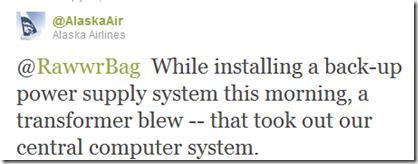
I got up at 5:15a this morning to get my mom on a 6:50a flight from SEA to SJC.  Checking with my sister she said the flight was a bit late.  Luckily she was only late 20 minutes arriving in SJC as opposed to the next 4 + hours of cancelled flights when AlaskaAir's computer system was brought down during installation of a back-up power system blew a transformer.

image

This is why  I couldn't check flight status this morning.

Systemwide Central Computer Outage

A systemwide central computer outage has caused delays to flights throughout the Alaska Airlines and Horizon Air network. We apologize for inconvenience this is causing our customers.

I wonder what the cost impact is of cancelling 95 + flights.

DALLAS (AP) - Alaska Airlines and its Horizon Air affiliate canceled 95 flights Saturday because a computer system used for flight planning failed.

How many of the AlaskaAir IT operations guys have learned some new things about facility operations.  You'd think they could run the power system change  during the window of time when AlaskaAir isn't running fleet operations. (update)  The transformer failure happened at 3a this morning, so the maintenance was performed after hours, but a major transformer failure is not a quick repair.

And, thanks to the good folks at Lunarpages, BestGreenWebHostingDeal is shut down

I’ve been blogging about the BestGreenWebHostingDeal that has been copying my content, and now thanks to folks at LunarPages the url now says.

Visitors, we are sorry, however, this site is experiencing difficulties at this time. Please return later.

Webmaster, please contact us by email at support@lunarpages.com or via Lunarpages Helpdesk athttp://support.lunarpages.com. Thank you for choosing Lunarpages (http://www.lunarpages.com).

2006 © Lunarpages Web Hosting

It was pretty convenient that the bot used to copy my content copied this post 100%.

Next step in stopping a Content Farm from stealing content, contacting web hoster

TUESDAY, MARCH 22, 2011 AT 1:56PM

I posted about BestGreenWebHostingDeal stealing my content.   I have tried to contact the owner of the site, but no response.

Next step I contacted the web hosting company and they asked for the following information.  As part of what they ask for below I plan on using this post as example of how BestGreenWebHostingDeal copies my content as it will be only a matter of minutes before their content bot scrapes my site and posts this up.  And here is the copy of my site http://www.bestgreenwebhostingdeal.com/2070/next-step-in-stopping-a-content-farm-from-stealing-content-contacting-web-hoster/

Hello Dave

Thank you for contacting Lunarpages regarding your recent copyright concerns. Please be advised that Lunarpages takes copyright issues very seriously and has implemented policies and procedures specifically to deal with claims such as yours pursuant to applicable law so as to protect the rights of all parties involved.

Top Mistake in Social Networking, not investing in Command and Control Technology like Telligent

I was able to meet with an ex-Microsoft employee Rob Howard who is founder and CTO of Telligent.

ABOUT US

Telligent is dedicated to being the most trusted and innovative enterprise collaboration and community software company. We were founded in 2004 by technology visionary Rob Howard around his fundamental beliefs that information should be independent of tools, and communities – social and business – contain vast amounts of untapped, unshared knowledge.

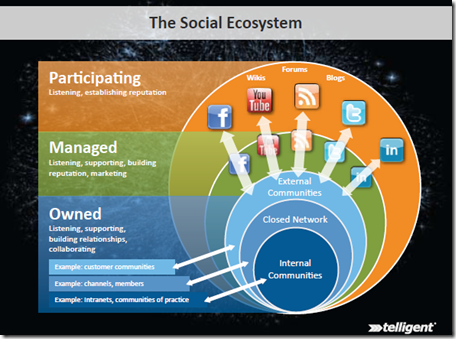
After I watched Rob's presentation on World Class Communities.   I was thinking about this graphic.  You can get a PDF of the presentation here.

image

And then it hit me.  Almost everybody focuses on throwing resources at the participation on Facebook, Twitter, Youtube, etc., but few think about the ownership of the community.  How can you own your community when you use Facebook and Twitter?

If you think about Facebook and Twitter as your distribution channel, then you need to have something at the core of your social networking strategy.  You need command and control (C2) technology.

Command and control, or C2, in a military organization can be defined as the exercise of authority and direction by a properly designated commanding officer over assigned and attached forces in the accomplishment of the mission.[1][2]

The DOD Dictionary of Military and Associated Terms defines it as "[t]he exercise of authority and direction by a properly designated commander over assigned and attached forces in the accomplishment of the mission. Command and control functions are performed through an arrangement of personnel, equipment, communications, facilities, and procedures employed by a commander in planning, directing, coordinating, and controlling forces and operations in the accomplishment of the mission. Also called C2." [3]

Rob has the idea of Command and Control is his paper.

To truly become world class, leaders will invest not only in the technology to run the community, but the people and resources to support the community. The community must be an integral part of the entire experience and culture of the organization.

It's so clear now.  The top mistake people make in social networking is they don't have command and control technology as part of their social networking strategy.

I am looking forward to more conversations with Rob on this topic and the use of Telligent SW in social networking solutions.

If you really want to go further you think about Command and Control Intelligence and Telligent does that as well with Analytics.

  • Monitor key decisions and community buzz.Evaluate brand awareness, sentiment and customer loyalty to enhance your interactive marketing strategy.
  • Get a handle on service performance. Monitor trends and identify the most valuable people and information to deliver on your support commitments.
  • Understand your community network. Track what your customers and employees are thinking, how they’re connected and what they contribute to your community.
  • Build a sustainable community. Mine community data and assess the impact of your community via community health indicators.