Facebook's Latest Data Center Design presentation at Uptime

Facebook gave a keynote presentation on its Data Center Design

Facebook's Latest Innovations in Data Center Design
Senior Electrical Engineer, Facebook  Paul Hsu
Datacenter Mechanical Engineer, Facebook Dan Lee

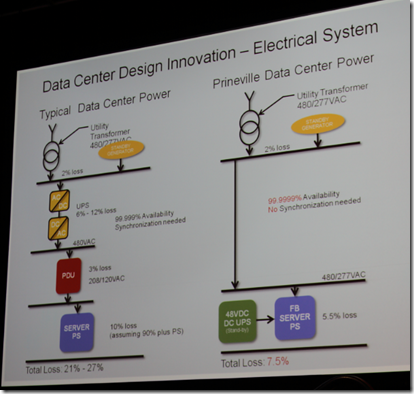
Below is a side by side slide Paul presented on the difference between a typical data center power conversion vs. the Facebook design.
image

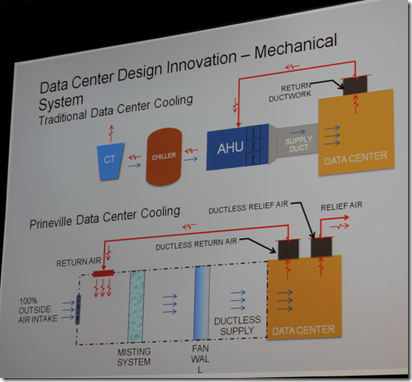
Dan has a slide with side-by-side comparison of a typical mechanical system vs. the Facebook design.
image

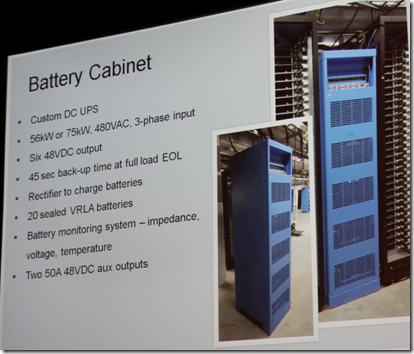
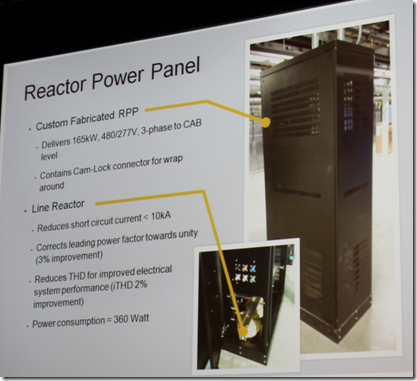
A couple of other slides share are on the Reactor Power Panel and Battery cabinet.
imageimage

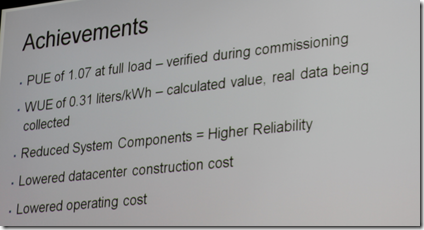
The results Facebook shared.

image

For more details you can find information at Facebook's Open Compute Project web site.

If you want to see pictures of inside the Facebook data center check out http://scobleizer.com/2011/04/16/photo-tour-of-facebooks-new-datacenter/ and http://www.datacenterknowledge.com/archives/2011/04/19/video-facebooks-penthouse-cooling-system/
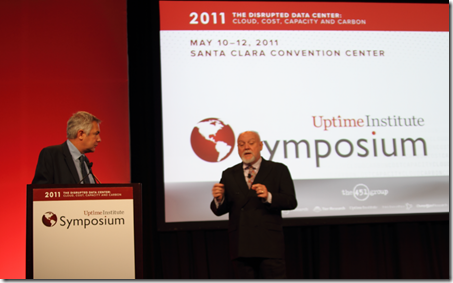
Disrupting the Data Center, Uptime Institute focuses on Cloud, Cost, Capacity, and Carbon

Watching the initial keynotes for Uptime Institute it is great to see the Green Data Center idea manifest in the tag line of Cloud, Cost, Capacity and Carbon.

image

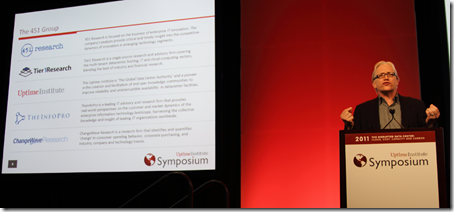
The keynote kicked off with the idea this the conference for the Disrupted Data Center which pulled together the groups of The 451 Group.

In the coming five years, a series of major technological innovations, coupled with significant, external legislative and market disruptions, will make an ever greater impression on the planning, design and operation of data centers. The economics, the operational practices and the underlying design principles of data centers, and of IT service provision, may be about to undergo some fundamental, disruptive shifts.

image

And, organizes the top underwriters of the conference.

image

But, then I ask the question is disruption of the data center come from the above list of companies.  Facebook is presenting part of its Open Compute project.

Open sourcing designs disruptive. 

As I spend the rest of my time at Uptime, I'll keep on thinking of what is disruptive in data centers.  Is Cloud, Cost, Capacity, and Carbon disruptive?  Or is it the companies who are not the underwriters list?

Data Center Analytics supports better decision making, Power Assure ships new capabilities

Power Assure has a press release on their new analytics capabilities. 

Energy Management version 4 (EM/4) software enables actionable-intelligence for maximizing data center efficiency

Santa Clara, Calif. – May 9, 2011 - Power Assure®, Inc., a data center infrastructure management solutions provider, today introduced at Uptime Institute’s Symposium 2011 Data Center Analytics for its Energy Management software platform, version 4 (EM/4). Data Center Analytics gives data center operators for the first time the ability to analyze and synthesize the overwhelming amount of raw data now available on data center equipment performance and turn it into useful business information to improve the efficiency, capacity and performance of their data centers.

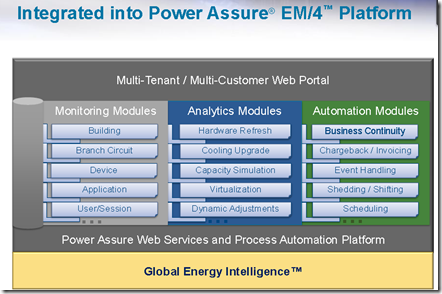
The Analytics capability exists side-by-side with the monitoring and automation modules.

image

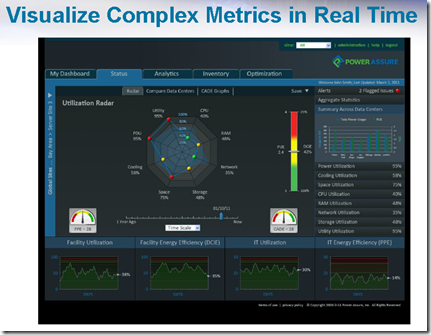
Here is a sample dashboard from Power Assure to visualize data center systems.

image

Interesting problem how to organize information in Facebook's Open Compute Project

I got a chance to meet some of the Facebook's Open Compute Project team last week, and the meeting went much better than I expected.  One of the great questions Facebook asked was how to organize the Open Compute Project's efforts.  One typical approach would be a taxonomy of the different parts of the system - power, cooling, servers, etc.

taxonomic scheme, is a particular classification ("the taxonomy of ..."), arranged in a hierarchical structure.

A hierarchical approach makes sense for a technical crowd

A hierarchy (Greek: hierarchia (ἱεραρχία), from hierarches, "leader of sacred rites") is an arrangement of items (objects, names, values, categories, etc.) in which the items are represented as being "above," "below," or "at the same level as" one another.

A different way to look at the problem is to use an ontological approach and use knowledge management techniques.

DEFINITION

In the context of computer and information sciences, an ontology defines a set of representational primitives with which to model a domain of knowledge or discourse. The representational primitives are typically classes (or sets), attributes (or properties), and relationships (or relations among class members). The definitions of the representational primitives include information about their meaning and constraints on their logically consistent application. In the context of database systems, ontology can be viewed as a level of abstraction of data models, analogous to hierarchical and relational models, but intended for modeling knowledge about individuals, their attributes, and their relationships to other individuals.

Note the yellow text where ontological vs. hierarchical is compared. 

I think the ontological approach could work for Open Compute Project.  I'll spend more time over the next couple of weeks circulating the idea and getting feedback.


Explaining the lack of Data Center critics, Emperor's New Clothes paradigm

I am heading off to Uptime Institute and many times I wonder why there are not more open discussions on what goes on in the data center industry.  Whoever hold the most amount of influence many times is able to define the rules of the game that the players should follow if they expect to play and make money.  The influential are the customers, events, analyst, and vendors with the biggest budgets.

One analogy you could use to explain the lack of critics of the system is the Emperor's New Clothes story.

The emperor walked beneath the beautiful canopy in the procession, and all the people in the street and in their windows said, "Goodness, the emperor's new clothes are incomparable! What a beautiful train on his jacket. What a perfect fit!" No one wanted it to be noticed that he could see nothing, for then it would be said that he was unfit for his position or that he was stupid. None of the emperor's clothes had ever before received such praise.

"But he doesn't have anything on!" said a small child.

"Good Lord, let us hear the voice of an innocent child!" said the father, and whispered to another what the child had said.

"A small child said that he doesn't have anything on!"

Finally everyone was saying, "He doesn't have anything on!"

I don't blame anyone in the system for this behavior it just naturally occurs as no one is going to survive long as a data center critic.  The one exception is if a critic has a business model that thrives with change.