Data Center Thought Leadership, gathering a dozen people in a private room for good wine and food

Data Center events like Uptime are great to connect with people in the industry, but rarely can you dive into difficult topics in hallway conversations.  People are constantly being interrupted by vendors who are looking to exchange business cards and sell their wares.  It is actually quite funny sometimes when a vendor will start talking to an executive and not know who they are talking to.   "you work for company X (top 5 data center operator WW), what do you do." DC executive responds,  "I work on data center construction (yeh, he runs the whole god damn team)."  Vendor, "oh, here is my card, we do blah, blah, blah."

Recognizing some of the top data center thought leadership was coming into town, some friends and I have spent the last month organizing a data center social to allow a dozen people to spend hours sharing stories, looking for where there is a common ground, and all without vendors.

Who was there? Sorry, no specific names, but trust me any vendor would have dreamed to be in the room.  A couple of the people there are keynote speakers. A good amount have VP titles or should.  The people run tens of thousands of servers for web critical infrastructure.  Many people had worked for each other at previous companies which helps create the glue between the group.  One person who would qualify and be invited is the late Olivier Sanche who we all knew and miss.  At least half the room has had lengthy passionate data center discussions with Olivier and would welcome his presence.  Also, he would have helped us drink the bottles of fine wine served that evening.

What was discussed?  Much of the topics revolved around the reality vs. the myths.  How difficult it was to get the data center industry to move. What are really the issues and how misguided decisions are like bad investments that waste resources.  Many of the conversations revolved around people, not technology.

One of the guys gave me a hard time and said Dave how come you aren't taking pictures this is an awesome crowd of people we have in the room.  It would be great to have some pictures showing the old team back together.  I talked to the friend later, and told him I've learned that taking pictures doesn't help future discussions as what gets discussed in the room, stays in the room.

This was our first data center social in this format and we are working on the next one for 7x24 Exchange in Orlando.    If you see a room of 12 people in a private and you want to exchange a business card, sorry you can't get in, we're too busy, having some good laughs, telling great stories, and enjoying a good glass of wine.  Discussing what the future of data centers should be like.

Many times what is promoted as thought leadership is who has the biggest market budget to sponsor an event and present a keynote.  I think thought leadership comes from people who have the chance to exchange ideas that challenge the norm and break the rules.  Like a Chaos Monkey.  FYI, there were no Donkeys at our event.  (see this post for explanation of Chaos Monkey and Donkeys.)

Eeyore is generally characterized as a pessimistic, gloomy,depressed,anhedonic
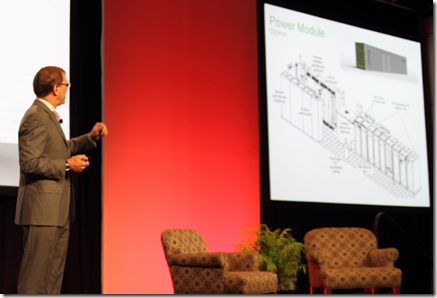
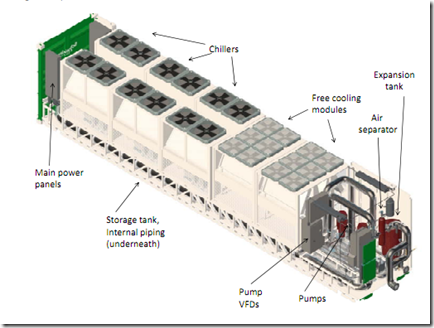
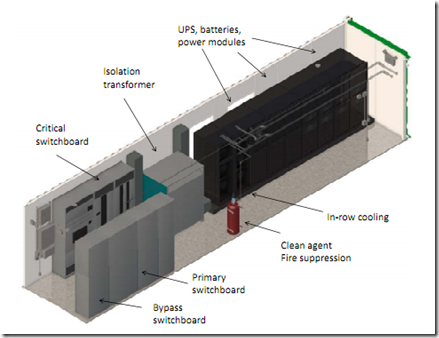
Schneider's Modular Data Center Infrastructure, discussed the Emerging Market scenario and Tax impact

Schneider Electric's Neil Rasmussen gave a Keynote talk at Uptime.

Six Reasons Why Modular Power and Cooling Plants Will Make Traditional Data Center Designs Obsolete
Neil Rasmussen
Senior Vice President of Innovation, IT Business, Schneider Electric

image

The press release is here.

Schneider Electric Advances Data Centers With New Modular Power and Cooling Facility Solutions

New Facility Modules Offer 500kW of Power & Cooling in Four Parking Spots -- 10-20% Less Capital Than Traditional Methods

For more technical details you can check out this pdf.

image

image

After Neil's keynote I got a chance to chat with him in more detail.  Two issues I brought up is most people are thinking only in their existing data center space, and not thinking about how to expand capacity in areas like emerging markets where a modular design could be used vs. traditional construction and the size of 500kW is a good starting point.

The other question I asked is what are tax implications and depreciation schedules for a modular design vs. traditional.  Too many people think of cost and don't understand the way things are expensed.  Even Ken Brill at Uptime said the cost of land is an expense.  Land is not an expense!  Land is not  depreciated as an expense.

Land is classified as a separate category for one major reason - land is not a subject to depreciation or depletion. Land is considered to have an infinite life, which makes it impossible to estimate its depreciation or depletion.

Before I decided in degree in Industrial Engineering, I actually thought about accounting, so I took lots of accounting and business classes in high school which reminds why I look at many data centers from a business perspective in addition to the IT technology.

If you are looking at modular data center construction, think about emerging markets and tax implications, and you may be surprised at what you discover.

Mike Manos keynote question are you Donkey or a Chaos Monkey?

Mike Manos gave a keynote at Uptime Institute in his new role at AOL as VP of Technology, and was back with his entertaining presentation style.  Mike's talk was on "Preparing for the Cloud: A Data Center Survival Guide", but Mike wisely changed his presentation to challenge the attendees to stop being Donkeys.

Watch this video where Mike makes the point too many people behave like a donkey, like Eeyore and they are depressed about the coming of the Cloud.

Eeyore is generally characterized as a pessimistic, gloomy,depressed, anhedonic

Mike Manos Don't be Donkeys

Here is background on why Mike is calling out the Donkey analogy and how he was inspired for this talk..  at 3:45 mark is where the Donkey/Eeyore idea is mentioned.

Mike Manos Listening to the Uptime Audience

Mike challenges the tag line "disrupted data center" as most of what is being discussed this week was discussed last year and the year before.

Mike Manos disrupted data center

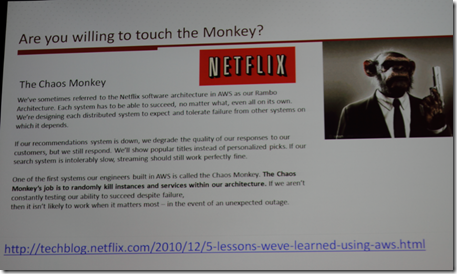
Mike uses Netflix's Chaos Monkey as a response to being a donkey.

The best way to avoid failure is to fail constantly.

We’ve sometimes referred to the Netflix software architecture in AWS as our Rambo Architecture. Each system has to be able to succeed, no matter what, even all on its own. We’re designing each distributed system to expect and tolerate failure from other systems on which it depends.

If our recommendations system is down, we degrade the quality of our responses to our customers, but we still respond. We’ll show popular titles instead of personalized picks. If our search system is intolerably slow, streaming should still work perfectly fine.

One of the first systems our engineers built in AWS is called the Chaos Monkey. The Chaos Monkey’s job is to randomly kill instances and services within our architecture. If we aren’t constantly testing our ability to succeed despite failure, then it isn’t likely to work when it matters most – in the event of an unexpected outage.

image

Are you a Donkey or Chaos Monkey?

Mike and I had a chance to talk about the reaction of people to his talk.  He had tons of people come up and say how they loved his talk.  Mike figured he had 50 people confess they were donkeys.  The funny thing is the guys I were hanging out during Mike's talk admitted they are chaos monkeys.  

Why are Donkeys so bad?  Because they slow down the movement of a group.  Consider this article on how groups disrupt crowd flow.

Secret of Annoying Crowds Revealed

by Dave Mosher on 7 April 2010, 5:00 PM

Get in line! People self-organize in crowds, often without thinking about it.

Push, shout, or politely excuse yourself all you want, but those slowpokes in your way just won't budge. A new study shows a long-neglected reason why: Up to 70% of people in crowds socially glue themselves into groups of two or more, slowing down traffic. What's worse, as crowds gets denser, groups bend into anti-aerodynamic shapes that exacerbate the problem. The study may be a boon to urban planners.

It is interesting to think of movement of ideas in the data center space like a crowds of people moving.

Uptime's Pitt Turner quickly adjusted his follow on to Mike Manos's call to action by telling people to take action and stop being donkeys.  But, telling people to move faster in a crowd can do more harm than good.

The study also determined that those who ask others to move faster actually do more harm than good. “You're contributing to chaos. Crowds are self-organized systems, so when you don't cooperate, the system breaks and you slow everyone down,” Moussaid concludes.

It was great to see Mike back in action and catch up.  I told Mike he should try and focus a presentation on the question of are you a Donkey or a Chaos Monkey?  It is a great topic that gets people thinking.

I think of my readers as more in the Chaos Monkey crowd.  I hope you do too.  I know I have too much fun creating making trouble.  I want one of the AWS Chaos Monkey T-shirts.

Google's low PUE from 10 data centers gets less media coverage than a Yahoo Chicken Coop and Facebook Open Compute DC

Chris Malone has a presentation at Uptime Symposium that DataCenterKnowledge covers Google's Data Center PUE status.

Google: No ‘Secret Sauce’ in Recipe for Efficiency

May 11th, 2011 : Rich Miller

A chart showing onoging improvement in Power Usage Effectiveness in data centers at Google.

Chris Malone didn’t come to the Uptime Symposium to reveal Google’s stealthy strategies to make its data centers super-efficient. Instead, Malone’s message was that no state secrets are required to make your facilities much more efficient – although perhaps not quite as efficient as Google’s highly-customized infrastructure.

There are ten data centers reported on starting 4 years ago. Yet, many data center novices are more aware of Yahoo's chicken coop and Facebook's Open Computer Data center., and think of these first data center build out as state of the art.

Yahoo’s Chicken Coop-Inspired Green Data Center

By Katie Fehrenbacher Sep. 19, 2010, 9:00pm PT Comments Off

Design inspiration can come from unusual places — for Yahoo and its data center design team, it was chicken coops, which utilize outside air and can reduce cooling power and costs. On Monday, Yahoo announced that the first data center to mimic this fine-feathered design has been built, commissioned and is up and running in Lockport, New York.

...

Facebook Open Sources Its Servers and Data Centers

By Stacey Higginbotham Apr. 7, 2011, 10:05am PT 20 Comments

Facebook has shared the nitty-gritty details of its server and data center design, taking its commitment to openness to a new level for the industry by sharing its infrastructure secrets much like it has shared its software code. The effort by the social network will bring web scale computing to the masses and is a boon for AMD and Intel and the x86 architecture.Sorry ARM.

Google is going to have its data center event in Zurich on May 24.  We'll see perception changes after Google's data center summit.

European Data Centre Summit 2011

Improving the energy efficiency of your data centre is a critical part of business best practices, ensuring the reduction of both your organisation's total energy consumption and its environmental impact.

The financial gains are potentially huge for infrastructures at any scale; whether you run a facility of a few hundred kWs or a multi-MW data centre, there are immediate steps you can take to deliver rapid environmental and economic returns.


Designing a Cloud Friendly Data Center, Jim Kennedy RagingWire & Peter Panfil Liebert

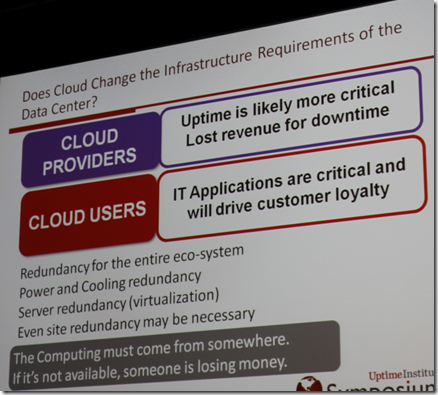
Considerations to think about in Cloud Data Centers is how Jim and Peter kicked off their presentation of what a cloud data center is.

Jim made an interesting point that RagingWire stopped using the Tier rating system in its data centers as it confused the users.  RagingWire's focus is illustrated in the following slide where redundancy of the entire eco-system is a requirement.

image

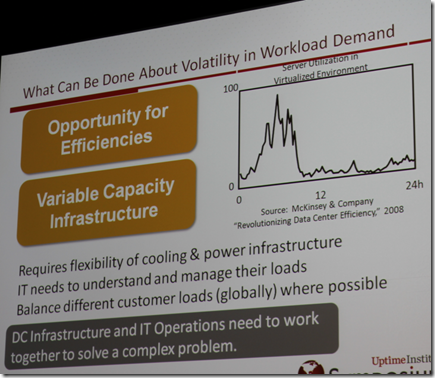
To create a cloud data center Jim makes the point that the data center needs to be more sensitive to the load being run.  And the last point made below is a difficult one - getting "DC infrastructure and IT operations to work together to solve this complex problem."

image

I just wrote about the separation between Facility Ops and IT, so I share many of the same views Jim and Peter are sharing.

Blue Collar vs. White Collar, understanding the separation between data center ops, IT, and business units

WEDNESDAY, MAY 4, 2011 AT 7:08AM

I posted on the idea of a System Program Manager in the data center.  In the same conversation I referenced, my friend and I were discussing how different data center ops is versus IT, let alone the business units who don't get their hands dirty. Getting your hands dirty is viewed by many as beneath them.

After listening to Jim and Peter, I have a simple way to explain what a Cloud Data Center is ... The Cloud Data Center takes what is typically separate groups roles and integrates the individuals into a more efficient team.  A team to provide data center services so customers get better uptime and availability for a given cost.   How well the team functions has a direct relationship to how well the cloud data center runs.  Cloud is IaaS, PaaS, SaaS are integration of teams to provide a service.

How many data center problems occur because individuals don't communicate as much as they should?  All it takes is one individual's mistake to bring down the whole team.