12.5% of Internet use Chrome, but 22.3% of GreenM3 use Chrome

CNET news had an article making the point that Chrome is used by 1 out of 8 Internet users.  But I knew the GreenM3 visitors are different and there was a much higher use of Chrome, 22.3%.

One out of eight people now use Chrome

by Stephen Shankland

Chrome is still the third-ranked browser in terms of worldwide usage, but its share is steadily climbing.

Chrome is still the third-ranked browser in terms of worldwide usage, but its share is steadily climbing.

(Credit: Net Applications)

Chrome is now used by one out of every eight people on the Internet, new statistics show, but Microsoft's newest browser is showing signs of steady growth, too.

Specifically, Chrome usage increased from 11.9 percent in April to 12.5 percent in May, according to statistics released today by Net Applications. The company bases its measurements on population-adjusted measurements of visitors to Web sites using its analytics tools.

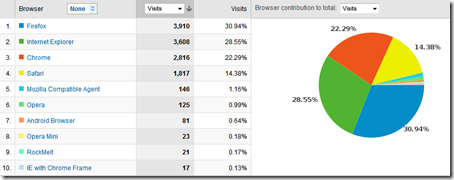
Here is another interesting part of the GreenM3 visitors.  The #1 browser is Firefox - 30.9%. #2 is IE 28.6%. #3 is Chrome 22.3%, and #4 is Safari with 14.4%.

image

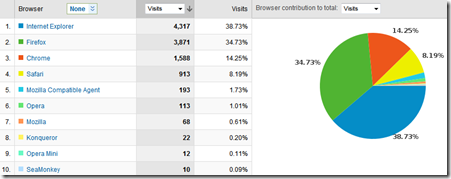
One year ago IE was #1 with 38.7%, then Firefox and Chrome.

image

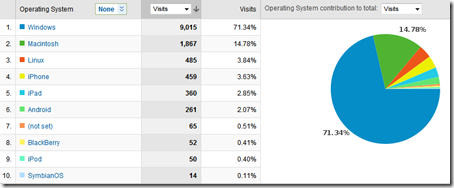
Here is the OS breakdown for the May 2011.  I am surprised the amount of users who are using iPhone, iPad and Android.

image

James Hamilton Keynotes, Amazon Technology Open House - Jun 7, 2011

If you are in Seattle you should try to go to Amazon's Technology Open house on June 7, 2011.

Amazon Technology Open House – June 7, 2011

Join us in one of our newest building locations on Amazon’s South Lake Union campus to hear from Amazon’s Distinguished Engineer, James Hamilton and network with teams from across the business including Amazon Web Services, Amazon Appstore for Android and Amazon Instant Video. Drinks and appetizers will be served and we look forward to welcoming you on campus. 

Sign Up for this Event
June 7, 2011
Amazon’s Campus in South Lake Union
345 Boren Avenue North
Seattle, WA 98109

Reasons to attend

  • Stay engaged in the local technology community and meet with like-minded individuals and companies who have helped maintain our community’s thriving technology culture
  • Learn more about recent engineering innovations at Amazon
  • Get an inside look at Amazon’s new South Lake Union headquarters

Who should attend:

  • Technology leaders, professionals and educators such as CIO’s, CTO’s, IT managers, consultants, SDEs, solution architects, administrators and professors of engineering and computer sciences

Failure Analysis ideas applied to Data Center

James Hamilton has a post on what went wrong at the Fukushima Nuclear power plant.

What Went Wrong at Fukushima Dai-1

As a boater, there are times when I know our survival is 100% dependent upon the weather conditions, the boat, and the state of its equipment. As a consequence, I think hard about human or equipment failure modes and how to mitigate them. I love reading the excellent reporting by the UK Marine Accident Investigation Board. This publication covers human and equipment related failures on commercial shipping, fishing, and recreational boats. I read it carefully and I’ve learned considerably from it.

James makes the point of how he connects his boating mindset to running IT services.

I treat my work in much the same way. At work, human life is not typically at risk but large service failures can be very damaging and require the same care to avoid. As a consequence, at work I also think hard about possible human or equipment failure modes and how to mitigate them.

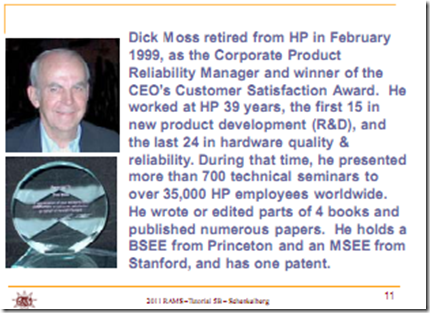
In one of my first jobs I worked at HP I worked in quality engineering and spent a lot of time in Palo Alto using their failure analysis facilities and learned ESD issues from Dick Moss.

image

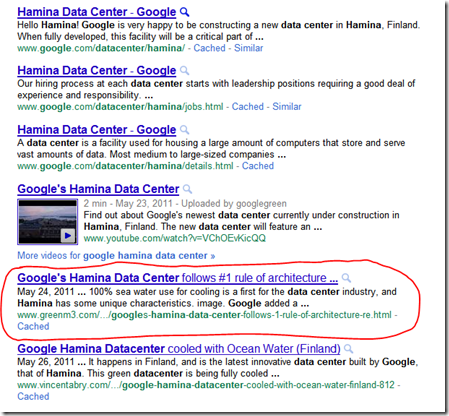
Discussing Reliability Engineering and Data Centers is not common.  Running a search on "reliability engineer data center" turned up this job post at Google.

The role: Data Center Reliability and Maintenance Engineer

The Data Center Operations team designs and operates one of the largest and most sophisticated power and cooling systems in the world. You should have extensive experience being involved in the large-scale technical operations, and demonstrable problem-solving skills to lead the RCM program for the Data Center team with limited oversight. You should possess excellent communication skills, attention to detail, and the ability to create work process and procedures to enable the collection of highly accurate field operational data. You will have access to reliability data for one of the largest data center footprints globally and be expected to interact with other reliability and software engineers to holistically address the reliability issues and develop a program wide data acquisition system to continually increase reliability and PUE while lowering TCO.

Responsibilities:
  • Develop RCM (reliability centered maintenance) program in collaboration with multiple stakeholders.
  • Perform Reliability Engineering analysis based on field data collected on the critical systems and equipment through the use of proven industry techniques and principles such as RCA (root cause analysis) & FMEA (Failure Modes and Effects Analysis).
  • Present data based Reliability Predictions and Reliability Block Diagrams.
  • Collaborate on the selection of the critical equipment vendors based on past operational data on equipment failures.
  • Spearhead on all RCA effort through collaboration w/equipment vendors.

Being a Blogger is not what it used to be (humor)

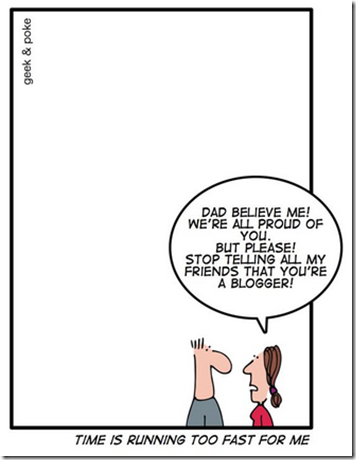
I saw this cartoon and my kids are not old enough to make this point, but I also don't tell my kids friends I am a bloggerSmile

image

I didn't want to be a blogger, but now I can't stop. 

The best thing about blogging is I get media status.  The downside of being a blogger is people think I am media. 

A huge part of my career was in publishing technology - fonts, print drivers, color, and apps (PageMaker, QuarkExpress, Photoshop).  I used to take regular trips to Altsys, Macromedia, Adobe, and Quark to discuss publishing technology.  I guess after all that time being a technical geek, I got the itch to publish and communicate.

Every once in a while I get asked for speaker engagements, but quite frankly I don't think it is worth the time to speak at conferences given I can blog on topics.  I've had the scary task of keynoting in front of 5,000 people at a Microsoft Windows Hardware conference, and I've spent plenty of time preparing keynotes for executives like Bill Gates and Steve Ballmer.

For all the effort though to prepare presentations, I would rather write a dozen blog entries or more in the same amount of time it takes to prepare a presentation.  Thanks to this blog, I reach a targeted audience world-wide, and I know they want to read the topics vs. people are looking to kill time at a conference by sitting in my presentation.  There may be dozen or two people who enjoy my presentation, but an average blog entry is read by at least 500 people.

One thing I know is my kids like it when I stay home and blog versus getting on a plane to go to a conference.

Maybe that's what keeps me blogging so much.  Knowing if I write up ideas as a blogger, I don't have to get on a plane to present the idea.  I can tell my kids friends, "I am a blogger and get to work from home."