Describing my blogger role, Fiercely Independent Guy (FIG)

I've been having a good time at 7x24 Exchange, and many of the people I see are good friends who I chat with and see regularly.  Part of going to a conference is to meet new people, and many times I am introduced as a blogger which many times brings up why I blog and how I make money.  One of my friends was describing what  I do and he made a description that is sticking in my mind.  Dave is a fiercely independent guy.

independent - free from external control and constraint; "an independent mind"; "a series of independent judgments"; "fiercely independent individualism"

I just ran into one of the new guys who I met at 7x24 before he headed out the door.  We chatted a bit, and he brought in up again.  "You are the FIG, fiercely independent guy."

This could be a fun title to put on a business card. FIG-Fiercely, Independent, Guy

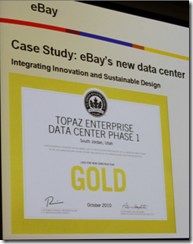
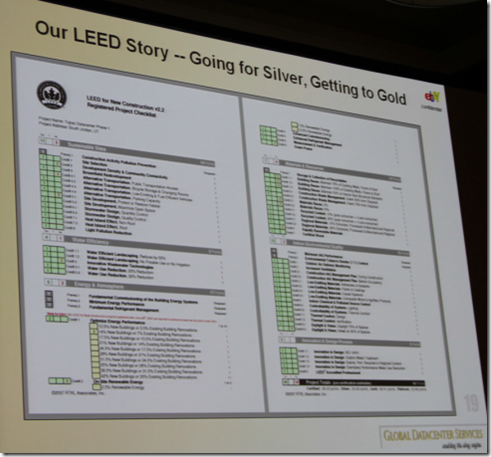
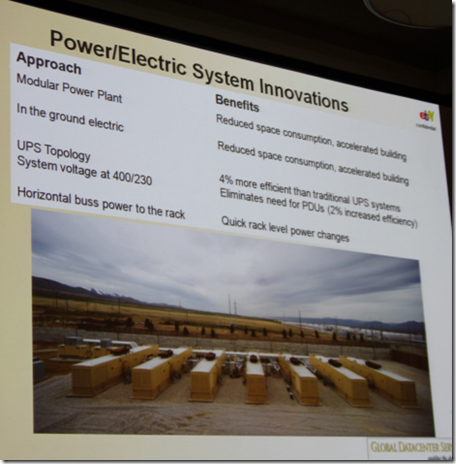
The right way to disclose Data Center LEED certification, eBay shows the points they earned for Gold

At 7x24 Exchange Orlando, eBay presented its story on achieving Gold LEED Certification.

image

image

eBay - Data Center Goes Gold

In May 2010, eBay officially opened its newest data center in South Jordan, Utah, named Topaz after the state stone of Utah. The facility was a green field development focusing on the design principles of reliability, maintainability, sustainability, and efficiency. As a result of the design and construction efforts, the facility achieved a LEED Gold rating in October of 2010.

Michael Lewis, Director Mission Critical Engineering, eBay
Stephen Spinazzola, Vice President, RTKL Associates Inc.

And, the one thing that eBay has done that I haven't seen any other data center is disclose its list of points earned to achieve Gold Certification.

Shouldn't this disclosure be a standard practice if someone markets their LEED certification?

image

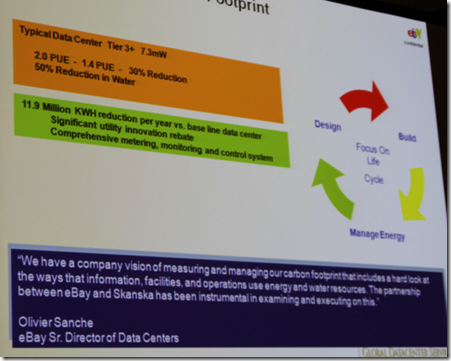
Here is a quote from Olivier Sanche.  Olivier is infamous as the departed Apple Data Center executive.  What few other people know is Olivier's baby, the data center he designed with Mike Lewis is the Topaz eBay Data Center.

We have a company vision of measuring and managing our carbon footprint that includes a hard look at the ways that information, facilities, and operations use energy and water resources.

image

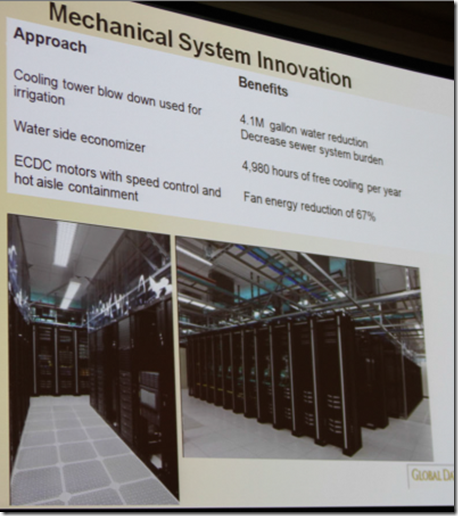
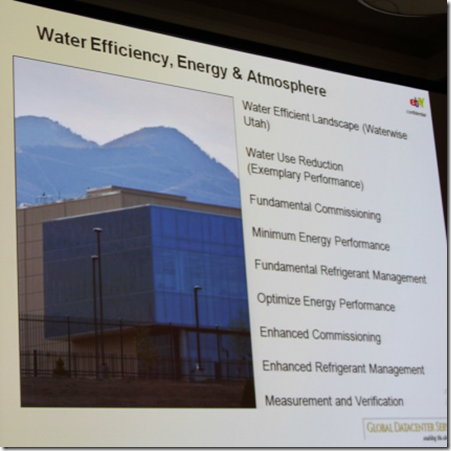
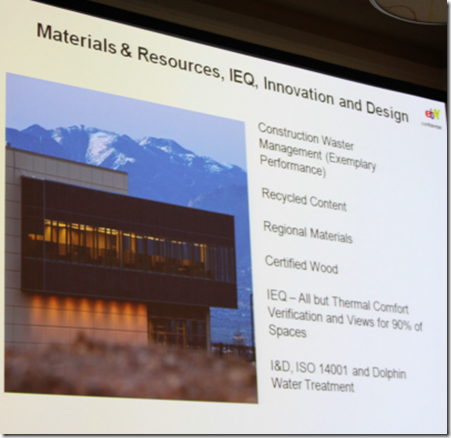
Here are few slides more slides that give details behind the LEED point achievements.

image

image

image

image

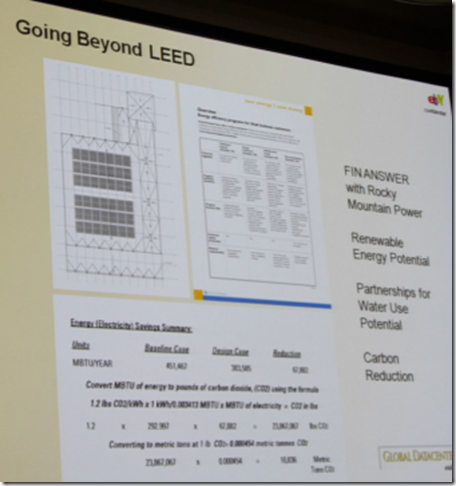
One of the last slides is going beyond LEED.

image

Reducing Human Error in the Data Center, checklist manifesto

Domenico Alcaro, VP of Sales Schneider Electric presented to a full room breakout session on Human Error in the Data Center.  Domenic shared his presentation and here it is for your viewing with his permission.

image

Breakout B: Case Study - Eradicating Human Error: Lessons Learned from the US Nuclear Navy

Human error continues to be cited as a leading cause of data center downtime. The goal of eradicating this blight from the data center can be advanced by studying the US Nuclear Navy. In fact, the similarities between a mission critical data center and a mission critical nuclear propulsion plant are striking and many. This presentation will demonstrate the operational methodologies utilized by the US Nuclear Navy to reduce human error drawing comparison to a modern day data center every step of the way.

Domenic Alcaro, Vice President, Enterprise Sales, Schneider Electric

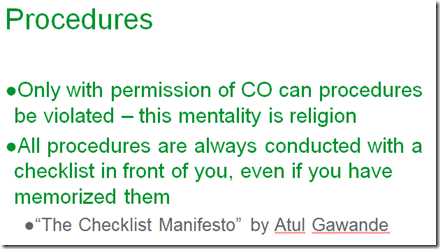
I was able to get access to Domenic presentation and I shared it with some other people ahead of time, and we started discussing human error in the data center.  One slide I especially liked is this one.

image

Note this last line for "The Checklist Manifesto" by Atul Gawande is a book suggested by a data center executive who I then passed on the information to Domenic.  Here is a web site too.

image

The book’s main point is simple: no matter how expert you may be, well-designed check lists can improve outcomes (even for Gawande’s own surgical team). The best-known use of checklists is by airplane pilots. Among the many interesting stories in the book is how this dedication to checklists arose among pilots.

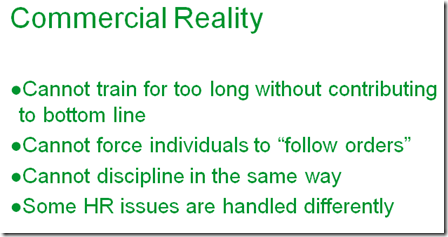
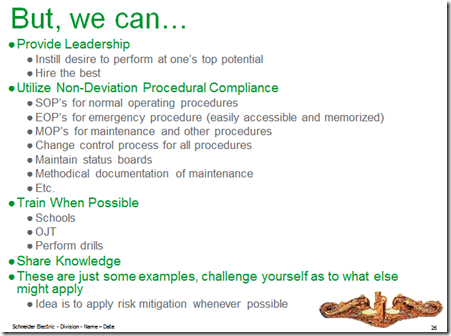
Can the USN Submarine procedures be applied?  Here are Domenic's points on what can be done and obstacles.

image

image

Solar Flares/Storms affect on Data Center is not known, an answer with data collection

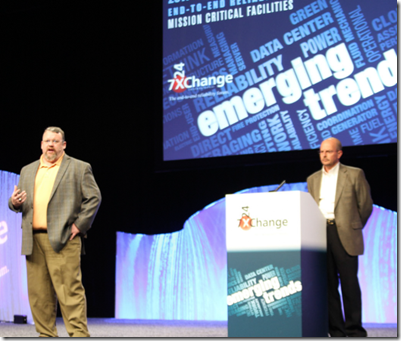
One of the great talks at 7x24 Exchange was given by Alex Young on a subject few have thought about.

NASA - The Influence of Solar Flares and Solar Storms: Why We Should Care About Space Weather

The Sun produces solar storms in the form of intense radiation and fast moving material. These storms can interact with the Earth to create electric currents in our atmosphere. The study of space weather developed to predict solar storms and understand their impact on our technology. The world's electrical grids-that fundamental technology enabling modern society-are vulnerable to these currents. While most days the sun's impacts are minimal, large solar storms have the potential to have a devastating impact on mission critical systems. This talk will present an overview of Space Weather to help your business begin to prepare for worst-case scenarios.

C. Alex Young, Ph.D., Solar Astrophysicist at NASA's Goddard Space Flight Center with ADNET Systems Inc. and the SOHO/STEREO Science Team

Here is a video of Alex discussing the Solar Flare on June 7, 2011.

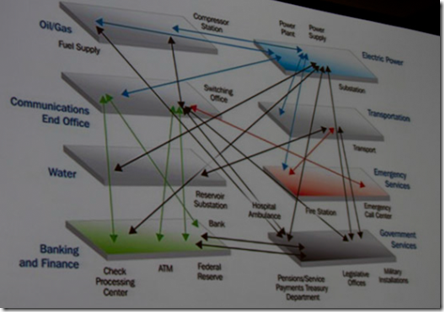
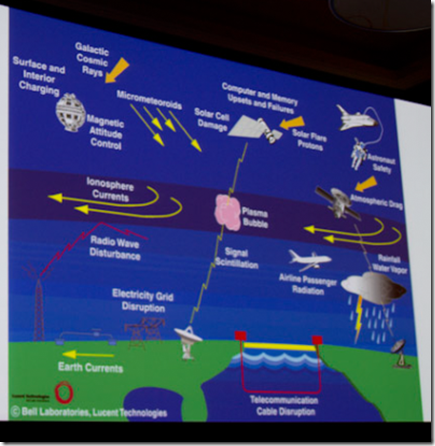
What are potential affects on the infrastructure is shown here.
image

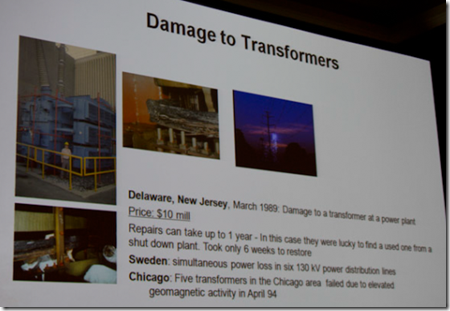
So what?  Check out this picture of what happened to a $10 Million power transformer in 1989.
image

image

And what is the affect on the electrical grid.
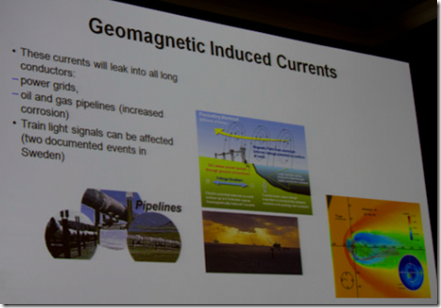
image

So other than risk of power outage what is the risk to a data center?

Luckily I sat with Alex at the speaker dinner and had a chance to chat much more and another data center executive joined in the discussion on what you could do about a solar storm that could last for days.

One choice we discussed is you could hope the arrival of solar storm is timed when it is night time and the storm strikes the other side of earth, but some storms last for days.  You could turn off the servers which is a strategy used by some satellites, but not a top choice.

So what could we do?  Here was my idea.  Why doesn't NASA notify the data center run by a company that is fanatical about data collection and tell them is the exact time when a solar storm will arrive at the data center site.  The data center operator then shares information back to NASA on error statistics that are potentially caused by the electromagnetic radiation storm.  Keep running this experiment to get data to answer the question of what happens to a data center during an electrical storm.

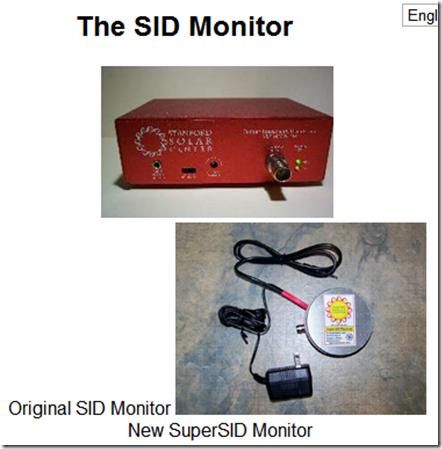
We moved to the Data Center Social 2.0 event and continued the discussions. One idea the data center executive came up with is can we collect information about the solar storm at the data center.  Alex said yes and pointed to Stanford Sudden Ionosphere Disturbance (SID).
image

So what is the plan.  The data center executive is going to back circulate the idea which we both agreed there would be two dozen data geeks who instantly jump on the idea.  Start the data collection and sharing with Alex at NASA, so he can start to answer the question of what is the effect on Solar Storms on a data center.

And, we may start an knowledge exchange that will get the data center industry ready for the peak in solar storms in 2013-2014, and answer the question what is the effect of a solar storm on a data center.
image

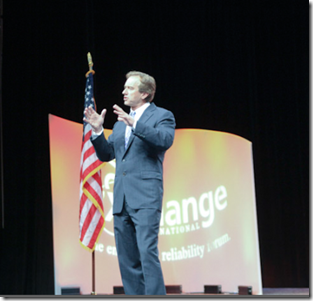
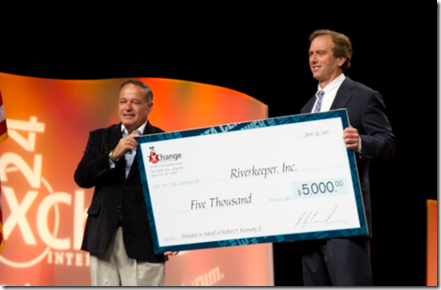
Inspiration for the Low Carbon Data Center, 7x24 Exchange keynote by Robert F Kennedy jr

I am sitting at 7x24 Exchange, the first keynote is delivered by Robert F. Kennedy jr, and I was lucky to meet him at Breakfast.  Sometimes I wonder whether people get the idea of a Green (low carbon) data center.  What a great way to start a data center conference with a keynote educating the data center audience of the issues faced by a carbon based economy.

image

image

CONFERENCE KEYNOTE:
"Green Gold Rush - A Vision for Energy Independence, Jobs, and National Wealth"

The creation of a green economy is an increasingly promising solution to multiple challenges. Sustainable business and energy independence are keys to our economic revitalization, according to Kennedy. America can boost its own infrastructure by powering industry with plentiful and domestic renewable resources. A sophisticated, well-crafted energy policy will help sharpen American competitiveness while reducing energy costs and our national debt. Intelligent energy policy is also the national fulcrum for US foreign policy and national security. From green jobs and technologies to weaning our reliance on carbon energy, Kennedy offers a bold vision to restore US economic might, safeguard our environment, and reestablish America's role as an exemplary nation.

Robert F. Kennedy, Jr., Visionary, Environmental Business Leader and Advocate

Here is an article that captures part of what Robert F. Kennedy Jr. presented.

If ever an issue deserved President Obama's promise of change, this is it. Mining syndicates are detonating 2,500 tons of explosives each day -- the equivalent of a Hiroshima bomb weekly -- to blow up Appalachia's mountains and extract sub-surface coal seams. They have demolished 500 mountains -- encompassing about a million acres -- buried hundreds of valley streams under tons of rubble, poisoned and uprooted countless communities, and caused widespread contamination to the region's air and water. On this continent, only Appalachia's rich woodlands survived the Pleistocene ice ages that turned the rest of North America into a treeless tundra. King Coal is now accomplishing what the glaciers could not -- obliterating the hemisphere's oldest, most biologically dense and diverse forests. Highly mechanized processes allow giant machines to flatten in months mountains older than the Himalayas -- while employing fewer workers for far less time than other types of mining. The coal industry's promise to restore the desolate wastelands is a cruel joke, and the industry's fallback position, that the flattened landscapes will provide space for economic development, is the weak punchline. America adores its Adirondacks and reveres the Rockies, while the Appalachian Mountains -- with their impoverished and alienated population -- are dismantled by coal moguls who dominate state politics and have little to prevent them from blasting the physical landscape to smithereens.

Obama promised science-based policies that would save what remains of Appalachia, but last month senior administration officials finally weighed in with a mixture of strong words and weak action that broke hearts across the region. The modest measures federal bureaucrats promised amount to little more than a tepid pledge of better enforcement of existing laws.

And government claims of doing everything possible to halt the holocaust are simply not true. George Bush gutted Clean Water Act protections. Obama must restore them.