Rather listen to Experienced Robotics Expert than President Obama, for example...

President Obama made the news with his media event at CMU announcing manufacturing’s comeback and role robotics can play, but I didn’t really learn much.  Did you?

Obama forecasts manufacturing comeback

June 24, 2011|By Alex Mooney, CNN White House Producer

President Barack Obama — whose poll numbers have dipped in recent weeks amid a stubbornly sluggish economic recovery — touted the hard-hit manufacturing sector Friday, saying the country’s best production days may well lie ahead.

“We are inventors, we are makers, and we are doers. If we want a robust growing economy, we need a robust manufacturing sector,” Obama told a crowd at Carnegie Mellon University, the school founded by steel industrialist Andrew Carnegie nearly 100 years ago.

The president’s speech followed a tour through the National Robotics Engineering Center at Carnegie Mellon, which the White House describes as a national effort to encourage investment from industry, universities, and the federal government in emerging manufacturing technologies.

President Obama’s media event was fluffy with little technical content.  Especially compared to the hour I spent on the same day listening to Hugh Durrant-Whyte, CEO of NICTA, ex research director at Australia’s robotics efforts.

Hugh Durrant-Whyte

Research Director
Professor of Mechatronic Engineering, Appointed 1995

At the Australian Centre for Field Robotics, USYD

My research focuses on two main areas; navigation of autonomous vehicles and senor data fusion.
In navigation I pioneered the application of Kalman filter and target-tracking methods to the problem of robot localisation. This has had substantial impact in robotics; Many operational mobile robots now use these methods for localisation. I also introduced the revolutionary Simultaneous Localisation and Mapping (SLAM) method. Interest in SLAM is now exploding. My research work is now focused on general probabilistic SLAM problems appropriate to very unstructured, outdoor and underwater, environments.
In data fusion I introduced and pioneered decentralised data fusion algorithms based on the information filter. While I initially undertook this work in the early 1990s, these algorithms are now being used as the theoretical underpinning for many new concepts in network-centric warfare systems. The ACFR now receives considerable funding from overseas defence companies in the UK and US for the development and implementation of this theory. New research work is broadening the scope of these methods to general information fusion problems.


Hugh had some great demonstrations of robotics in Australia.


The Future of Mining has Hugh’s work as well.

Local mines ponder ‘sci-fi’ future

  • From:AAP
  • June 13, 2011 1:25AM

AUSTRALIA-IRON ORE-RIO TINTO

Taking control: A line of Komatsu 930E driverless trucks parked up at a Rio Tinto mine in Western Australia. The company is pushing towards what’s always been science fiction fantasy.

THE film ‘Moon’ portrayed a future where the lunar surface had become a mine dominated by driverless machines.

It’s an eerie concept - mines operating without humans - but moves by Rio Tinto Ltd show the Hollywood  scenario may not be just science fiction dreaming.

The mining giant has announced the roll-out  of driverless haul trucks at Western Australia’s Yandicooginain site.

It’s the largest technological move of this type in the world so far, part of Rio’s “Mine of the Future” program, launched in 2008.

Watch what happens when a Komatsu truck runs over a 4x4.

And, here is another project Hugh worked on.

I was lucky to meet Hugh in person and see his talk on Friday which is one of the best presentations I have seen on using robotics.  Here is one of his speeches from 2010.  Click on the link to see a video of his talk.

The robotics revolution. Hugh Durrant-Whyte

Part 1 | Part 2
In this Warren Centre Innovation Lecture 2010, Hugh Durrant-Whyte describes some of the great leaps forward that have occurred in the field of robotics in Australia over the past decade. Professor Hugh Durrant-Whyte is recognised internationally as one of the most innovative researchers in robotics and is creating an Australian robotics industry. He has played a critical role in raising the visibility of Australian robotics in government, industry, academia and the community, and his work has been applied in mining, defence, agriculture, logistics and remote sensing. Presented by The Warren Centre for Advanced Engineering (University of Sydney) at the RACV Club, Melbourne. June 2010

First task if you are building your first data center, fire the executives

I am spoiled spending a bunch of time with executives who have built many data centers which also means we spend time in bars and talk about all kinds of stuff.  What is one of the most hilarious observations is watching what occurs when companies build their first data centers.  The mistakes are funny, but expensive.  Chatting with a guy who has built more than many would build in a lifetime, it hit me.  "How about if the CFO/CEO fired the IT data center staff as the first step after the data center project is approved?  Then went out to the data center community to hire a free agent, experienced data center expert who knows how to design, build, and operate data centers."

Why would you do this?  Because, as soon as the data center project is approved, the #1 goal of the DC project team, composed of the real estate, facilities, and IT staff is not to lose their job in one of the biggest projects they have ever done.  As opposed to the #1 goal of an experienced executive is to design a data center which aligns with the business model of the company.  They have worked on many different version of data centers and know the trade-offs made in design that affect performance, cost and operations.  They have the confidence of experience and are not scared of losing their jobs as they know there is a long line of people who would hired them.

Morale could be bad when you fire the top guys, but don't get rid of the people who do the work.

The rank and file at Patni must have grown nervous seeing you fire so many executives. How are you handling employee morale?

First, I've done a lot of town halls. Second, I've made it very clear that beyond the executive level, I'm not letting anyone else go. Third, we've shown a huge difference in transparency between the way we do things and the way Patni did. That's gone a long way with people. Things are quite positive right now, but it will take a few quarters to work everything out. If we grow revenues quickly enough, people will trust us.

If you hired top data center talent for $500,000 a year salary with a two year contract you will save this big salary cost before you even start operating the data center as an experienced data center executive knows the way the numbers work in data center design, construction, and operations.  You could subscribe to all the consulting, analyst, and vendor advice you want, but very rarely do you find someone who has actually been the end user who has design, build and operate data centers.  There are about 7 guys who come to mind that could be data center free agents which are the same guys I thought of that use good management practices.

Robert Gates's 7 management rules for managing the Pentagon, some good ideas for Data Center Executives

TUESDAY, JUNE 21, 2011 AT 10:36AM

I am lucky to spend a lot of time with some really good data center executives.  When I read this WSJ article on Robert Gates's 7 rules for managing the Pentagon it reminded me a lot methods I see these guys using.  I can name about 7 guys who use these methods.  Can you?  One who used these rules is my dear departed friend Olivier Sanche.

The ironic part of using this strategy is the data center team who is looking to build their first data center may rethink how it approaches the data center project if they think they may be fired and replaced by an experienced data center executive.

The funny thing about this idea is I got a bunch of people thinking they would be up for the free agent data center position if became an industry standard practice.  And, the guys who would be most scared is the data center consultants, analysts, and vendors as the free agents shift the negotiating power.

Posting this blog may put at risk my working for a first time data center executive, but the CFO/CEO may contact me to ask who a data center free agent is and what they could do.  And, I actually enjoy having CFO data center discussions as they ask good questions on how to spend their money.

An Example of why I blog, gaining insight to how important topics are

I come up with all kinds of ideas and many times I wonder whether others think the ideas are any good.  In the old days, I would test an idea by sharing them with others and see what they had to say.  Now, I can write a blog entry and see the traffic numbers.  Some may say the comment are what people read, but  I don't spend time on the comments as moderating comments takes up just as much time as writing blog entries if not more and is much more frustrating.

Here is an example.  Before going to 7x24 Exchange I saw Domenic Alcaro from Schneider was to present on the idea of Human Error in the Data Center.  I had talked to Domenic on the phone and met him in person for the first time at Uptime Symposium in May.  I asked Domenic if I could get a copy of his presentation before hand to see what he had to say.  This gave me time to think about what he was presenting and how his ideas could be applied.  I posted Domenic's talk here.

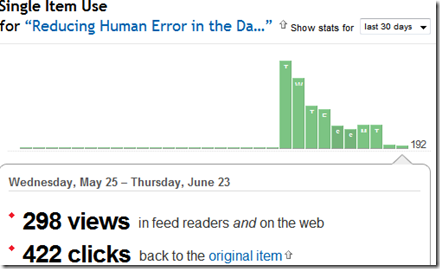
Curious I wanted to see what traffic was.  On Feedburner I got these numbers.  The 192 is the peak read on the first day.  Domenic presented to 100 people at 7x24 and I double the reach with one blog entry in one day. Smile

image

In addition I had another 200 hits, so metrics were about 900 view/clicks.  The raw number isn't as important as how this compares to my other entries.  This one is in top group of interest.

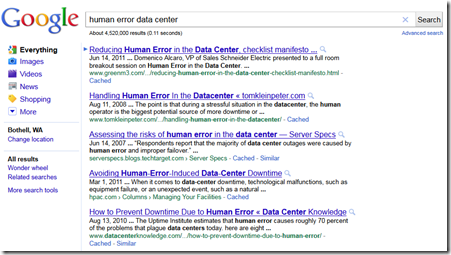
Google search "human error data center" and my entry is #1.

image

So why blog all this.

  1. I want to share these results with Domenic, and it takes me just as much time to write a blog entry as writing an e-mail.
  2. It is good once in a while to see what my readers think is important.
  3. It explains part of the reason why I am a pervasive blogger, and what I learn from sharing ideas.

An Example of what I am thinking of what I'll be working on next

At Structure I ran into some of my readers and they asked what I was planning on doing next as I posted on my plan to change what I work on.

Time to make some changes, my present to myself for my 51st B'day, "it is time"

FRIDAY, JUNE 17, 2011 AT 6:13AM

5 Years ago, I quit Microsoft after 14 years with no idea what I was going to do next.  What I did know is after 5 years I would be working on things that were much bigger and more fun than than what I was doing at Microsoft when I left.  Working on Win3.1, Win95, Windows 2000, and Windows XP were the most fun I had at Microsoft and I have the best memories.  Working at Apple, re-architecting the physical distribution system, being part of the hardware team on the Macintosh II, and working on software components for System 7 was when I had the most fun at Apple.  HP fresh out of school, I had all kinds of ideas on what I wanted to try.  Ideas in quality/reliability engineering, process engineering, and distribution logistics were fun.  Yeh, I am engineering nerd.  Why can’t the same ideas I worked on 30 years ago be applied to data centers?

I was lucky to catch up with one of my old friends who was visiting from Japan yesterday and review some of my plans.  Another of our SW friends who has been working on cloud solutions for the three years said our friend stationed in Japan was in town.  Both of these guys are extremely smart SW operating system, application development, and even data center operations experience.  I quickly sent e-mail seeing if he was available for dinner and cleared my schedule.  As background, we all used to work together at Apple 20 years ago.  One engineer worked for the other at Apple and Adobe.  The senior engineer worked for me for a while at Microsoft and we have always had great discussions on technology, but haven't formed a business together.  Now is the time to try.

In the hour dinner conversation we reviewed the solution and he agreed on the innovative approach that works well in data centers, but applies to many other areas besides data centers.  He complimented me that I had figured out some great insights being immersed in data centers that no one thinks about, and the ideas scale like a platform.  Platform ideass like we did at Apple and Microsoft with operating systems.

We discussed patent strategies, and he came up with better intellectual property protection mechanisms.  We discussed user interface design and real time information vs. post analysis processing of information.  We agreed on a strategy to create a new language that solves many issues we discussed. 

The two engineers will meet in person on Saturday for lunch and hopefully come up with more ideas. We'll have a conference call on Monday to review things as a group.

This reminds of the fun we had at Apple where I was project leader and supported great engineers who knew the right thing to do.  We all left Apple in the dark ages of 1992-3 after System 7.  Neither of us went back to Apple, but we look fondly back to the old days when we were much younger.  One of great lessons we all learned early on at Apple was the confidence and method to create solutions with no data to support the product.  There is no data that supports the solution we are thinking about will work and what the market size is.  The typical business plan approach would be to conduct a market analysis study.  Nahh.  We are going to build it.

My next data center conference is 7x24 Exchange Phoenix in Nov, 2011 and I'll see if some of the SW engineers will join me there.

Quincy Diesel Generator footprint, 69 existing + 28 Dell + 44 Sabey

Wenatchee World writes on the state of Diesel generator permits for data centers in Quincy, WA.

Ecology seeks comments on data center generators

By K.C. Mehaffey
World staff writer

Thursday, June 23, 2011

QUINCY — The state Department of Ecology wants public comment of its review of the impact of 28 diesel-powered generators that would provide electricity during power failures for the new Dell Data Center under construction in Quincy.

The 28 engines proposed for Dell’s 350,000-square-foot building would be added to 69 diesel generators already permitted at three other Quincy data centers — 37 at Microsoft, 23 at Yahoo and 9 at Intuit, said Greg Flibbert, Ecology’s project manager for the data center permits.

He said Sabey Corp. is also proposing to install 44 diesel generators for its 520,000-square-foot data center, but Ecology has not yet issued a draft permit for Sabey’s proposal, which will have its own public review period.