A better heat exchanger for that hot processor, The Sandia cooler

CNET reports on what they call a fanless heat exchanger.

Fanless heat sink design promises cooler, quieter CPUs

by Rich Brown

As a product category, CPU cooling hardware tends to offer few worthwhile developments, but a new heat sink concept from Sandia National Laboratories seems to offer tremendous promise for computers, as well as cooling appliances. Designed by researcher Jeffrey Koplow, the new "Sandia Cooler" does away with a separate fan component, and instead relies on the heat sink itself to disperse heated air.

The Sandia Labs press release is here.

Sandia’s “Cooler” technology offers fundamental breakthrough in heat transfer for microelectronics, other cooling applications

Jeff Koplow

Sandia’s Jeff Koplow makes an adjustment to an earlier prototype of his Air Bearing Heat Exchanger invention. The technology, as known as the “Sandia Cooler,” will significantly reduce the energy needed to cool the processor chips in data centers and large-scale computing environments.(Photo by Dino Vournas) Click on the thumbnail for a high-resolution image.

Licensing opportunities now available

LIVERMORE, Calif. — Sandia National Laboratories has developed a new technology with the potential to dramatically alter the air-cooling landscape in computing and microelectronics, and lab officials are now seeking licensees in the electronics chip cooling field to license and commercialize the device.

The “Sandia Cooler,” also known as the “Air Bearing Heat Exchanger,” is a novel, proprietary air-cooling invention developed by Sandia researcher Jeff Koplow, who was recently selected by the National Academy of Engineering (NAE) to take part in the NAE’s 17th annual U.S. Frontiers of Engineering symposium.


The benefits of the Sandia Cooler are on this site which doesn't list servers.

Benefits Dramatic increase in cooling performance without resorting to exotic methods
10x smaller than current state-of-the-art CPU coolers
Exceptionally quiet operation
Immune to dust fouling
Simple, rugged, and cost-competitive design
Provides increased energy

efficiency Applications and Industries Laptops
High performance "gaming" PCs
Home video game boxes
Various other electronic devices

If you are interested in the patent application go here.

Sandia Cooler - A Fundamentally New Approach to Air-cooled Heat Exchangers for Electronics Chip Cooling

Solicitation Number: 11_360

Agency: Department of Energy
Office: Sandia Corp. (DOE Contractor)
Location: Sandia National Laboratories

Synopsis:

Added: Jun 17, 2011 1:00 pm

Sandia National Laboratories seeks licensees for patent application #12/185,570 [title "Heat Exchanger Device and Method for Heat Transfer or Removal"; inventor Jeff Koplow; filing date Aug. 4, 2008; US Patent Application Publication #2009/1099997 A1; SD #10948]. This patent application involves a novel, proprietary air-cooled heat exchanger technology, known as the "Sandia Cooler" or alternatively the "Air Bearing Heat Exchanger". The current solicitation regards licensing opportunities in the field of electronics chip cooling. Sandia will be establishing a separate process for exploring partnering and/or licensing opportunities in other fields.

Checklist for Checklists and a website for medical checklists

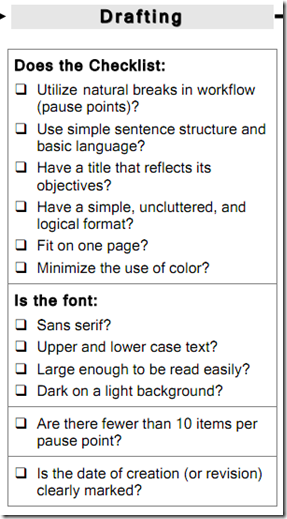
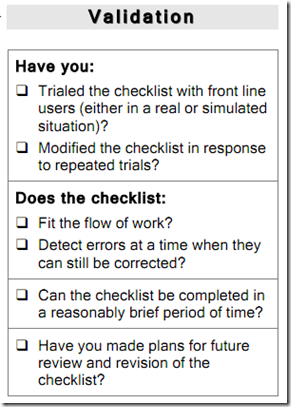
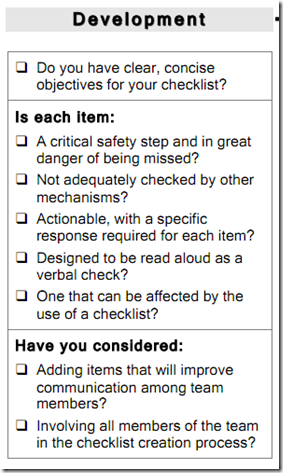
I found a checklist for checklists on Project Check website.

Welcome!  Project Check is a website designed to provide the public with easy access to a number of life saving medical checklists.  To view and download one of our currently available checklists, please visit the "Checklists" page.  If you do not see the checklist you are looking for, we encourage you to develop your own.  We have created a "Checklist for Checklists" to aid you in this process.  If you have questions along the way, feel free to either contact us or pose your question to the forum.  Once your checklist is complete, please submit it to us and we will post it for others to access.

image

image

image

image

Picture

And, here is a Surgical Safety Checklist on the site which is from http://www.safesurg.org/

Picture

I've got the e-mail of Boeing's Checklist god, Dan Boorman and a collection of data center executives who will attend a future meeting.  Part of the homework for the people who will join us is to spend some time thinking of data center checklists.

Who will be the new Carbon Data Center target for Greenpeace?

I take it for granted that the Green Data Center idea has caught on.  DatacenterDynamics published an article about Interxion being powered by 100% green energy.

Interxion purchases 100% green energy for Zurich data center

Increases reductions in emissions by purchasing elecricity generated by renewables

Published 8th July, 2011 by Penny Jones

Eddy Van den Broeck, managing director of Interxion (Schweiz) AG

Interxion has chosen to use 100% ‘green energy’ for its Zurich data center, signing up to receive electricity produced by solar and hydroelectric power from energy provider Energie Opfikon.

The colocation provider was already using some hydroeclectric-generated energy from the company, but had recently undergone an expansion which led it to take on the 100% offering.

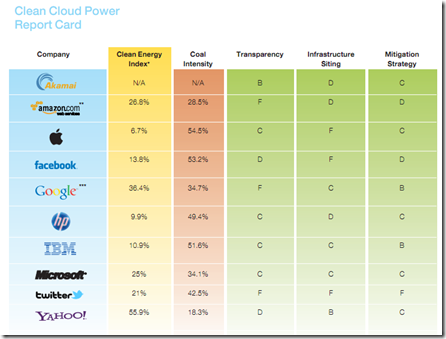
But that doesn't mean everyone thinks having a green (low carbon) data center is important.  Some have said the cloud is greener, but Greenpeace pointed out cloud data centers have carbon impacts.

image

I have some ideas who would be the next potential targets for Greenpeace identifying a high carbon data center.  We'll see if I can figure out who the next Greenpeace data center target is.

I wrote two years ago, thinking the targets where Apple, Google, or Microsoft, but Facebook surprised us all as the data center target for Greenpeace.

My guess is it is going to be someone who we wouldn't expect as all the big data center operators have low carbon data center strategies.

Checklist expert, Boeing's Dan Boorman who from Data Center industry will contact him?

Reading the Checklist Manifesto which I posted about last month, there is a discussion how the author Atul Gawande contacted Boeing to find a checklist expert.

Here is the Boeing pdf about Boeing's checklist expertise.

image

Along with his primary responsibilities, Boorman is the contact for organizations outside of aviation that want to benefit from
checklists. He has worked with the FBI, the American Society
of Radiation Oncologists, Northwestern Memorial Hospital in
Chicago and the Washington State Hospital Association.
One of the most important beneficiaries of Boeing’s checklist
knowledge is the World Health Organization. Using ideas learned in
part from Boorman and the Flight Technical & Safety team, a study
of eight hospitals around the world showed that major complications for surgical patients decreased 36 percent after the introduction of checklists. Deaths fell by 47 percent. The World Health
Organization now is creating and distributing checklists worldwide

I think I am going to reach out to some people who would be interested in meeting with Boeing's checklist expert, and organize a meeting.

Living in the Seattle area, I am surrounded by Boeing people and my kids are fans as well.  Here is an old picture from their photo shoot for a Boeing Store poster.

image

image

Is ITIL being used as an excuse to slow change?

In many enterprise discussions ITIL is assumed.  But when have you ever heard Google, AWS, Facebook, Twitter, or Zynga say their success is built on an ITIL framework.

Here may be a reason why the most agile companies don't use ITIL.

ITIL and other IT management frameworks can take our genetic tendency to say "no" and codify it. "You want a new application installed? Well, you're going to have to go through the Change Management Process." Dilbert's pointy-haired boss couldn't have come up with anything better. Users who ask for the simplest things can be told "no," simply because the Rules support that position. Worse, in many companies, admins who step out of the change management framework to help a user with something small are chastised, written up, and put at the bottom of the list for promotions and interesting projects.

The author doesn't hate ITIL.

No, I'm not trying to beat up on ITIL. It's actually a pretty solid, comprehensive framework for managing IT. Given that most of us weren't doing much better of a job, ITIL offers some universal structure. My problem is that ITIL pretty muchabhors change. No, not on paper -- on paper, ITIL manages and controlschange. In practice, IT organizations use ITIL as a blunt instrument to haltchange.

How many of you have run into people who are all into process, and don't really focus on the business impact?