Google buys Motorola Mobility, can you imagine the future integration of SW, HW, and data centers?

Google's official blog post announces Google's acquisition of Motorola Mobility.

Supercharging Android: Google to Acquire Motorola Mobility

8/15/2011 04:35:00 AM

Since its launch in November 2007, Android has not only dramatically increased consumer choice but also improved the entire mobile experience for users. Today, more than 150 million Android devices have been activated worldwide—with over 550,000 devices now lit up every day—through a network of about 39 manufacturers and 231 carriers in 123 countries. Given Android’s phenomenal success, we are always looking for new ways to supercharge the Android ecosystem. That is why I am so excited today to announce that we have agreed toacquire Motorola.

Motorola has more than Smartphones.

Motorola is also a market leader in the home devices and video solutions business. With the transition to Internet Protocol, we are excited to work together with Motorola and the industry to support our partners and cooperate with them to accelerate innovation in this space.

And Google gets Motorola's mobile patents.

We recently explained how companies including Microsoft and Apple are banding together in anti-competitive patent attacks on Android. The U.S. Department of Justice had to intervene in the results of one recent patent auction to “protect competition and innovation in the open source software community” and it is currently looking into the results of the Nortel auction. Our acquisition of Motorola will increase competition by strengthening Google’s patent portfolio, which will enable us to better protect Android from anti-competitive threats from Microsoft, Apple and other companies.

I knew I would see Google people when I went to GigaOm Mobilize.  Glad I am going and decided to go to Mobilize instead of another data center conference.

Looking for how Mobile intersects with Data Center at GigaOm Mobilize Conference, Sept 26-27 SF

THURSDAY, AUGUST 11, 2011 AT 8:10AM

Going to a data center show I frequently find I spend more time networking than watching the presentations.  So to learn some new things I saw that GigaOm has aMobilize conference in SF, Sept 26-27 that I decided to attend.

Looking for how Mobile intersects with Data Center at GigaOm Mobilize Conference, Sept 26-27 SF

Going to a data center show I frequently find I spend more time networking than watching the presentations.  So to learn some new things I saw that GigaOm has a Mobilize conference in SF, Sept 26-27 that I decided to attend.

Here are a few talks that look interesting for a data center audience, and will keep my attention.

CAN INVISIBLE ALSO BE AMAZING? DESIGNING FLUID AND CONNECTED EXPERIENCES

Can we fall in love with things we cannot see? As the bond between mobility and the cloud increases, we will need to design invisible and seductive service experiences. Device-to-cloud interactions will yield new products that will adapt to device capabilities and context. But as bright and attractive as the future might look, we have to consider the ethics of money-making in this new age – who will own user data and is pushing advertising going to ruin user experience? This and more is covered by leading design firm, Fjord.

Speakers:Olof Schybergson - CEO, Fjord

...


TABLETS AND SMARTPHONES BY THE NUMBERS

The growing popularity of smartphones and tablets has opened up new opportunities for mobile content and apps – and raises critical questions, as well. Do different platforms and devices require different monetization strategies or does it depend on which demographic group you are trying to reach? How do different kinds of consumers respond to mobile ads? How much are consumers willing to pay for various types of content? How effective are mobile ads? These questions and more are revealed by audience research giant, The Nielsen Company.

Speakers:Jonathan Carson - CEO, Telecom, The Nielsen Company

...

BETWEEN THE CLOUD AND THE CONSUMER

There have been two major tectonic shifts in the communications services world - the shift to the cloud for technology infrastructure and the focus of the core business to be on innovating services. In the grey undefined area between the cloud and the consumer is middleware. Alcatel Lucent, industry giant and supplier of choice to the world's telcos, is laying down huge bets in this space. We talk with the company's leader as to why the industry's future for services innovation lays in the middle.

Moderated by:Chetan Sharma - President, Chetan Sharma Consulting and Analyst, GigaOM Pro
Speakers:Wim Sweldens - 2nd President, Wireless Product Division, Alcatel-Lucent

Iyad Tarazi - VP, Network Development, Sprint

...

ARCHITECTING FOR THE CONSUMERIZATION OF IT

There's a new force to be reckoned with: consumerization. The rise of mobile products like the iPhone, iPad and Android platforms, along with the accessibility of cloud computing services, is radically disrupting conventional IT infrastructures. Resistance may be futile, but as these advances turn the $20 billion/year security industry upside down, smart and agile enterprises stand to realize significant competitive advantages. This talk will delve deeper into the innovative responses demanded of IT departments.

Moderated by:Quentin Hardy - Silicon Valley Bureau Chief, Forbes
Speakers:Tom Gillis - VP and GM Security Technology Business Unit, Cisco

...

3 KEY PILLARS OF ENTERPRISE MOBILITY: APPLICATIONS, DATA AND PEOPLE

Virtualization and high powered smartphones are a match made in heaven for the Enterprise. Most of the arguments involving security and data integrity dissappear. We talk with the visionary CTO and thought leader at technology giant VMWare, about what he sees as being the real outcomes of virtualization on the handset and where VMWare will lead the industry next.

Moderated by:Om Malik - Founder, GigaOM
Speakers:Stephen Herrod - CTO, VMware

...

THE SHAPE OF (THE INTERNET OF) THINGS TO COME

The internet connected toaster never arrived, mercifully, but the continued success of the Kindle and some early internet connected objects points to larger consumer markets for the right product and the right applications. In the talk we hear from The leading thought leader in the In arena of "The Internet of Things"

Speakers:Mike Kuniavsky - CEO, ThingM

...

HOW DO WE CONNECT EVERYTHING TO EVERYONE, EVERYWHERE?

We are on the cusp of connecting everything to everything else. eReaders, tablets, netbooks, smart meters, smart cars you name it. But with high bandwidth comes high demands on the chipsets, batteries and the spectrum.Atheros pioneered some of the first chips in the wifi standard. Now they are betting it all onWe talk with their President about why they see WiFi as the way forward for everything being connected to everyone, everywhere and what else he sees being needed to make this grand vision a reality.

Moderated by:Stacey Higginbotham - Senior Writer, GigaOM
Speakers:Craig Barratt - President, Qualcomm Atheros

The Challenge of specifying what you want, how many IT projects make mistakes, and are like a wreck?

Mistakes in IT and Data Center projects occurs much too often, and part of the problem is people's difficulty in clearly communicating their requirements, and checking to make sure they were heard correctly.

It is difficult to get data center wrecks documented, but here are some Cakewrecks to illustrate the point.

The Problem With Phone Orders

January 23, 2009

[answering phone] "Cakey Cake Bakery, Jill speaking! How can I help you?"

"Hi, I need to order a cake for my boss. We have a photo of him playing golf that we'd like to put on it, though - can you do that?"

"Of course! Just bring the photo in on a USB drive and we'll print it out here."

"Great, I'll bring it by this afternoon."

Later...

"Hey, Jill, what am I putting on this cake?"

"Oh, check the counter; I left the jump drive out for you there."

[calling from the back room] "Really? This is what they want on the cake?"

"Yeah, the customer just brought it in."

"Okey dokey!"

Believe it or not, this is a TRUE story: Elisabeth R. worked at the office in question. Besides, how could I ever make up something this good?

...

The Cake That Started It All...

May 20, 2008

"...And underneath that, write 'We will miss you'. Got it?"

Oh yeah, they got it.

...

Sorry, You Can't Have Any

October 11, 2008

I guess you'll have to make do with just the roses, Jessica P.

And for one that applies to hiding mistakes.

This Made Me Laugh 'Til I Cried

May 29, 2008

So I was putzin' around on google image search, looking at cakes, of course, when I stumbled across this picture:

Which, you know, made me kind of curious.

So I went to the originating site of the photo and read the corresponding blog post. It's written by Scott of Basic Instructions, which you should definitely check out sometime. Anyway, by the time I finished reading his post I was crying with laughter, and I knew I could not post his cake photo without the whole story attached. I e-mailed him and got his permission, and so without further ado, here it is:

"I had a day job as an office manager for the Seattle office of an international firm. We found out that one of our employees was transferring to one of our offices in China. When one of our people would leave, we usually had a little wing-ding with drinks and cake on the departing employee's last Thursday in the office, so on Tuesday it fell to me to fax a cake order into our nearest Costco Bakery.

I should point out that on that day I had a headache so bad that it hurt to move my eyes. Ordering the cake was the last thing I did before I went home sick for the afternoon. As I filled out the order form, I realized that in addition to the personalized message ("Good Luck in China," in this case) we could also get a large decoration for no extra charge. I looked at the options and none of them were appropriate. They were all things like teddy bears, balloons, or race cars. Crap, in other words. I figured if none of them were appropriate, I might as well get something that made no sense whatsoever.

I put a check mark next to the word "Fireman."

The next morning (Wednesday), lying in bed just before getting up, my mind wandered over the previous day and all the things I had accomplished. My eyes snapped open as I thought, "What did I do!? Why did I order a fireman? That makes no sense!!! I'm going to look like an idiot!"

I went to work, intent on calling the Costco as soon as they opened and stopping the cake before it started. I still had a day before I was supposed to pick it up. I figured that should be plenty of time. After some effort, I got hold of the bakery manager, only to be told that the cake had already been made. It was too late. I figured I'd just have to stand up straight and take it like a man.

My wife and I went to Costco to pick up the cake. When I got to the bakery, this is what was waiting for me.

(see above picture)

Making the hose flesh-toned had been a very bad move.

At first all I could do was blink at it and wonder, "Am I the only one who sees a giant wang?" I looked at my wife. She was blinking at the cake. An awkward silence and a few stammered sentences later we established that we both saw the same thing. A fireman holding an immense, dripping wang.

I could not serve this cake to my coworkers.

My first thought was that I would just absorb the cost of a second cake and pretend this never happened. Then I thought, "Wait a minute! This is not an erotic bakery! This is Costco! I should be able to order any stupid cake I want and be confident that it will not be sexually charged."

While at the checkout line I found a Costco employee to complain to, and showed him the cake. He blinked at it. I told him I was uncomfortable serving this cake at a place of business, and he started laughing and looking relieved.

Here’s what I came to realize about the cake. The obscene image was just obvious enough that you can't help but recognize it, but also obviously innocent enough that you don't want to say anything for fear that you're the only one who sees it.

Soon I was surrounded by several Costco employees who were looking at the cake and laughing. They explained that they had a new cake decorator who was a deeply religious woman from a foreign country, as if that explained everything. At one point while we were hammering out a settlement a woman happened by, caught a glimpse of the cake, covered her mouth and gasped. Good stuff."

California environmentalist sue to block Solar Farm, $1.8 billion 399MW project

It's kind of hard to get renewable energy, especially when various groups block projects based on the environmental impact.  It is really hard tto have zero environmental impact.  An example of the problem is in the SJ Mercury news article about a solar project facing a court battle.

Huge San Benito County solar farm proposal has its day in court

By Paul Rogers

progers@mercurynews.com

Developer PV2 Energy of San Francisco is proposing to build a 399-megawatt solar farm over 3,200...

A proposal to build one of the world's largest solar farms south of Silicon Valley had its day in court Monday as a long-simmering battle between the Bay Area investors supporting the project and environmentalists who say it will harm wildlife finally came before a judge.

At the center of the debate is a $1.8 billion, 399-megawatt solar farm proposed for Panoche Valley, an arid expanse of rangeland and barbed wire 50 miles southeast of Hollister. Last year, the San Benito County Board of Supervisors voted to approve the project, saying it would make rustic San Benito County -- known more for its cattle and condors than computer chips -- a national center of clean energy.

What is the problem?  The environmentalist think this is the wrong place to put solar farm.

Society, the Sierra Club and a group of local residents known as Save Panoche Valley sued to block it, claiming the 4 million solar panels that would be constructed across the roughly 3,200 acres west of Interstate-5 would harm endangered species and disrupt the rural character of the area.

"Solar obviously is very critical. No one disputes the necessity for solar energy," said Rose Zoia of Santa Rosa, the attorney representing the three environmental groups, during oral arguments. "The issue here is that it is improper on this site."

This problem is occurring at other California projects.

The case is symbolic of a recent trend across California and other parts of the nation. As concerns over global warming have grown and with it, government and private funding for huge solar and wind projects, the main opponents have often been environmental groups. The issue has split the environmental movement. Some conservationists argue that they need to change their approach while others stick to the lawsuits they have traditionally used to block logging, mining and development.

Last month, for example, California Gov. Jerry Brown filed a brief asking a federal court to deny a request by an environmental group seeking an injunction to stop a $2.2 billion solar power project in the Mojave Desert. The Western Watersheds Project wants to stop construction of the 370-megawatt Ivanpah project because of desert tortoises at the site.

Three Tips for a Smarter City project, IBM's Justin Cook shares insights working on Portland modeling project

I got a chance to talk to IBM's Justin Cook, Program Director, System Dynamics for Smarter Cities about IBM's press release for the Smarter Cities Portland project. 

IBM and City of Portland Collaborate to Build a Smarter City

Portland, Oregon, USA - 09 Aug 2011: To better understand the dynamic behavior of cities, the City of Portland and IBM (NYSE: IBM) have collaborated to develop an interactive model of the relationships that exist among the city's core systems, including the economy, housing, education, public safety, transportation, healthcare/wellness, government services and utilities. The resulting computer simulation allowed Portland's leaders to see how city systems work together, and in turn identify opportunities to become a smarter city. The model was built to support the development of metrics for the Portland Plan, the City's roadmap for the next 25 years.

I've got friends in Portland, so I appreciate the unique environment Portland has.  Here is what IBM discusses as when and why Portland was chose for the Smarter City project.

IBM approached the City of Portland in late 2009, attracted by the City's reputation for pioneering efforts in long-range urban planning. To kick off the project, in April of 2010 IBM facilitated sessions with over 75 Portland-area subject matter experts in a wide variety of fields to learn about system interconnection points in Portland. Later, with help from researchers at Portland State University and systems software company Forio Business Simulations, the City and IBM collected approximately 10 years of historical data from across the city to support the model. The year-long project resulted in a computer model of Portland as an interconnected system that provides planners at the Portland Bureau of Planning and Sustainability with an interactive visual model that allows them to navigate and test changes in the City's systems.

In talking to Justin, I asked him what Tips he had for implementing this complex project.  Here are three tips Justin shared with me.

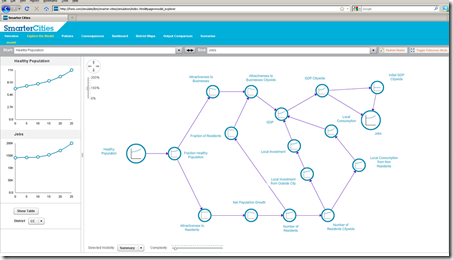
  1. Discuss the relationships of the groups to understand their perspectives and views.  This data will help you understand the semantics of information that helps you build a model.   There were 75 subject matter experts and multiple organizations involved in discussing initiatives for Portland's Plan.  Below is a view of one dashboard showing various metrics that get you thinking beyond an individual department's view.image
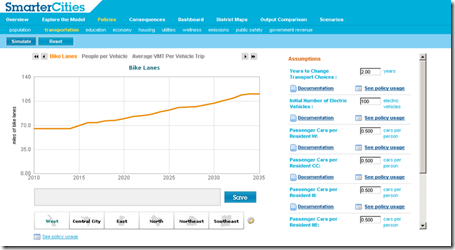
  2. Assumptions are openly documented to let others know inputs into the models.  Below is an example of bike lanes.image
  3. Trade-off between transparency and complexity where a simpler approach is easier to understand, therefore appears more transparent.  Justin shared that IBM's system dynamics team had 7,000 questions identified in a smarter city modeling project.

IBM is working with other cities to apply the lessons learned in Portland.

This collaboration with the City of Portland has also proven valuable for IBM.  IBM is applying its experience and modeling capabilities developed in this collaboration with the City of Portland to create offerings that will help other cities leverage systems dynamics modeling capabilities to enhance their city strategic planning efforts. Based upon IBM's experience in working with and conducting assessments of cities around the world, they've found that strategic planning in many cities is still being done in stovepipes without a holistic view of impacts/consequences across systems. By leveraging systems dynamics modeling techniques, IBM will be able to help other cities plan "smarter".

In closing Justin and I discussed the potential for projects that affect multiple city metrics and multiple city organizations to see in the model how ideas like more walking & biking lanes can address obesity, getting people out of cars which then reduces the carbon footprint of the city.  Bet you didn't think that addressing obesity could fit in a carbon reduction strategy.  IBM and Portland see the relationships in this and many other areas.

How valuable is the IBM Smarter City model?  We'll see some of the first results from Portland.