ABRY Partners and Berkshire Partners acquire Telx from GI Partners

Last week a friend asked who was acquiring Telx.  I told him I didn't know but, I found the tweet on Telx being acquired and posted the question.

Who is acquiring Telx?

WEDNESDAY, AUGUST 3, 2011 AT 8:44AM

Found this Tweet.

image

Well, here is the press release with the answer.

The Telx Group Acquired by ABRY Partners and Berkshire Partners

GI Partners Sells Leading Colocation and Interconnection Company to Two Boston-Based Investment Firms
August 8, 2011 9:30 AM EDT

MENLO PARK, CA and BOSTON, MA -- (MARKET WIRE) -- 08/08/11 -- GI Partners ("GI"), a leading mid-market private investment firm, announced today the sale of its portfolio company, The Telx Group, Inc. ("Telx"), one of the fastest growing providers of global interconnection and colocation facilities, to ABRY Partners and Berkshire Partners LLC, two Boston-based investment firms. Terms of the transaction were not disclosed.

Telx facilities serve over 900 customers with approximately 34,000 interconnections, and customers can connect with hundreds of communication service providers, enterprises and cloud providers in Telx facilities. The company was acquired by GI Partners in 2006 and, under the investment firm's nearly five-year stewardship, Telx achieved considerable organic growth in its existing markets and also dramatically improved its competitive position as a result of key add-on acquisitions. The company has since developed a national footprint of 15 locations starting from two facilities at the time of acquisition. GI Partners also significantly expanded the management team with the appointment of industry veteran Eric Shepcaro as CEO, in addition to several other senior positions. As a result of these and other initiatives, Telx achieved dramatic sales and EBITDA gains, including topline growth of over 40% throughout the hold period despite the recession, landing on the Inc. 5000 list two consecutive years in a row and earning a nod from Red Herring as a Top 100 North American Company.

Wall to remember a bad 1st experiment, Japanese American Internment logistics, shipping 276 to prison

Both of my parents were in Internment Camps during WWII, along with many of my Aunts and Uncles when they were all children.

"Most of the 110,000 persons removed for reasons of 'national security' were school-age children, infants and young adults not yet of voting age."
- "Years of Infamy", Michi Weglyn

...

These Japanese Americans, half of whom were children, were incarcerated for up to 4 years, without due process of law or any factual basis, in bleak, remote camps surrounded by barbed wire and armed guards.

...

Rather, the causes for this unprecedented action in American history, according to the Commission on Wartime Relocation and Internment of Civilians, "were motivated largely by racial prejudice, wartime hysteria, and a failure of political leadership."

On Aug 6, 2011 The NYTimes writes about a new Wall was dedicated on Bainbridge Island.

A Wall to Remember an Era’s First Exiles

Matthew Ryan Williams for The New York Times

Holly Wilson visited a newly completed memorial on Bainbridge Island, a cedar and stone wall dedicated to its residents' World War II experience. More Photos »

By KATHARINE Q. SEELYE
Published: August 5, 2011

BAINBRIDGE ISLAND, Wash. — Frank Kitamoto was only 2 when he and his family — and more than 270 others of Japanese ancestry — were forcibly removed from this forested island and sent to an internment camp after Japan bombed Pearl Harbor in World War II. Mr. Kitamoto, now 72, said he spent many of his younger years in a severe identity crisis, ashamed of his Japanese heritage and wishing he were white. Other young men went so far as to have plastic surgery to disguise their Japanese features. Some committed suicide.

Bainbridge Island was the 1st experiment to figure out the logistics of shipping hundreds of people, 2/3 US citizens to prison for having Japanese ancestry as a crime.

Associated Press

Japanese-American residents of Bainbridge Island, Washington, boarded a ferry to Seattle. From there, they were transferred to a camp in California. The government chose Bainbridge Island as its test run for mass evacuations. More Photos »

“As a kid, I thought this was the land of equality and freedom, and so this couldn’t be happening because of discrimination,” Mr. Kitamoto, who became a dentist, said the other day in his office, where one wall is covered with photos from that era. “So I thought it was because there was something wrong with me, that I was a bad person.”

One of the most famous photographs from this experiment is a mother with her 13 month old daughter taken by the SeattleTimes.

Everywhere she went, Kayo Natalie Hayashida Ong, now 70, was greeted over and again with delight and recognition as "the baby!"

An iconic photograph of her at age 1, asleep in her mother's arms as her family was forcibly removed from their Bainbridge Island home during World War II, became one of the best-known symbols of a dark period in American history.

MUSEUM OF HISTORY AND INDUSTRY /

Fumiko Hayashida, then 31, carries her daughter Natalie, 1, to the Bainbridge ferry and exile.

If my daughter had been born 70 years ago, she would be amongst the other 1 year olds who were a threat to US security.

At the time, Executive Order 9066 was justified as a "military necessity" to protect against domestic espionage and sabotage. However, it was later documented that "our government had in its possession proof that not one Japanese American, citizen or not, had engaged in espionage, not one had committed any act of sabotage." (Michi Weglyn, 1976).

There was one loan voice in the USA who spoke through the media, a Bainbridge publication.

_TIM4636 - Milly and Walt Woodward at the Review -1945

Two months before Pearl Harbor, Walt and Milly Woodward pledged in a front page editorial to "always strive to speak the truth, unafraid, whether it be on a national issue or something purely local." In 1940, the young couple–barely thirty–had purchased the weekly Bainbridge Review, a chatty conveyor of neighborhood gossip. A year later, when the U.S. entered WWII, the couple had transformed the Review into a respected community paper full of current, factual news, and an editorial page that drew national attention.
The day after Pearl Harbor, Milly and Walt Woodward warned, "There is the danger of a blind, wild hysterical hatred of all persons who can trace ancestry to Japan. That some of those persons happen to be American citizens...easily could be swept aside by mob hysteria." Urging Islanders to remain calm, the Woodwards continued, " The Review says this: These Japanese Americans of ours haven't bombed anybody...They have given every indication of loyalty to this nation. They have sent...their own sons–six of them–into the United States Army."
The Woodwards continued, throughout the war, to speak against the constitutional violations inherent in E.O. 9066. The tiny Bainbridge Review has been singled out nationally as the lone newspaper to take such a stand. Also, in an attempt to report accurately on Islanders' lives, Milly and Walt Woodward hired high school students to report from Manzanar and, later, Minidoka on the daily events in the exiles' lives. Thus Islanders could keep track of each other. Perhaps as a result of that, 150 of the 272 exiled Islanders returned to Bainbridge, a greater percentage than most communities.

I don't think my children could understand why grandma and grandpa were in prison.  Which is why the Bainbridge wall is dedicated with these words.

Nidoto Nai Yoni, translated as

"Let It Not Happen Again"

is the motto and mission of the Nikkei Exclusion Memorial.

_TIM3977 - Evacuation Day: Walking onto the Ferry Kelohken

Fiercely Independent Guy/Gadfly, Innovator's DNA, and Chaos Monkey

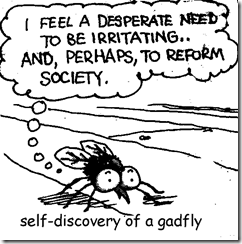
I was telling one of my good friends who will tell me when I am wrong the story about how one of my other good friends described me as a Fiercely Independent Guy.  She says, "remember, I am the one who said you are a gadfly.  So, you can still be use the FIG acronym - Fiercely Independent Gadfly, instead of Fiercely Independent Guy.  Now it was one thing to describe myself as the Fiercely Independent Guy, it is another to say I am Fiercely Independent Gadfly.

What is a Gadfly?  Merriam's definition.

Definition of GADFLY

1 : any of various flies (as a horsefly, botfly, or warble fly) that bite or annoy livestock

2 : a person who stimulates or annoys especially by persistent criticism

It can hurt to be called a Gadfly.
image

These two people who categorized me as a gadfly could not be more different - one a Prince of the institutional church, almost 70 years old; the other a model for the Jesus follower of the future, recognized by many for his genius with people that the church routinely does not welcome.  What they have in common is (a) they are 2 of the most powerful men in churchianity I know personally and (b) they took the time and effort to call me a gadfly.  When both of them said this term, in very different settings,  it was meant as a slur, a term of disparagement - and trust me, it hurt.

...

There is a funny thing about this slur - inside many institutions, it is a term to shut down new ideas, criticism or even challenges to power or sacred cow.   Outside some of the most fallow institutions, these very characteristics are not a negative category or a way to stifle new life - they are, in fact, the core ethos the organizations strives to achieve.  As is so often the case, a word meant to demean is actually a word of holiness, redeemed as part of our essence as beloved creatures made in God's image.

Do you know who is one of the most famous Gadfly is?  Socrates.

The term "gadfly" (Ancient Greek: μυω̃ψ, myops)[1] was used by Plato in the Apology[2] to describe Socrates' relationship of uncomfortable goad to the Athenian political scene, which he compared to a slow and dimwitted horse. During his defense when on trial for his life, Socrates, according to Plato's writings, pointed out that dissent, like the gadfly, was easy to swat, but the cost to society of silencing individuals who were irritating could be very high. "If you kill a man like me, you will injure yourselves more than you will injure me," because his role was that of a gadfly, "to sting people and whip them into a fury, all in the service of truth." This may have been one of the earliest descriptions of pragmatic ethics.

The nice thing is with 30 years in the industry I've developed more patience and you can achieve results without being overzealous.

The Innovator's DNA is an example of a more tactful way to be a gadfly.

  • Associating—drawing connections between questions, problems, or ideas from unrelated fields
  • Questioning—posing queries that challenge common wisdom
  • Observing—scrutinizing the behavior of customers, suppliers, and competitors to identify new ways of doing things
  • Networking—meeting people with different ideas and perspectives
  • Experimenting—constructing interactive experiences and provoking unorthodox responses to see what insights emerge

When engaged in consistently, these actions—questioning, observing,networking, and experimenting—triggered associational thinking to deliver new businesses, products, services, and/or processes. Most of us think creativity is an entirely cognitive skill; it all happens in the brain. A critical insight from our research is that one’s ability to generate innovative ideas is not merely a function of the mind, but also a function of behaviors. This is good news for us all because it means that if we change our behaviors, we can improve our creative impact. By completing an Innovator’s DNA assessment, you can better understand your personal innovation skill strengths and learn how to make them even better.

Was Socrates an Innovator, labeled as a Gadfly with critics hoping he would go away?

Socrates was in all things an innovator, in religion, in as much as he sought to eliminate from the theology of his contemporaries “those lies which poets tell “; in politics, in as much as he distrusted several institutions dear to Athenian democracy; in education, in as much as he waged war against authority, and in a certain sense made each man the measure of his own actions.

It is because Socrates was an innovator that we, who see in him the founder of philosophical inquiry, regard him as a great man; it was because Socrates was an innovator that old -fashioned Athenians, who saw’ in the new fangled culture the origin of all their recent distresses and disasters, regarded him as a great criminal.

The Gadfly label is applied as Socrates was a gadfly to a horse.

The term "gadfly" (Ancient Greek: μυω̃ψ, myops)[1] was used by Plato in the Apology[2] to describe Socrates' relationship of uncomfortable goad to the Athenian political scene, which he compared to a slow and dimwitted horse.

Isn't this the same as Mike Manos's talk on Chaos Monkeys, Donkeys and Innovation of Action?

In my talk I tried to focus on what I felt to be emerging camps at the conference.    To the first, I placed a slide prominently featuring Eeyore (from Winnie the Pooh fame) and captured many of the quotes I had heard at the conference referring to how the Cloud, and new technologies were something to be mistrusted rather than an opportunity to help drive the conversation.     I then stated that we as an industry were an industry of donkeys.  That fact seems to be backed up by data.   I have to admit, I was a bit nervous calling a room full of perhaps the most dedicated professionals in our industry a bunch of donkeys – but I always call it like I see it.

I contrasted this with those willing to evolve their thought forward, embrace that Innovation of Action by highlighting the Cloud example of Netflix.   When Netflix moved heavily into the cloud they clearly wanted to evolve past the normal IT environment and build real resiliency into their product.   They did so by creating a rogue process (on purpose) call the Chaos Monkey which randomly shut down processes and wreaked havoc in their environment.   At first the Chaos Monkey was painful, but as they architected around those impacts their environments got stronger.   This was no ordinary IT environment.  This was something similar, but new.  The Chaos Monkey creates Action, results in Action and on the whole moves the ball forward.

Interestingly after my talk I literally have dozens of people come up and admit they had been donkeys and offered to reconnect next year to demonstrate what they had done to evolve their operations.

So, if you are called a Gadfly, maybe the person is a Horse or a Donkey, and you are a Chaos Monkey, an Innovator.

" Criticism may not be agreeable, but it is necessary. 
It fulfills the same function as pain in the human body. It calls attention to an unhealthy state of things."
- Winston Churchill

"A society that gets rid of all its troublemakers goes downhill."
Robert A. Heinlein

Tricks of the Trade,"Turning Numbers into Knowledge", info for the new wave of Data Analysts

I just received from amazon.com Jonathan Koomey's Turning Numbers into Knowledge book, and one of the things that caught my eye is the Foreword where

There is nothing else like this book out there.
Nobody who deals with problems where numbers matter—and everybody in today’s world really needs to—should be without it.
John P. Holdren*
Woods Hole, MA, October 2007

And Professor Holdren explains the "Tricks of the Trade" course he taught at UC Berkeley.

Berkeley’s guardians of academic respectability eventually made me change what they regarded as too frivolous a title for the course to “Professional Methods for Interdisciplinary Careers”, but the focus remained the same for the 15+ years that I taught it. It covered ways of thinking through complex problems; how to find and manage information; how to function in a committee; how to identify and avoid common pitfalls in the interpretation of data; how to present results clearly in words, graphs, and tables; how to manage one’s time; and even how to avoid jet lag.

Many students over the years suggested that I should write a book teaching the “Tricks of the Trade”. Notwithstanding my advice to others about time management, however, I never found the time to write it.

With the 2001 publication of the first edition of Jonathan Koomey’s remarkable book, Turning Numbers into Knowledge, I realized that I no longer needed to try. Dr. Koomey, who had taken my course in the 1980s as a Berkeley graduate student, had plenty of ideas of his own about the need and how to fill it. And the book that he wrote surpassed what I would have done, if I had found the time, in every important respect

WSJ has a post on how there is a new wave of Business Schools planning to educate students in data analysis.

Business Schools Plan Leap Into Data

By MELISSA KORN And SHARA TIBKEN

Faced with an increasing stream of data from the Web and other electronic sources, many companies are seeking managers who can make sense of the numbers through the growing practice of data analytics, also known as business intelligence. Finding qualified candidates has proven difficult, but business schools hope to fill the talent gap.

This fall several schools, including Fordham University's Graduate School of Business and Indiana University's Kelley School of Business, are unveiling analytics electives, certificates and degree programs; other courses and programs were launched in the previous school year.

Some of the students who are thinking of getting into Data Analytics should consider Jonathan Koomey's book, Turning Numbers into Knowledge.

Turning Numbers into Knowledge: Mastering the Art of Problem Solving