QUINCY — The state Department of Ecology on Friday issued an air quality permit to Sabey Corp., allowing the company to install 44 backup generators for a 520,000-square-foot Intergate-Quincy Data Center in case of a power outage.
On Aug. 5, Ecology approved 28 backup generators for the Dell Data Center in Quincy. Last year, Microsoft won approval to expand its diesel generators to 37, and early this year, Yahoo! was granted permission to increase its generators to 23.
This brings the total diesel generators permitted to 132.
That brings the total number of approved backup generators in Quincy to 132.
The state agency evaluated the potential health risks from that much diesel exhaust, which has several toxic pollutants.
Open Compute Project had its West Coast event on June 17, 2011. And the next OCP event will be in NYC Oct 27. Registration will be open on Sept 9 at http://opencompute.org/
Luckily I was planning a trip with some data center executives that week and I have registered myself and others for the event.
Here is a summary of the last OCP event in Palo Alto.
Reflections on the Open Compute Summit
by Yael Maguire on Wednesday, June 22, 2011 at 2:24pm
Facebook hosted the first Open Compute Summit last Friday to grow the community forming around the Open Compute Project.
More than 200 people traveled from around the world to participate in the event, representing many of the great technology and finance companies. After morning presentations, the group broke into a series of smaller discussions focused on a variety of topics ranging from server design to management software to how the ecosystem is evolving.
Doubling the Compute Density
Amir Michael, Facebook’s hardware design manager, introduced our new initiatives in server hardware, presenting new AMD and Intel motherboard designs that double the compute density relative to our original designs.
Instead of placing a single motherboard in each chassis, we’re now building servers with two narrow motherboards sitting next to each other. These motherboards support the next generation of Intel processors and AMD’s Interlagos. To enable these new designs, we’ve also modified the server chassis, power supply (700W output from 450W), server cabinet, and battery backup cabinet.
The following is a bunch of ideas that I find interesting in that it illustrates a point that “the team” is more important than individuals. And, the data center teams that will beat the others are the ones who operate better as a team. A better data center team will enable businesses to beat others.
WSJ has an article about Hollywood’s change in battle plan in creating military movies. Here is a video that introduces the concept.
After 10 years of the same story, Hollywood realize they have a problem telling the war story.
Ten years after the Sept. 11 attacks opened an ongoing chapter of U.S. military action, Hollywood’s long history of depicting fighters at war is entering a new phase. The grinding wars in Afghanistan and Iraq spawned films that highlighted characters in uniform who were disillusioned with their missions and scarred in their homecomings. With the conflicted protagonists of movies such as “Green Zone” and “Stop-Loss,” filmmakers tried to tap into the public’s ambivalence about the conflicts, but their movies mostly sank at the box office. Now that deployments to Afghanistan and Iraq are tapering down, filmmakers are homing in on the more clear-cut job of battling terrorists. And they’re finding heroes in the elite—and now famous—special-operations forces leading the hunt. Projects in the pipeline focus on the armed heroics, high-tech tactics and teamwork involved in getting the bad guys.
The US Navy was changing their tune as well.
Courtesy of ‘Act of Valor’
Director Scott Waugh films the SEALs.
In 2008, Navy Special Warfare invited a handful of production companies to submit proposals for a film project, possibly a documentary, that would flesh out the role of the SEALs. The goals: bolster recruiting efforts, honor fallen team members and offer a corrective to misleading fare such as “Navy Seals,” the 1990 shoot-em-up starring Charlie Sheen as a cocky lone wolf. “In the SEAL ethos, the superman myth does not apply. It’s a lifestyle of teamwork, hard work and academic discipline,” said Capt. Duncan Smith, a SEAL who initiated the project and essentially served as producer within the military.
A reoccurring theme is “the team.”
After they made a group decision to participate, deciding the project served the SEALs’ greater good, the Navy made the film a formal task for the sailors, who were between deployments. Their names won’t appear in the “Act of Valor” credits; instead, the film will list Naval Special Warfare members killed since Sept. 11.
And what happens when the studio focuses on the team? The action is better than they have ever shot.
By contrast, in the movie’s many battle scenes, the sailors move with a fluid precision that makes typical Hollywood action movies look bogus. When the SEALs picked off enemies and moved through buildings in a tight snaking column, some footage was captured by helmet-mounted cameras. Certain plot points were based on true stories from the field, including a scene in which a sailor takes a rocket-propelled grenade to the chest at close range and lives.
I worked at the HP Personal System Division (PSD) 20 years ago when the division grew out of the data terminals business, and haven't spent much time thinking about the impact of that division. The news of HP considering spinning off the PC business has a variety of views. The WSJ has an intense critique of HP's business practices. The one comment that most caught my eye was comparing the PCs to Hamburgers.
Never mind the years of effort H-P spent -- including a controversial merger with Compaq -- becoming the world's largest PC maker. Never mind that the PC business feeds H-P's more profitable businesses. Dumping it is a beautiful absurdity that one analyst, Jayson Noland of Robert W. Baird & Co., described as "like McDonald's getting out of the hamburger business."
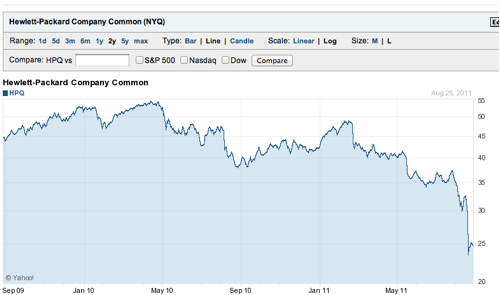
You can make a variety of arguments whether HP was right or not, but the market definitely did not agree.
Here are a few more summaries of HP's move over the past year.
Let's say you were given a year to kill Hewlett-Packard. Here's how you do it:
Fire well-performing CEO Mark Hurd over expense-report irregularities and a juicy sexual-harassment claim that you admit has no merit. Fire four board members, as publicly as possible. Foment a mass exodus of key executives who actually know how to run the giant computer company.
Hire new a CEO from German competitor, SAP, which sells business software, not consumer products. Tell the new CEO, Leo Apotheker, that Mr. Hurd "left H-P in great shape."
...
Provoke partners Microsoft and Oracle by threatening to put H-P's own operating software on PCs. Then decide not to. Remember that promising webOS software H-P bought in a $1.2 billion acquisition of Palm last year? Sideline it.
Bristle when Oracle's Larry Ellison tells the New York Times: "The H-P board just made the worst personnel decision since the idiots on the Apple board fired Steve Jobs." And file lawsuits when Mr. Ellison hires Mr. Hurd.
Boast that you're going to attack Apple's iPad with your $499 TouchPad. Then dump your TouchPad in a $99 fire sale and announce you're just not going to offer it anymore.
Telegraph to the world that you are just too dumb to make smartphones.
...
Announce plans to maybe sell the PC business. Or maybe spin off PCs as a stand-alone company. Uncertainty will damage the price.