How many data center problems are caused by knowledge holes? Address the Swiss Cheese gaps in education-Salman Khan & Bill Gates

The top cause of data center outages are related to human action.  Part of the problem is caused by how our education system works which gives people the framework to think in the future.  What happens when you think differently of how education works? Salman Khan is reinventing education.  Bill Gates’s focus education has connected Bill to Salman.  Here is a video with Salman presenting at TED and Bill Gates discussing the Khan Academy.

Bill Gates: I've seen some things you're doing in the system that have to do with with motivation and feedback -- energy points, merit badges. Tell me what you're thinking there?

SK: Oh yeah. No, we have an awesome team working on it. And I have to make it clear, it's not just me anymore. I'm still doing all the videos, but we have a rockstar team doing the software. Yeah, we've put a bunch of game mechanics in there where you get these badges, we're going to start having leader boards by area, and you get points.It's actually been pretty interesting. Just the wording of the badging or how many points you get for doing something, we see on a system-wide basis, like tens of thousands of fifth graders or sixth graders going one direction or another, depending what badge you give them.

One of the things that caught my attention in Salman’s presentation is pointing out the swiss cheese problem in education.

In a traditional classroom, you have a couple of homework, homework, lecture, homework, lecture,and then you have a snapshot exam. And that exam, whether you get a 70 percent, an 80 percent,a 90 percent, or a 95 percent, the class moves on to the next topic. And even that 95 percent student,what was the five percent they didn't know? Maybe they didn't know what happens when you raise something to the zero power. And then you go build on that in the next concept. That's analogous to imagine learning to ride a bicycle, and maybe I give you a lecture ahead of time, and I give you that bicycle for two weeks. And then I come back after two weeks, and I say, "Well, let's see. You're having trouble taking left turns. You can't quite stop. You're an 80 percent bicyclist." So I put a big C stamp on your forehead and then I say, "Here's a unicycle."But as ridiculous as that sounds, that's exactly what's happening in our classrooms right now. And the idea is you fast forward and good students start failing algebra all of a sudden and start failing calculus all of a sudden, despite being smart, despite having good teachers. And it's usually because they have these Swiss cheese gaps that kept building throughout their foundation. So our model is learn math the way you'd learn anything,like the way you would learn a bicycle. Stay on that bicycle. Fall off that bicycle. Do it as long as necessary until you have mastery. The traditional model, it penalizes you for experimentation and failure, but it does not expect mastery. We encourage you to experiment. We encourage you to failure. But we do expect mastery.

Here are some of the key learning from Salman that gets you appreciate the different approach.  The worse question to ask when teaching “do you understand this?”

And as soon as I put those first YouTube videos up,something interesting happened -- actually a bunch of interesting things happened. The first was the feedback from my cousins. They told me that they preferred me on YouTube than in person.(Laughter) And once you get over the backhanded nature of that, there was actually something very profound there. They were saying that they preferred the automated version of their cousin to their cousin. At first, it's very unintuitive, but when you actually think about it from their point of view, it makes a ton of sense. You have this situation where now they can pause and repeat their cousin,without feeling like they're wasting my time. If they have to review something that they should have learned a couple of weeks ago, or maybe a couple of years ago, they don't have to be embarrassed and ask their cousin. They can just watch those videos. If they're bored they can go ahead. They can watch it at their own time, at their own pace.And probably the least appreciated aspect of this is the notion that the very first time, the very first time that you're trying to get your brain around a new concept, the very last thing you need is another human being saying, "Do you understand this?"And that's what was happening with the interaction with my cousins before. And now they can just do it in the intimacy of their own room.

What would happen if you apply Salman’s ideas to data center education and training?  Would data center outages decrease?  Would more projects happen on budget and on time?  I vote yes.
How much do you want to follow Netflix’s data center strategy given CEO says "I messed up"?

I’ve always wondered whether Netflix’s strategy of getting out of the data center business and moving to Amazon Web Services would make sense long term.  Netflix 2 months ago was considered invincible before they announced their price increase and separation of DVD and streaming business.

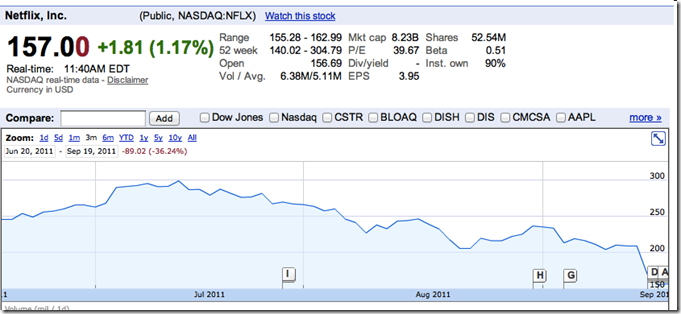
2 months ago Netflix stock was approaching 300, now it is close to 150.

image

One interesting perspective on why Netflix made this move is

So why is the company raising its rates?

Mr. DANIEL ERNST (Research Analyst, Hudson Square Research): The simple reason is because they can.

GREGORY: That's Daniel Ernst. He's an analyst at Hudson Square Research.

Mr. ERNST: They don't really have competition. They have some competition at the margin but the reality is, there is no one offering a full slate of movies and television shows that's digital and in DVD.

If you assume you have no competition what is the big deal where your data center is and whether you have one?

Netflix is offering an apology, but is adding more confusion by substituting the Qwikster brand for Netflix DVD.

An Explanation and Some Reflections

I messed up. I owe everyone an explanation.

It is clear from the feedback over the past two months that many members felt we lacked respect and humility in the way we announced the separation of DVD and streaming, and the price changes. That was certainly not our intent, and I offer my sincere apology. I’ll try to explain how this happened.

So we realized that streaming and DVD by mail are becoming two quite different businesses, with very different cost structures, different benefits that need to be marketed differently, and we need to let each grow and operate independently. It’s hard for me to write this after over 10 years of mailing DVDs with pride, but we think it is necessary and best: In a few weeks, we will rename our DVD by mail service to “Qwikster”.

We chose the name Qwikster because it refers to quick delivery. We will keep the name “Netflix” for streaming.

One of the things I have learned working at big brand companies – HP, Apple, and Microsoft is managing your brand is not something that should be taken lightly.  Netflix’s moves to introduce a new brand “Qwikster” seems really expensive and confusing.  Out of the millions of Netflix users how do you think will easily understand “Netflix DVD” = “Qwikster”

Amazon, Vudu, Hulu, and Redbox must be doing high fives as the watch Netflix decrease the value of their brand.

When you watch all of this does it make you question whether Netflix’s logic for getting out of the data center business and moving to Amazon Web Services may later be a mistake “I messed up.”


Little (micro) green servers achieve product category at Intel Developer Forum, promotes Micro Server Lab

At Intel Developer Forum I missed a session, but luckily one of my friends from ARM went to it and said it was quite good.  Yes, there is a guy from ARM walking around an Intel conference.

image

The presentation is here.

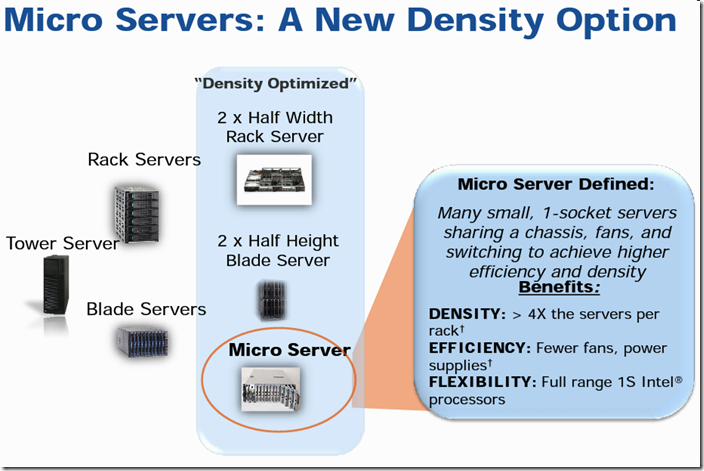
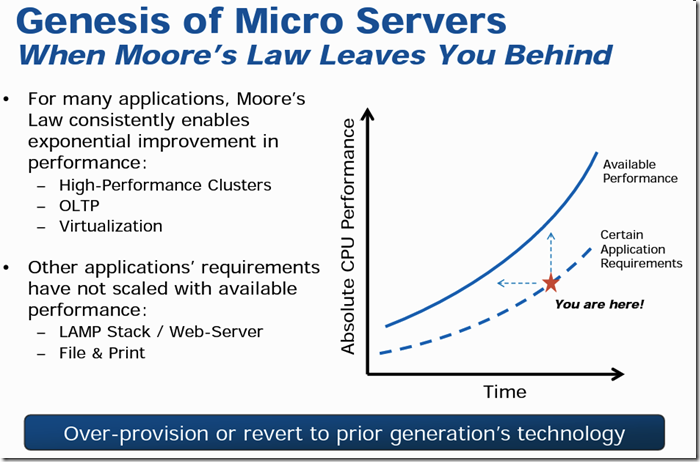
For over three years I have been discussing the idea of little green servers, and now they are called micro servers.

image

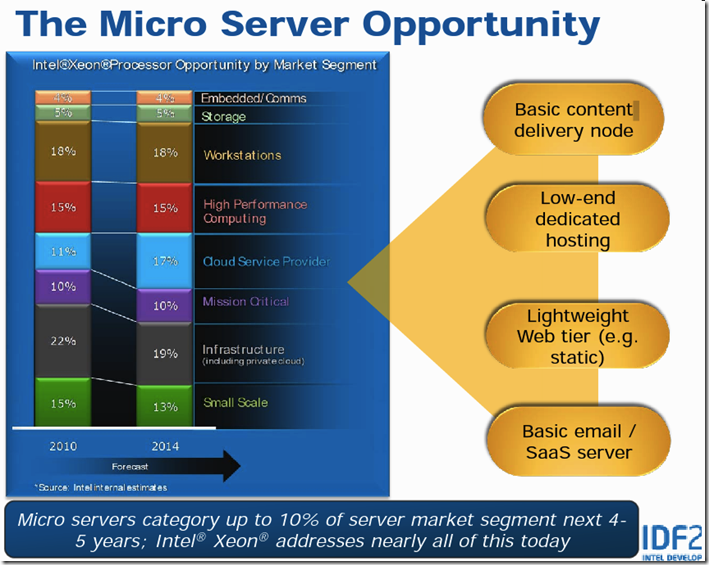
Why did Intel give a speaking slot to micro servers?  Because in 4-5 years they think it could be 10% of the current market dominated by Xeon.

image

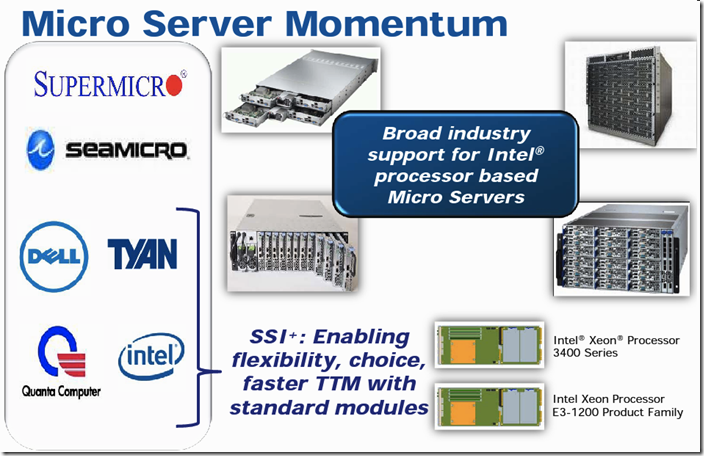
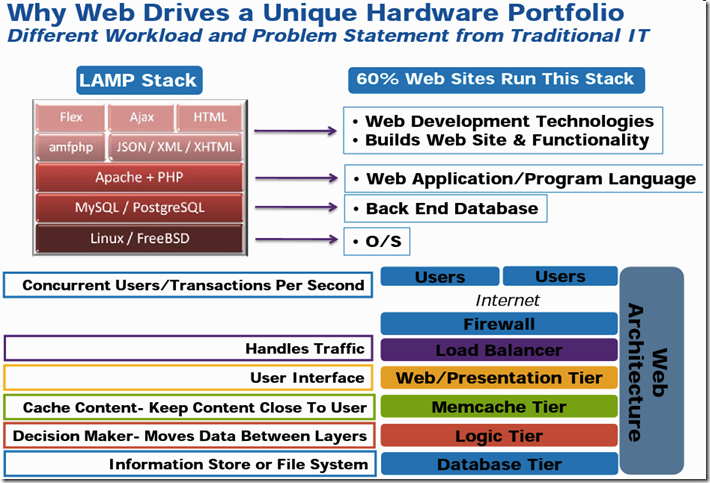
The Micro Servers are composed of Supermicro, SeaMicro, Dell, Tyan, and Quanta

image

Why would you want a micro server?  Dell’s Brandon Draegar presented.

image

image

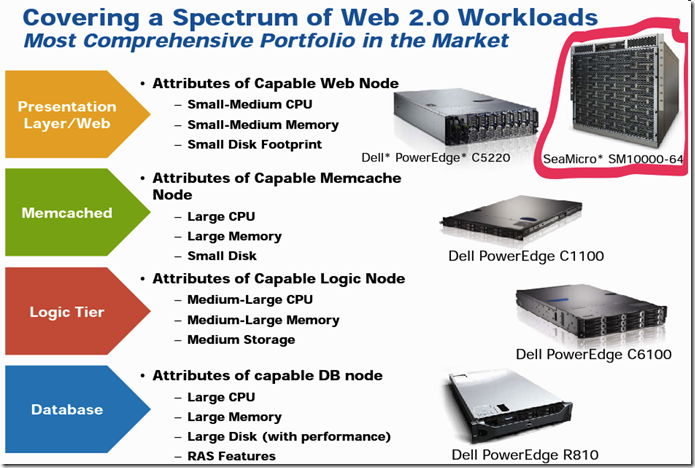
It is interesting that Dell included SeaMicro in its portfolio slide.

image

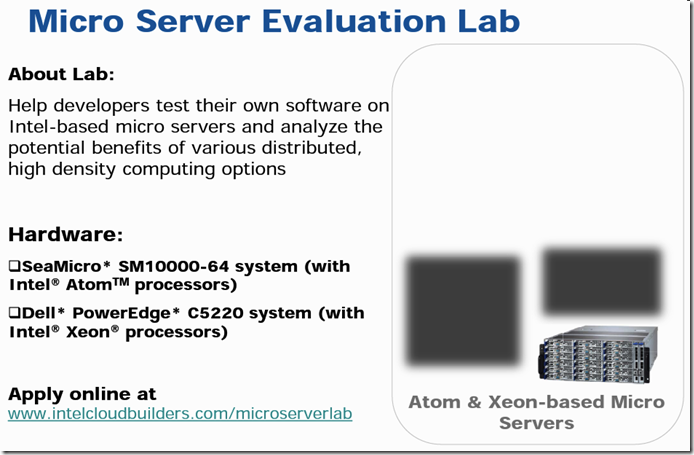
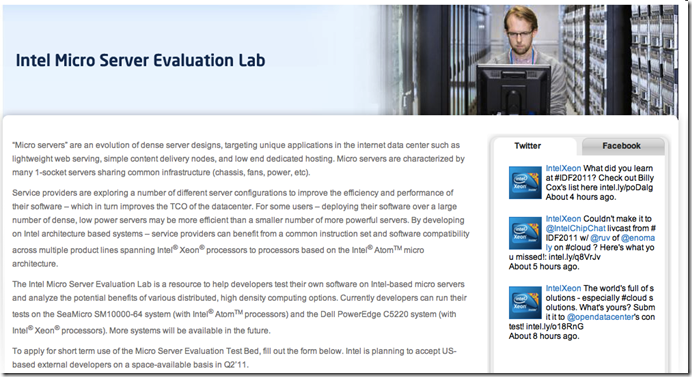
Wonder how important micro servers are to Intel?  Intel has launched a Micro Server lab.

image

http://www.intelcloudbuilders.com/microserverlab

image

Dell Modular Data Center Tour running Microsoft Bing Maps

Barton George has a post of Dell’s Ty Schmitt and Mark Bailey giving a tour of Dell’s modular data center in Longmont, CO running Bing Maps.

A Walk-through of Dell’s Modular Data Center

In my last entry I featured a video with the Bing Maps imagery team. In it they talked about why they went with Dell’s Modular Data Center (MDC) to help power and process all the image data they crunch. For a deeper dive and a look at one of these babies from the inside join Ty Schmitt and Mark Bailey in the following video as they walk you through the MDC and how it works.

Here is the YouTube video of the tour.

Illogic or Logic of building your own servers

Facebook is creating more visibility for build your own servers.

The logic of the approach is in this Bloomberg article.

Dell Loses Orders as Facebook Do-It-Yourself Servers Gain: Tech

By Ian King and Dina Bass - Sep 11, 2011 9:01 PM PTMon Sep 12 04:01:00 GMT 2011

When Facebook Inc. set out to build two new data centers, engineers couldn’t find the server computers they wanted from Dell Inc. (DELL) or Hewlett-Packard Co. (HPQ) They decided to build their own.

“We weren’t able to get exactly what we wanted,” Frank Frankovsky, Facebook’s director of hardware design, said at a conference on data-center technology last month.

Will this logic be successful is countered by ZDNET “between the lines”

Facebook DIY servers really poaching from Dell, HP, IBM? It's too early to tell

By Larry Dignan | September 12, 2011, 3:50am PDT

Summary: Do-it-yourself servers designed by Facebook are allegedly poaching server sales from HP, IBM and Dell, but the data is inconclusive at best.

And Larry makes an excellent point which I totally agree on.

Bloomberg reports that do-it-yourself servers used by the likes of Facebook, Google and Microsoft in data centers threaten Dell, HP and IBM. When I saw the headline, I got excited. Why? I thought there would be some quantification in it. Aside from the fact that 20 percent of the server market is customized, it’s unclear how many orders Dell, HP and IBM were really losing. There aren’t any concrete examples or figures to back up the premise.

You can argue the Logic of build your own servers or the Illogic of build your servers.  But from what I am hearing and seeing looking at other indicators of what is going on.  The momentum to build your own servers is growing.  Companies are putting the infrastructure in place to get it their way.

Hold the ‘Pickles’

“People want to be able to build it their way,”Frankovsky said at the Dell-Samsung Chief Information Officer Forum in Half Moon Bay, California. “They kind of want a Burger King: ‘I don’t like pickles -- why do I have to have pickles?’”

Building your own servers is a niche that is addressing a problem the Server industry has seen in the lack of R&D which results in a commoditization of the servers and lack of innovation.

Do you see Google going back to buying servers from OEMs?

For the same reason Apple has changed smartphones, tablets, and computers by integrating SW and HW, isn’t it logical to integrate SW and HW design in the data center?

Think Carnegie and Vertical Integration.

One of the earliest, largest and most famous examples of vertical integration was the Carnegie Steel company. The company controlled not only the mills where the steel was made, but also the mines where the iron ore was extracted, the coal mines that supplied the coal, the ships that transported the iron ore and the railroads that transported the coal to the factory, the coke ovens where the coal was cooked, etc. The company also focused heavily on developing talent internally from the bottom up, rather than importing it from other companies.[1] Later on, Carnegie even established an institute of higher learning to teach the steel processes to the next generation.

Many of the companies looking to build their own servers use open source so they have control of the supply chain of SW.  They want control of hardware.