Amazon Silk Browser, technical explanation and where the Amazon Silk name came from

Watch this video to get an explanation of how Amazon Silk has been designed to leverage Amazon's Cloud.

And, where does the Silk name come from?

A thread of silk is an invisible yet incredibly strong connection between two different things.  In our case it is the connection between your kindle fire and Amazon Compute Cloud.

NewImage

Here is the consumer explanation of Silk.

Amazon Silk

What is Amazon Silk?

Amazon Silk is a new kind of web browser, built from the ground up to leverage the power and capabilities of the Amazon Web Services (AWS) cloud to fundamentally rethink the level of performance and functionality that a browser can provide.

Do people really need another browser?

Browser development has really accelerated in recent years, with new entrants emerging and big upgrades from legacy browsers.  If we only thought we could deliver “another” browser, we wouldn’t have bothered.  In the case of Amazon Silk, however, we are very excited about the potential for this “cloud-powered” browser to truly delight our customers.

How does “the cloud” make this browser faster?

With Amazon Silk, most of the heavy-lifting is shifted from the processor on your device to our powerful AWS servers.  Access to such lightning fast CPUs, expansive memory, and huge network connections allows the performance of Amazon Silk to transcend the capabilities of your local device.  Amazon Silk isn’t just about massive computing power, however.  Because much of the intelligence of the browser is in the cloud, a number of performance enhancements become possible, including squeezing the utmost throughput out of your “last mile” connection, smart caching both on your device and on our servers, and on-the-fly content optimizations.  In addition, Amazon Silk has the ability to learn about traffic patterns on individual sites over time, allowing it to begin fetching the next page that users may wish to visit.
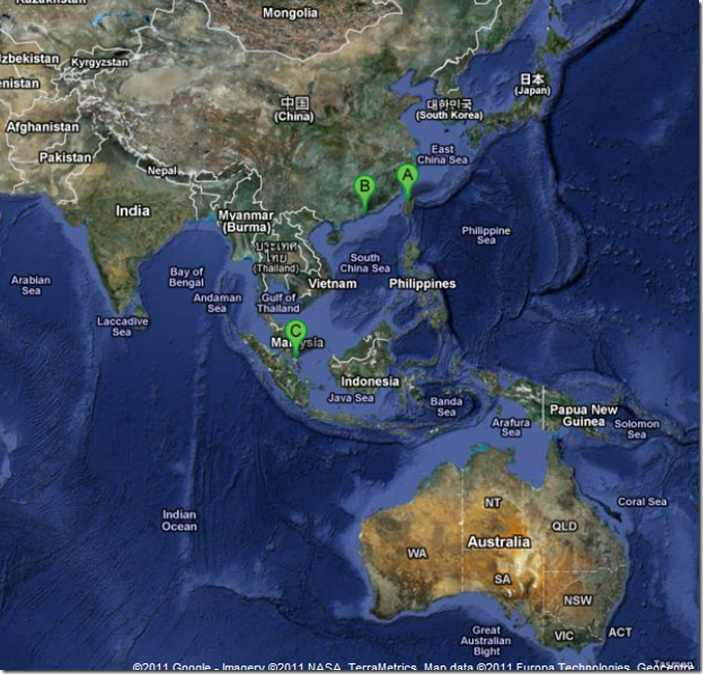
Google’s Three Asia Data Center Locations

Google announced its three data center locations in Asia - Taiwan, Hong Kong, and Singapore.

image

The logic of the three locations being in the center of the Asia Pacific region is hard to argue against. Which most likely disappointed governments in Australia, Korea, Japan, Vietnam, Phillipines, and India.  Here is Australia news.

Google will build three new data centres in Asia to service increased internet demand from the region, but Australia has missed out on being picked as a site location.

A Hong Kong-based spokesman, Taj Meadows, said Google used a stringent process to choose locations for the new facilities. The three cities met the criteria better than Australia, he said.

“We have a rigorous process in place around selecting sites for our data centres, taking many technical and other considerations into account. Some of the key things we look for in a site include closeness to our users, robust local infrastructure, reliable power, availability of skilled workers, reasonable business regulations and cost”, Meadows told IT Pro. He later added close proximity to existing underwater communications cables was also important.

Here is news about Singapore and Google’s Green Data Center plans.

“A data center here would be among the most efficient and environmentally friendly in Asia, subject to the same high technical and environmental standards we use worldwide,” Google said. It added that Singapore was chosen based on its proximity to users, access to robust infrastructure and reliable power, and reasonable business regulations, among others.

Hong Kong is a site to reach China.

Google faces stiff competition in Asia, particularly in the mainland market where homegrown search services such as Baidu are household names.

An Economist Intelligence Unit study released on Tuesday said Asian economies are closing the gap on the West in terms of IT competitiveness.

The United States is still the most competitive IT industry, but seven Asian economies made it to the top 20, including Singapore at No3 and Taiwan at 13.

And Taiwan makes the third.  

Three

The number 3 (三, Pinyin: sān, jyutping: saam1) sounds similar to the character for “birth” (生, Pinyin: shēng, jyutping: saang1), and is thus considered a lucky number.

Google to build US$100 million data center in Taiwan
2011/09/28 11:39:08


Taipei, Sept. 28 (CNA) Google Inc. will acquire 15 hectares of land in Changhua County to build a data center that will offer faster access to its services, the company announced Wednesday.
The world’s largest Internet search company said in a statement that it plans to invest over US$100 million (NT$3.04 billion) in the data center, which it expects to come on line in one or

.

Is Kindle Fire like the Wii of Game Systems, simpler and cheaper? with a bit of help from the Cloud

I've placed my order for a Kindle Fire.  Some iPad users will make the point the Fire has no 3G, only 8GB of memory, no camera, and no microphone. But, who can argue with a $199 price point?  This is like the Xbox/Playstation vs. Wii where a simpler cheaper device enables a lower price point.

Some apps are mentioned as being evangelized for the platform.

Amazon will go through its Appstore for Android, which has more than 15,000 apps, and filter out those apps that won’t work on the Kindle Fire for users who visit the store from a Kindle Fire. The company is approaching app developers to build new apps and optimize existing titles for the Kindle Fire, but it’s not putting out its own SDK. Instead it will encourage them to use Google’s existing tools. Amazon has started talks with Twitter, Facebook, Pandora and Netflix to optimize apps for Kindle Fire, but it’s too early to say what will happen.

But, I wouldn't hold your breath for Netflix optimized for the Kindle Fire.

What the Kindle Fire Silk browser does is enable Amazon to conduct analytics on the browsing experience that few can see.

Finally, Silk leverages the collaborative filtering techniques and machine learning algorithms Amazon has built over the last 15 years to power features such as "customers who bought this also bought..." As Silk serves up millions of page views every day, it learns more about the individual sites it renders and where users go next. By observing the aggregate traffic patterns on various web sites, it refines its heuristics, allowing for accurate predictions of the next page request. For example, Silk might observe that 85 percent of visitors to a leading news site next click on that site's top headline. With that knowledge, EC2 and Silk together make intelligent decisions about pre-pushing content to the Kindle Fire. As a result, the next page a Kindle Fire customer is likely to visit will already be available locally in the device cache, enabling instant rendering to the screen.

And, there is the cloud.

With Kindle Fire, you have instant access to all the content, free storage in the Amazon Cloud, the convenience of Amazon Whispersync, our revolutionary cloud-accelerated web browser, the speed and power of a state-of-the-art dual-core processor, a vibrant touch display with 16 million colors in high resolution, and a light 14.6 ounce design that's easy to hold with one hand - all for only $199. We're offering premium products, and we're doing it at non-premium prices."

Can you imagine if Netflix shipped the Kindle Fire.  We'll charge you for your cloud usage, separate your shopping from your video watching, and Games are on a separate website you need to subscribe to.

Bundling services in interesting ways is what customers want.  Amazon wants the data that allows them to create new services.


Mobile & the Enterprise, A list of ideas including FlipBoard for the Enterprise

I just spent the last 2 days at GigaOm Mobilize and it was a great event to think about where the connection is between Mobile and Data Centers.  I had a chance to spend time with a lot of C Level executives of the companies exhibiting and when I heard of good consumer scenarios l found myself thinking of how the technology could be used in the data center ecosystem.

How can mobile be used in data centers to support better operations?

One interesting talk was by Flipboard CEO, Josh Quitner.

LEARNING FROM FLIPBOARD

Flipboard isn't only at the top of its game; it seems to be reinventing it. What can we learn from the company's success? Om Malik talks to Josh Quitnner about Flipboard's meteoric rise and what impacts its brand of success will have on the media ecosystem.

Moderated by:Om Malik - Founder, GigaOM
Speakers:Josh Quitnner - Editorial Director, Flipboard
NewImage

NewImage

Turns out one of Mobile entrepreneurs I follow was at Mobilize and we hadn't chatted for a year or so.  And guess what, his app is called the "FlipBoard for the Enterprise."

Moprise Is Launching A

“Flipboard For The Enterprise”

posted on September 16th, 2011
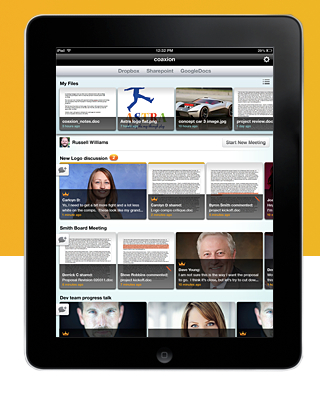
coaxion-ipad2

Moprise is launching a new iPad application it’s calling a “Flipboard for the Enterprise.” The app is a tablet-optimized version of the company’s currently available Coaxion iPhone application. The Flipboard analogy isn’t quite right, however. Flipboard is about reading news and articles, browsing photos and viewing updates from your social networks in a magazine-like format. Coaxion and Flipboard are only similar in that they both have easy-to-browse, touchable, swipe-friendly user interfaces. But Coaxion’s content is corporate documents, not news or tweets.


What enterprise problems is Moprise solving?

  • Work with All Your Critical Documents
    Seamlessly integrated access to SharePoint and Dropbox keeps you connected to all your important documents.

    Optimized Microsoft Office document views allow you to see everything including annotations, graphics, and formatting.

  • Discuss and Share in Real-Time
    Group messaging and sharing in real-time keeps your team in sync and moving forward from anywhere.
  • Secure
    All conversations and documents are transmitted over encrypted connections, and discussions and documents are only visible to the coworkers you explicitly invite.

    When conversations are closed, files are removed from devices while leaving the originals on SharePoint and Dropbox intact.

  • Optimized for Mobile
    Push notifications keep you updated in real time without draining your battery.

Geekwire also covers Moprise.

Flipboard has transformed the way people consume information on the iPad, allowing readers to quickly scan headlines and photos in a beautiful and easy-to-read interface. Moprise co-founder David D’Souza now wants to bring that same type of functionality to business documents through a new iPad application they’re dubbing “Flipboard for the Enterprise.”

D’Souza and his team previewed the new application at theTechCrunch Disrupt conference in San Francisco last week. We caught up with the ex-Microsoftie to learn more about what they are up to.

In fact, it was an experience at Microsoft that helped shape the concept of the new product, which is known as Coaxion for iPad.

Maybe it is my Microsoft time that gets me thinking about Enterprise and where the money is.  David D'Souza and i were chatting how much more money is available in the enterprise vs. consumer and we'll continue the conversation on how Moprise could be used in data scenario document scenarios.

One of the huge opportunities for Mobile is in the enterprise and there were many other talks on this topic at Mobilize.

THE $20 BILLION UPSET

There's a new force to be reckoned with in the enterprise: the consumerization of IT. The rise of mobile products such as the iPhone, iPad and Android platforms -- along with the easy accessibility of cloud computing services -- is radically disrupting conventional IT infrastructures. Resistance is futile. The network and content security industry is estimated to be worth more than $20 billion by 2015, and as advances in technology turn this industry upside down, smart and agile enterprises stand to realize considerable competitive advantages by recognizing the new shape of IT architecture and the value of a seamless user experience. This talk between Cisco Security's VP/GM Tom Gillis and the New York Times’ Quentin Hardy will delve deeper into the infinite number of possible responses demanded of IT departments.

Moderated by:Quentin Hardy - Deputy Tech Editor, The New York Times
Speakers:Tom Gillis - VP and GM Security Technology Business Unit, Cisco

WILL ENTERPRISE BE THE GAME CHANGER FOR HTML 5 AND TABLET APPS?

For companies that have embraced device diversity, the decision to go with native or web-based mobile apps can cause analysis paralysis. While native apps provide richer functionality, in-house app developers have already standardized on HTML as the platform of choice for building B2B apps. Will enterprise lead the way in using cross-platform mobile development tools and mobile middleware platforms to get the job done? There is much anticipation and hype about the entry of tablet devices into the enterprise. Yet we are seeing very little innovation of applications that actually take advantage of the tablet's benefits. Is the future of the tablet simply replacing existing game consoles and e-readers, or will productivity be the app that really makes use of the tablet form factor?

Moderated by:Nathan Clevenger - Chief Software Architect, ITR Mobility
Speakers:Santiago Becerra - Co-Founder and CEO, MeLLmo
Adam Blum - CEO, Rhomobile
Chris Kemmerer - Director, Mobility Solutions, Verizon
Sean Whiteley - SVP, salesforce.com
3 KEY PILLARS OF ENTERPRISE MOBILITY: APPLICATIONS, DATA AND PEOPLE

Virtualization and high-powered smartphones are a match made in heaven for the enterprise. Most of the arguments involving security and data integrity disappear. We talk with the visionary CTO and thought leader at technology giant VMware about what he sees as the real outcomes of virtualization on the handset and where VMware will lead the industry next.

Moderated by:Stacey Higginbotham - Senior Writer, GigaOM
Speakers:Stephen Herrod - CTO, VMware