Day One, at IT Asset Management Conference

A few months ago, I decided to start studying the state of Asset Management in data centers.  Fortunately, there is a conference on Asset Management, and when checking with some friends they were also attending the same conference.

NewImage

When people think about greening the data center they think about the building.  Some are thinking about the energy efficiency of their equipment.

But, only a few are thinking of how asset management and better utilization of their assets fits in a green data center strategy.

I am used to going to conferences that can be a little geeky.  This conference is about people who live and drink (even in the bars) asset management.

There are a lot of eWaste companies here and software asset management.  Hardware asset management is covered as well and RFID has a  presence with companies like RF Code which many of us have run into at other data center conferences and given many of the guys came from APC NetBotz team there are familiar faces.

There is a small group of people I've been hanging with who are focused on data center asset management at the scale that is interesting, not 10,000 servers, but more around 100,000.

Overall the first day was a good, and I am looking forward to a 2nd day of diving in deeper.

Syska opens Data Center office in Dubai to serve Middle East and Africa

Data Center Growth in emerging markets is hot, and one of the regions growing fast is the Middle East and Africa.  It can be difficult to understand those markets and I was quite excited to hear one of my data center friends has relocated to Dubai to be a local resource for the market.

NewImage

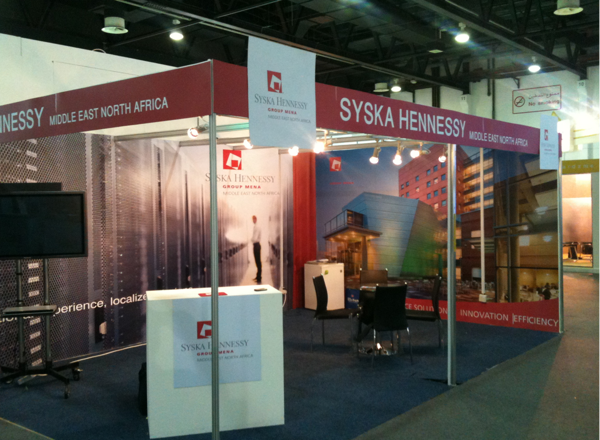
Syska has made a press release announcing their office in Dubai with VP Greg Jasmin running the local office.  I met Greg years ago as he was one of my early followers on this blog.  We have had many great conversations about green data centers and how sustainable approaches can be applied, and I am sure we will have many more interesting conversations as he services one of the high growth data center markets.  Connecting with great people makes my day. :-)

Syska Hennessy Group Establishes an Office in Dubai


DUBAI, United Arab Emirates--(BUSINESS WIRE)--Syska Hennessy Group, Inc. a leading global consulting, engineering and commissioning firm, is underscoring its commitment to clients in the Middle East/North Africa (MENA) region by opening a permanent office in Dubai’s Internet City, United Arab Emirates (UAE).

...

Syska Hennessy Group's global presence is continuing to expand with the formation of Syska Hennessy Group MENA. The new entity is the result of a joint venture between SH Group, Inc., the parent company of Syska Hennessy Group and LZ Technologies Middle East FZ-LLC. The new company will be led by Greg Jasmin, a vice president of Syska Hennessy Group, and Bassem Hariri, of LZ Technologies Middle East FZ-LLC. Mr. Jasmin will serve as co-managing director of the firm's Dubai office, overseeing operations and assuming technical leadership of the enterprise, while Mr. Hariri, also co-managing director, will oversee client relations and business development.

NewImage

Syska Hennessy Group has enjoyed long term success in the region with signature projects throughout Saudi Arabia, Qatar and the UAE. Jasmin commented, "Syska has been active in the Middle East for more than 30 years but we've never had a permanent presence. Now we both live and work here, elevating our commitment to this strategic region. Being in the region will certainly help Syska Hennessy broaden its array of platinum-level clients, as these clients seek out the experience and technical expertise that we bring from the U.S. to help solve the challenges these clients face in building exceptional buildings."

Shifting mindset to an Information Factory from a Data Center, the industrialization of the data

There is a different way to think about data centers where the goal of a company is to bring raw unprocessed bits and turn them into higher value bits just like a factory brings in raw materials and transforms the materials into higher value finished goods. The factory uses huge amounts of power in special buildings with lots of equipment and custom processes to support the transformation.   This is the industrialization of the data center.

Barton George writes a post on Big Data any how in general 5% of data is only used.

Big Data is the new Cloud

Rate This


Big Data represents the next not-completely-understood got-to-have strategy.  This first dawned on me about a year ago and has continued to become clearer as the phenomenon has gained momentum.  Contributing to Big Data-mania is Hadoop, today’s weapon of choice in the taming and harnessing of  mountains of unstructured data, a project that has its own immense gravitational pull of celebrity.

So what

But what is the value of slogging through these mountains of data?  In a recent Forrester blog, Brian Hopkins lays it out very simply:

We estimate that firms effectively utilize less than 5% of available data. Why so little? The rest is simply too expensive to deal with. Big data is new because it lets firms affordably dip into that other 95%. If two companies use data with the same effectiveness but one can handle 15% of available data and one is stuck at 5%, who do you think will win?

But, do you think Google, Facebook, Amazon, Twitter, and Zynga use only 5% of the data.  These companies are analyzing all their users and information looking where to make more money.

The new way of thinking is all that data is both market intelligence and the raw materials for information factories.

Barton goes on to point out that Google Facebook, and Yahoo are big Hadoop type of users analyzing unstructured big data.

Deal with it

Hadoop, which I mentioned above, is your first line of offense when attacking big data.  Hadoop is an open source highly scalable compute and storage platform.  It can be used to collect, tidy up and store boatloads of structure and unstructured data.  In the case of enterprises it can be combined with a data warehouse and then linked to analytics (in the case web companies they forgo the warehouse).

And speaking of web companies Hopkins explains

Google, Yahoo, and Facebook used big data to deal with web scale search, content relevance, and social connections, and we see what happened to those markets. If you are not thinking about how to leverage big data to get the value from the other 95%, your competition is.

Some of you may think of this is new, but this is standard practice for many.  The winners think like an information factory integrating across many different systems.  The losers are thinking of a data center as a place their data is stored in silos to support internal organizational structures.

5 months since Mike Manos posts, Shares his Lights Out Data Center achievement

Mike Manos hasn't posted on his blog since May 20, 2011. Mike was nice enough to give me a heads up on what he posted today.

So, what has been Mike up to?  His post as usual is quite long, but having worked with Mike many times I am going to boil down this long post into something that is thought of as a blog post, less than 200 words.  :-)

Here is a graphic of what AOL has launched.
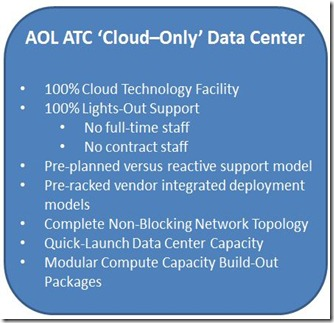
NewImage

So what did Mike's team do?  They shut themselves in their own world, in a cocoon for months to come up with a better way to run AOL's infrastructure.

Luckily I have a world class team at AOL and together we built and entered our own cocoon and busily went to work. We have gone down the path of changing out technology platforms, operational processes, outdated ways of thinking about data centers, infrastructure, and overall approach. Every inch fighting forward on this idea of unified infrastructure.

And part of that time was identifying the cruft.

As I look at the challenges facing modern IT departments across the world, their ability to “go to the cloud” or make use of new approaches is also securely anchored behind by the “cruft” of their past. Sometimes that cruft is so thick that the organization cannot move forward.

And getting rid of the cruft is required for automation.

One of the key foundations for our ATC facility is our cloud platform and automation layer.

Mike shared some of his achievements at Uptime.

We went from provisioning servers in days, to getting base virtual machines up and running in under 8 seconds. Want Service and Application images (for established products)? Add another 8 seconds or so. Want to roll it into production globally (changing global DNS/Load balancing/Security changes)? Lets call that another minute to roll out. We used Open Source products and added our own development glue into our own systems to make all this happen. I am incredibly proud of my Cloud teams here at AOL, because what they have been able to do in such a relatively short period of time is to roll out a world class cloud and service provisioning system that can be applied to new efforts and platforms or our older products. Better yet, the provisioning systems were built to be universal so that if required we can do the same thing with stand-alone physical boxes or virtual machines. No difference. Same system. This technology platform was recently recognized by the Uptime Institute at its last Symposium in California.
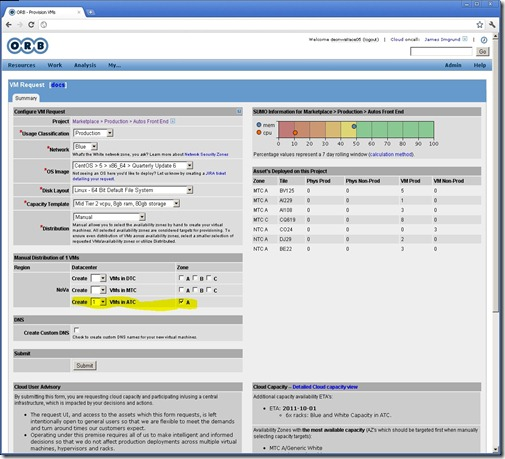
NewImage

And Mike gives credit to his team.

The culmination of all of this work is the result of some incredible teams devoted to the desire to affect change, a little dash of renegade engineering, a heaping helping of some new perspective, blood, sweat, tears and vision.   I am extremely proud of the teams here at AOL to deliver this ground-breaking achievement.   But then again, I am more than a bit biased.   I have seen the passion of these teams manifested in some incredible technology.

And what did Mike's team do?  They modularized the work.

This time frame was made possible by a standardized / modular way to build out our compute capacity in logical segments based upon the the infrastructure cloud type being deployed (low tier, mid-tier, etc.).   This approach has given us a predictability to speed of deployment and cost which in my opinion is unparalleled.

One of the things Mike can do that he couldn't do at Microsoft is use open source tools.

This time frame was made possible by a standardized / modular way to build out our compute capacity in logical segments based upon the the infrastructure cloud type being deployed (low tier, mid-tier, etc.).   This approach has given us a predictability to speed of deployment and cost which in my opinion is unparalleled.

...

We used Open Source products and added our own development glue into our own systems to make all  this happen.

Mike can now have really interesting discussions on the use of open source tools with the likes of Facebook, Twitter, Zynga, Mozilla, and others.

Steve Jobs Lesson to learn for Data Centers, Start with customer experience

The data center has some phenomenally smart mechanical and electrical engineers designing more efficient power and cooling systems.  DCIM is a hot topic for software to run data centers.  ZDNet has a blog post on the 100-year legacy of Steve Jobs.  One point made that is a quote from Steve Jobs is a lesson that is hard to learn.

“One of the things I’ve always found is that you’ve got to start with the customer experience and work backwards to the technology. You can’t start with the technology and try to figure out where you’re going to try to sell it. I’ve made this mistake probably more than anybody in this room and I’ve got the scar tissue to prove it, and I know that it’s the case. As we have tried to come up with a strategy and a vision for Apple, it started with ‘What incredible benefits can we give to the customer? Where can we take the customer?’ [It's] not starting with ‘Let’s sit down with the engineers and figure out what awesome technology we have and how are we going to market that?’”

Almost everyone does what Steve says not to do.

‘Let’s sit down with the engineers and figure out what awesome technology we have and how are we going to market that?’”

The nice thing is some of my entrepreneur friends are ex-Apple including myself we embrace this approach.

One of the things I’ve always found is that you’ve got to start with the customer experience and work backwards to the technology.

We've been sharing some of our product ideas with innovative data center operators, and we are pleasantly surprised on how much they like our approach to solving the customer problem.  We actually don't even really talk about the technology.  One of the guys who I shared the solution said you guys are using the "Challenger Sale" technique.

In The Challenger Sale, Matthew Dixon and Brent Adamson show how this critical finding has turned conventional wisdom on its head. While most companies focus on building customer relationships, the best focus on pushing customers’ thinking, introducing new solutions to their problems and illuminating problems customers overlook. That is, they challenge their customers.

NewImage

Here is data that shows the challenger approach wins.

NewImage

It's kind of logical to buy solutions from those who push your performance.  How many fanatical loyal Apple fans feel like they have products that push their experience of life.  Steve Jobs was a genius who learned some hard lessons that made him better in his 40s and 50s than in his 30s.