Blogging on a MacBook Air OSX Lion vs. Lenovo WIndows 7, part 1

About 3 months ago I bought a MacBook Air and posted on my transition.  Disclosure: I am biased.  I worked on the MacOs at Apple from 1985 - 1992, and Windows OS at Microsoft from 1992 - 2001.  In 2001, Windows XP was my last client OS, and I switched to work on servers and enterprise management from 2001 - 2006, and refused to use Windows Vista Beta. :-)

So, am i religious on the Mac vs. Windows?  i understand and appreciate the different perspectives

Think Different switch back to the Mac from Windows

I worked at Apple from 1985 to 1992.  The Mac was introduced in 1985 and 1991 Apple shipped System 7. I spent much of time working on Mac OS 6.0.x and System 7 was years of being immersed in Mac development.  When I moved to Microsoft to work on Win3.1 my coworkers and I spent much of time using Macs as we were working TrueType and the vast majority of tools where on the Mac.

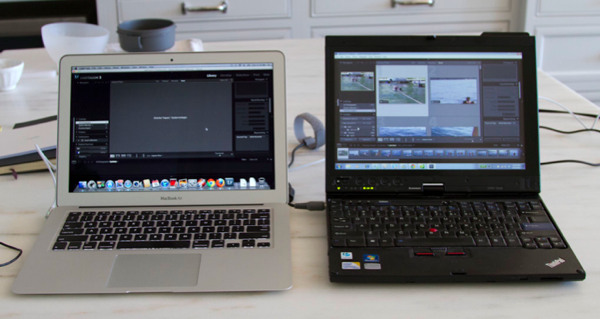
Even though many of my friends used Macs I didn't take the time to switch.  But, yesterday I switched to a 3rd generation MacBook Air and the Lion OS.
NewImage

Back when I made the switch I was loyal to Windows Live Writer as my blogging tool.

I have written a few blog entries with MarsEdit.  Downloaded photos from my Canon 7D.  Installed Office, Aperture, Lightroom as well.

I was much faster writing with Windows Live Writer, but it's only my  second day switching back to the Mac after almost 19 years.

I have Parallels installed on the MacBook Air with Windows 7 and Windows Live Writer, and guess what I have not fired up Windows 7 with Live Writer for the last month.  Marsedit is not perfect as a blogging tool and there are some features that I like on Windows Live Writer, but they are not worth the time to switch to Windows 7.

I'll write another post on the specifics of using Marsedit vs. Live Writer.

It took me about a 6 weeks to get really comfortable with the MacBook Air and OSX Lion, but keep in mind again I worked at Apple so I was a loyal religious Mac User before.

One thing I am quite pleased with on the MacBook Air is the 256GB SSD integration.


Looking for the more useful Data Center vendor, Find the Challenger

You can't go to any data center event without running into the vendors and the sales people.  The easy thing for me is they don't bother me as I tell them I don't buy things. On the other hand, the people I hang out with buy lots of things and we get frequent laughs watching the sales people maneuver.  We rarely seek out a vendor as almost all are just looking to build relationships with the people they see, saying what they do and exchanging business cards.

One of the funny things we discussed at the Facebook Open Compute Summit is how it would be great if we get could have penalty flags for inappropriate vendor behavior.

So, what would be a vendor that people would want to talk to.  Consider this Book and new sales research.

Presenting The Challenger Sale

New book from Corporate Executive Board uses research to confront traditional sales wisdom.

In a world of hesitant, risk-averse, empowered customers, what sales approach consistently wins?

To find out, Corporate Executive Board surveyed over 6,000 sales reps across geographies and industries. The research revealed that sales reps fall into one of five profiles:

  1. The Hard Worker
  2. The Problem Solver
  3. The Challenger
  4. The Relationship Builder
  5. The Lone Wolf

And the winner is?  The challenger, not the relationship builder.

Each profile can turn in average performance, but only one consistently outperforms – the Challenger.

In The Challenger Sale, Matthew Dixon and Brent Adamson show how this critical finding has turned conventional wisdom on its head. While most companies focus on building customer relationships, the best focus on pushing customers’ thinking, introducing new solutions to their problems and illuminating problems customers overlook. That is, they challenge their customers.

The Challenger Sale is a must-read book for any business leader, sales manager or rep. It explains why Challengers win and, more importantly, how companies can build the Challengers they need to drive customer loyalty and higher growth.

Think about.  How many data center sales people know how to be a challenger?

Open Compute Project Subscribe Link Lists of Technical Workshops - Virtual IO, DC Design, Openrack, Storage, and HW Mgmt

For those of you Open Compute Project fans that Facebook has hosted in Palo Alto and NYC. The following are the subscriber lists you can get updates on the latest discussions.

NewImage

Hacking Conventional Computing Infrastructure

We started a project at Facebook a little over a year ago with a pretty big goal: to build one of the most efficient computing infrastructures at the lowest possible cost. We decided to honor our hacker roots and challenge convention by custom designing and building our software, servers and data centers from the ground up – and then share these technologies as they evolve.


  • VIRTUAL IO http://lists.opencompute.com/mailman/listinfo/opencompute-virtualio
  • DATACENTER DESIGN http://lists.opencompute.com/mailman/listinfo/opencompute-datacenterdesign
  • OPENRACK http://lists.opencompute.com/mailman/listinfo/opencompute-openrack
  • STORAGE http://lists.opencompute.org/mailman/listinfo/opencompute-storage
  • HARDWARE MNGT http://lists.opencompute.org/mailman/listinfo/opencompute-hardwaremngt
  • Opencompute-datacenterdesign --


    About Opencompute-datacenterdesign
    English (USA)


    To see the collection of prior postings to the list, visit the Opencompute-datacenterdesign Archives.

    Using Opencompute-datacenterdesign
    To post a message to all the list members, send email to datacenterdesign@opencompute.org.

    You can subscribe to the list, or change your existing subscription, in the sections below.

    Subscribing to Opencompute-datacenterdesign

    Subscribe to Opencompute-datacenterdesign by filling out the following form. You will be sent email requesting confirmation, to prevent others from gratuitously subscribing you. This is a private list, which means that the list of members is not available to non-members.

      Your email address:
      Your name (optional):
      You may enter a privacy password below. This provides only mild security, but should prevent others from messing with your subscription. Do not use a valuable password as it will occasionally be emailed back to you in cleartext. 

      If you choose not to enter a password, one will be automatically generated for you, and it will be sent to you once you've confirmed your subscription. You can always request a mail-back of your password when you edit your personal options. Once a month, your password will be emailed to you as a reminder.
      Pick a password:
      Reenter password to confirm:
      Which language do you prefer to display your messages? English (USA)
      Would you like to receive list mail batched in a daily digest? No  Yes
    Opencompute-datacenterdesign Subscribers
    (The subscribers list is only available to the list members.)

    Enter your address and password to visit the subscribers list:


    Address: Password: 


    To unsubscribe from Opencompute-datacenterdesign, get a password reminder, or change your subscription options enter your subscription email address:


    If you leave the field blank, you will be prompted for your email address


    Tuna Industry attacks Greenpeace, lessons for the data center industry?

    WSJ has an article and video on Greenpeace vs. the Tuna industry where part of the accusation is Greenpeace is focused on fund raising.  It would be interesting to know how much money Greenpeace has collected due to the uncoal Facebook data center campaign. The Tuna Industry must be pretty fed up to go to the media with their story.

    The WSJ articles is here.

    Unfortunately, this attack on canned tuna isn't about science. It's about fund raising, and Greenpeace has discovered a recipe for success: Target something that's easily recognizable (like tuna), make some scary claims in the media, parade around in funny costumes—and start raking in the donations. It's a recipe that Greenpeace has perfected over the past two decades.

    Here is the video Greenpeace has put on line.

    87,675

    Uploaded by  on Aug 14, 2011

    Each year the canned tuna industry kills thousands of sharks, rays, turtles and seabirds. Now that's a dirty little secret. Greenpeace is launching a new campaign to get the canned tuna industry to clean up its act and end its destructive ways. To kick things off we've teamed up with Pulitzer Prize winning cartoonist Mark Fiore on this video. Help expose the the tuna industry's dirty little secret by sharing this video with everyone you know.

    Learn more at www.greenpeace.org

    • likes, 114 dislikes


    Note how much dislikes (114) vs. likes (259).

    SSDs arrive in the Public Cloud, Is CloudSigma starting a new trend

    I speculated a year and half ago that AWS would add SSD, but I was wrong and AWS added HPC instead.

    GigaOm reports on CloudSigma adding SSD support.

    CloudSigma adds SSDs to its public cloud

    Cloud provider CloudSigma has become the first to add solid-state-drive storage to its public cloud computing service. SSDs (aka flash memory) are well known for their ability to significantly increase storage I/O performance and decrease power consumption when compared with hard disk drives, but until recently they have been too expensive for consideration in most data centers that aren’t backed by serious computing needs and deep pockets. That’s starting to change with the advent of new companies promising ever-lower prices on enterprise-grade flash storage, but making flash available as a service to cloud customers is still relatively unheard of.

    There is mention of the lower power consumption, but the key is performance.  BTW, part of why I like my MacBook Air is its 256GB SSD that makes my machine outperform my other laptops.

    The SSD is meant for high performance areas of the cloud.

    At this point, CloudSigma is targeting its flash offering at tiered storage environments in which companies place “hot” data or data that requires high I/O throughput on flash, while keeping less-performance-intensive data and backup operations on hard disks.