Don't expect Solar Panels at an Amazon Data Center without tax incentives

James Hamilton writes an analysis of Facebook's and Apple's solar panel deployments.

I love solar power, but in reflecting carefully on a couple of high profile datacenter deployments of solar power, I’m really developing serious reservations that this is the path to reducing data center environmental impact. I just can’t make the math work and find myself wondering if these large solar farms are really somewhere between a bad idea and pure marketing, where the environmental impact is purely optical.

And closes with this.

Looking more deeply at the Solar Array at Apple Maiden, the panels are built by SunPower. Sunpower is reportedly carrying $820m in debt and has received a $1.2B federal government loan guarantee. The panels are built on taxpayer guarantees and installed using tax payer funded tax incentives. It might possibly be a win for the overall economy but, as I work through the numbers, it seems less clear. And, after the spectacular failure of solar cell producer Solyndra which failed in bankruptcy with a $535 million dollar federal loan guarantee, it’s obvious there are large costs being carried by tax payers in these deployments. Generally, as much as I like data centers, I’m not convinced that tax payers should by paying to power them.

As I work through the numbers from two of the most widely reported upon datacenter solar array deployments, they just don’t seem to balance out positively without tax incentives. I’m not convinced that having the tax base fund datacenter deployments is a scalable solution. And, even if it could be shown that this will eventually become tax neutral, I’m not convinced we want to see datacenter deployments consuming 100s of acres of land on power generation. And, when trees are taken down to allow the solar deployment, it’s even harder to feel good about it.  From what I have seen so far, this is not heading in the right direction. If we had $x dollars to invest in lowering datacenter environmental impact and the marketing department was not involved in the decision, I’m not convinced the right next step will be solar.

Given this information, I wouldn't hold my breath for a solar panel at Amazon for a few reasons.

  1. The economics don't make sense for Amazon
  2. Amazon would not want the visibility for its data centers.  (Is Amazon the next Greenpeace target?)
  3. Taxes is what drives many Amazon decisions, and they look long term at tax incentives.
  4. There are probably a bunch more, but bottom line the numbers don't support solar panels

Amazon acquires automated material handling vendor Kiva Systems

Amazon has a press release on the acquisition of Kiva Systems.

Amazon.com to Acquire Kiva Systems, Inc.

SEATTLE--(BUSINESS WIRE)--Mar. 19, 2012-- Amazon.com, Inc. (NASDAQ:AMZN) today announced that it has reached an agreement to acquireKiva Systems, Inc., a leading innovator of material handling technology.

“Amazon has long used automation in its fulfillment centers, and Kiva’s technology is another way to improve productivity by bringing the products directly to employees to pick, pack and stow,” said Dave Clark, vice president, global customer fulfillment, Amazon.com. “Kiva shares our passion for invention, and we look forward to supporting their continued growth.”

“For the past ten years, the Kiva team has been focused on creating innovative material handling technologies,” said Mick Mountz, CEO and founder of Kiva Systems. “I’m delighted that Amazon is supporting our growth so that we can provide even more valuable solutions in the coming years.”

Most of you have probably never heard of Kiva Systems.  I have.  Why?  Because, I used to be a distribution logistics geek.  I studied the subject in college. Worked in Distribution Logistics and packaging engineering at HP.  Apple actually hired me for my distribution logistics expertise away from HP and I worked on Apple's distribution system for years before moving to hardware product development and software product development.

One of the things that distribution logistics teaches you is supply chain management principles.  When I worked on hardware development the connection is obvious. Working on software, I would think of bits and information as a supply chain issue as the bits move.  The data center is a factory to support the movement of bits in a supply chain.  It is interesting when you start to think of things as abstractions that are simply bits of information.

So, who is Kiva Systems and why are they so interesting.  Kiva moves material to the person on robotic carts.  The software is quite intelligent to keep the fast moving items closest to the material handlers, and move the slow moving items further away.  This is no different than storage and caching issues in an operating system.

Read more about Kiva implementations in these markets.

The WSJ does a pretty good job of giving background on Kiva Systems

Robots on the March

How Kiva's robots run a warehouse

  • To complete an order, Kiva's squat orange robots fetch tall movable shelves, or pods, that have the items needed, bringing them to the human "picker."
  • A laser pointer tells the human which item needs to be picked from each shelf. The worker, who stays in one place, scans a bar code to confirm it is the right item. It's placed in the order box, which sits on another one of the mobile pods.
  • New pods arrive steadily with additional items as needed. Items are grouped together to fulfill the orders.
  • Pods filled with completed orders are taken by the robots to the shipping door, where a human tapes them closed in preparation for final transport.

But, here is an easier way to understand what Kiva System is.

Here is a TED talk by the founder.


Here is a IEEE Spectrum video on YouTube.


This will make for fun conversations with some of friends who work on logistics.

Amazon.com most likely figured out how much more efficient it is to move material with robots.  The old way of thinking about robots is like this video.


Hunt for Data Center Talent, if you think it is a popularity contest you'll be surprised

Last year, I had the pleasure of moderating a panel with Jack Glass, Joe Kava, and Mike Manos on the Hunt for Data center talent.

Hunt for Data Center Talent panel at 7x24 Exchange - Jack Glass, Joe Kava, Mike Manos

The folks at 7x24 Exchange gave us the opportunity to discuss a topic that does not focus on the technology.  So, if we don't discuss data center technology, what should we discuss? Our idea was to discuss the #1 issue that defines the operations and design of a data center, the people on the data center team.

We had an awesome panel with a good perspective on what talent is needed in the data center.

Jack Glass, P.E.
Director - Data Center Planning
Citi Technology Infrastructure

Mike Manos
Senior Vice President, Technical Operations
AOL

Joe Kava
Senior Director, Data Centers
Google

NewImage

Now that I pay more attention to the topic of data center talent it is amazing how many times people make the wrong decisions on who to hire.  Well wrong in the opinion of people who work on data centers.  Someone at a senior executive level who usually knows little about data centers picks based on his personal preference.  But, what do senior company executives know about data center executives.  The NYTimes writes on "The Secrets of Talent Scouts" and makes an excellent closing remark.

For all of Sequoia’s success, Mr. Moritz cautions: “We often get it wrong. Judging people is more difficult than judging a market or a product. Markets rarely deliver big surprises. People will always produce surprises.”

When someone is on the speaker tour they are either selling their services, adding public speaking engagements as their internal achievements, looking for a new job.  Or a 4th option is sharing knowledge because it is the right thing to do.

Hint: the data center talent is more often the 4th option, and not the necessarily the most popular.  As we have all learned being the nerdy kids in the school, the most popular are not necessarily the most talented.


Decided to add a new iPad to my iPhone 4S and MacBook Air

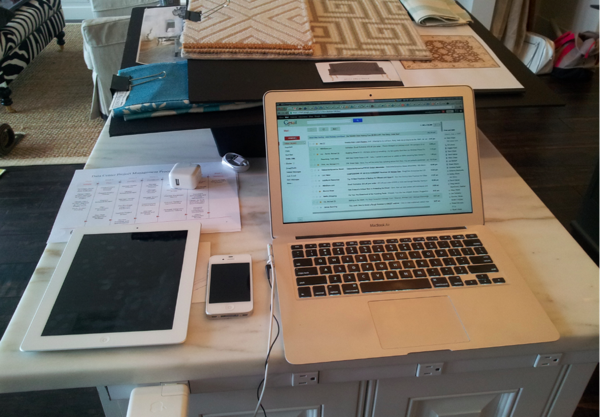
Below to the left is my new 64GB wifi iPad next to my iPhone 4S and MacBook Air.  It's been about 6 years since I left Microsoft and it is now 20 years since I left Apple. I use Parallels and Windows 7 on the Mac when i need to run Quickbooks or other Windows apps.  But, I am amazed at how much I just stay on OSX.

When I was in Austin with other data center people attending SXSW, we all had Macs.

I am getting back into Apple thinking, not to use Apple products, but it reminds me of how we did things at Apple.  Microsoft was great too, but many things were based on iterating on past products.  Not creating something brand new.

After 5+ yrs blogging on green data centers, I've figured out a lot of things, and it is time to help some of my friend do things differently.  A lot of what I have been studying lately are checklists, habits, workflow, and bouncing lots of ideas off of my friends.  There is no market data that supports the ideas, but that's OK.  One of the things we learned at Apple is marketing data is useful for looking at the past, but not useful for creating the future.

NewImage

Off to LV for a day to see more friends.  I think I'll use my new iPad to review some of the drawings and diagrams, and leave the MacBook Air at home.

Google shares its recycled water use in a green data center, 7 reasons why it is smart

It is sad that most think of a Green Data Center almost exclusively in terms of energy use.  Google's Joe Kava has been talking about water publicly since 2009.

Google's Joe Kava discussed water use in data centers in its 2009 data center summit.  Joe's presentation on water start at the 9:20 mark.

A green data center has smart water use in addition to efficient power and cooling systems.

Google has a new post on its new recycled/grey water facility in Georgia.

NewImage

NewImage


Helping the Hooch with water conservation at our Douglas County data center

March 15, 2012 at 7:00 AM
If you’re familiar with the work of the Southern poet Sidney Lanier, you’ll know hewrote about the beauty of the Chattahoochee River in Georgia. “The Hooch,” as it’s known around here, starts up in the northeastern part of the state, runs through Atlanta and down into Alabama before emptying out into the Gulf of Mexico. Those of us who work in Google’s Douglas County, Ga. data center have a special fondness for the Chattahoochee because it’s an integral part of our ability to run a highly efficient facility.

I got an early peak at the Youtube video yesterday which had only 40 views.  24 hrs later the video has 7,488 views.  Google, water, and data centers is not as esoteric as you may think.

Here is the press release from Douglas County and Google GoogleDouglasCountyRelease.pdf

FOR IMMEDIATE RELEASE March 15, 2012

Google and Douglasville-Douglas County Water and Sewer Authority Unveil Reuse Water Facility

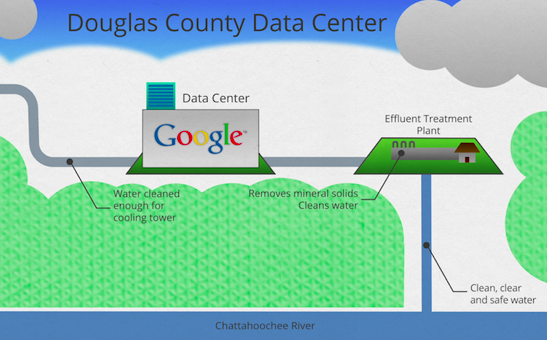
Recycled water used to cool Google’s data center equipment

(ATLANTA and DOUGLAS COUNTY, Ga.) - Douglasville-Douglas County Water and Sewer Authority (WSA) officials and Google executives on Thursday announced Google’s first reuse water system for one of their U.S. data centers. Google’s Douglas County data center is also the state’s first data center to conserve water using a reuse water system. The system, financed by Google and owned by WSA, is helping to keep the Chattahoochee River clean and conserving the reservoir's water supply.

“Working with Google on this reuse water system has been a great experience for the WSA. Our water supply gets hit hard during the drought season and in the summer months,” said Peter Frost, executive director of WSA. “The Google-funded sidestream facility is a welcomed reprieve on our reservoir’s water system and saves water capacity for our residents and businesses.”

Some people may flush this idea down the drain as not worth their effort.  But, there is another reason that few would think about.  One of the top risks to data center operations is the breaking of a water main supplying the data center.  Water infrastructure is one of the most ignored parts of society that are critical for life.  As one of my data center friends who told the story of having no water in his apartment for 2 days, it is hard to occupy a building without water.

This Google Water story that has been going on for a long time as the original financial investment from Google was in 2008.

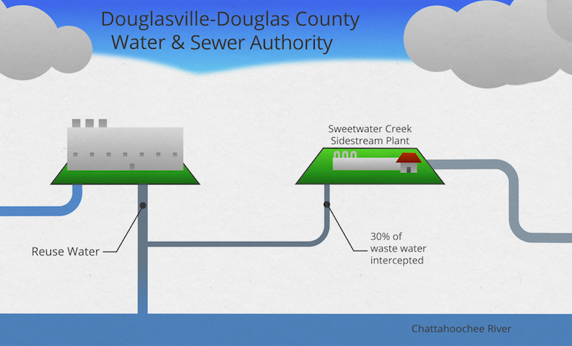
In 2008, Google financed the building of the WSA’s Sweetwater Creek Sidestream Plant, which is a reuse treatment facility that intercepts up to 30 percent of the water from the local water and sewer authority’s treatment plant.

“At Google we’re always looking for smart ways to reduce our impact on the environment,” said Joe Kava, Google’s senior director of data center construction and operations. “We’ve been working for years on maximizing the efficiency of our servers and our data center designs so that we can minimize the entire energy footprint consumed by our data centers.”

It can be hard to bring in a 2nd water line to a data center, and on site storage of water is difficulty for a scenario of a week's worth of water.

What Google's recycled water system does is provide an alternative cooling water source that has many benefits.  Below are 7.

  1. 2nd source of cooling water (recycled water and potable city water)
  2. brand new and will last longer than data center (water mains can be up to 75 years old)
  3. supported by the local gov't (community relations in improved with joint projects)
  4. is part of the city's critical infrastructure which makes it a high priority to operate (Google gets to the top of the list after hospitals, fire, and police)
  5. financed by Google, city owned (Google's cash reserves put to funding innovation and thought leadership in sustainable data centers)
  6. cost effective, reduce cost of water and sewage fees (if you haven't looked at water and sewage costs, the costs are growing faster than any other consumable)
  7. good for the environment (obvious)