a t-shirt for old data center guys, Old Guys Rule

I've been working with in the Technology industry for over 30 years.  5 years at HP, 7 years at Apple, 14 years at Microsoft, and 6 years on my own.

In one of my Skype video chat sessions a friend saw my Old Guys Rule t-shirt.

A badge of honor.
There comes a time in your life when comfort meets substance. When all your hard work seems to have paid dividends, and the world is at your command. All the things you hoped you could do someday, you're doing. The toils of youth are now your experiences... no longer the student, but the teacher.

To celebrate your accomplishments we offer up "Old Guys Rule" to be worn as a badge of honor for a life well spent, but not nearly over...


NewImage

I'll see if any of my other data center friends buy an "old guys rule" t-shirt as well.

Google expands in Oklahoma, instead of launching a new site, Why?

It is interesting how much news Google gets by expanding its data center capacity at a site.

Print story only Print story with comments Email Facebook
Google to double capacity in Oklahoma
Justin Hobbs, a facilities technician for Google, works on his computer in January at the company's data center in Pryor. Google announced Wednesday plans to expand the Pryor facility, adding about 50 jobs. MATT BARNARD/Tulsa World file

By ROBERT EVATT World Staff Writer


OKLAHOMA CITY –Mike Wooten, Google Data Center Operations Manager, had previously said the company was looking into building a much smaller auxiliary building to support its Pryor data center.

But that’s not what he announced during a press conference at the state capital building Wednesday.

“We’re going to construct a new building that will house twice as much server capacity,” Wooten said.

The new building slated for Google’s 800-acre campus at Mid-America Industrial Park will be roughly the same size as the 130,000 square-foot data center that opened just six months ago, and enable Google to add 50 jobs to its current 100-employee Pryor workforce.


There are many like the so called Nebraska Edge project that are hoping to land a big data center from Google in their area.  Site selection is complex and has a long list of factors.

Jones Lang LaSalle’s data center services include:

  • Location and site selection strategy
  • Site due diligence
  • Project management
  • Purchase, lease and build-to-suit negotiations
  • Financing strategies
  • Business and economic incentives negotiations
  • Critical environment management
  • Project and development services

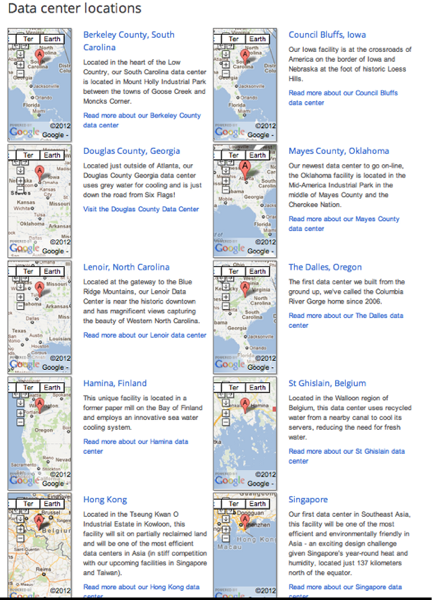
With Google's 12 data center sites you may say why not add another site in my area.  (Note the list has only 11 sites, and I included Dublin where Google has announced expansion.)

NewImage

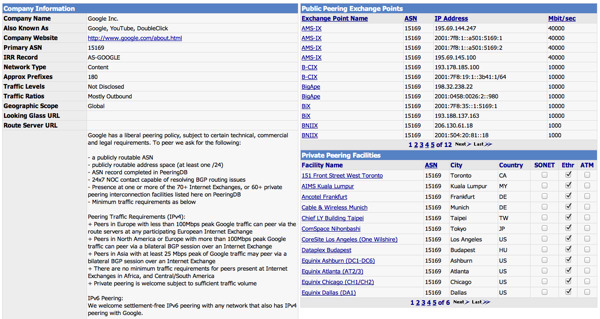
But, the one answer a site selection consultant has difficulty answering is what is the right number of data center sites and how does a new site affect your operations.  Google has 12 main data centers that are bigger than 5MW.  I would assume there are another 120 sites (10X the main data centers) to support lower latency.  Here is a list of the public and private peering sites which gives you an idea of the other Google locations.

NewImage

How a data center site interacts with this system is a question that only Google can answer.  it is useful to have consultants take fresh looks at where data center sites can be.  Given Google has 800 acres in Pryor, OK and hundreds of acres in other sites in the US, you shouldn't hold your breath for a new Google data center site in the US.

In the same way FedEx has a strategy for its site locations, Google has their own.

Why is it news that Google announces a data center expansion?  Because Google articles drive traffic.  The way the news is written it seems like many are not aware that there is a new Google data center project announced every 3-6 months.


Is the iPhone camera the only camera you need? Not me

WSJ has a post on how the iPhone is dominating digital photography.

Is the iPhone the Only Camera You Need?

If you're armed with the right photo apps, editing tricks and shooting know-how, it just might be

[WEBpromoiphone]F. Martin Ramin for The Wall Street Journal (cameras, phone); Lisa Corson/The Wall Street Journal (sunset)

The iPhone simplifies the photographic process—you can shoot, edit, share and order prints using one device.


I, POINT-AND-SHOOT, hereby call to order the inaugural meeting of the Secret Society of Digital Cameras That Are Sick and Tired of the iPhone. Ultra Zoom. Micro Four Thirds. Budget Digi Camera that takes AA batteries. Thanks for coming.


I think everyone knows why we're here in the basement of this abandoned Circuit City in Ho-Ho-Kus, N.J. I mean, it's in the name of our club: the iPhone. A lot of you have been sitting in junk drawers, so I'll bring you up to speed. It ain't just a phone. It has a camera. And not one of those 1.3-megapixel numbers from a decade ago. This is the real deal. People have already started documenting their breakfasts with it. We're in trouble.

Have you checked out Flickr lately? The iPhone is the site's most-used camera. Instagram, an app that let's people share photos, reached 27 million users to become one of the world's biggest social networks. It hit that milestone purely with the iPhone. Last time I checked, we took photos. Where is our piece of the zeitgeist pie?


For many, who are not camera snobs the iPhone works fine.

I am a camera snob and use a Canon S100 as my pocket camera.  It takes awesome shots which gets close to the quality of Canon 7D where I use mainly 24-105 f/4 L IS lens.  One of the things I learned working with Professional photographers is lens makes a big difference.  This lens is $1,000 and I am spoiled.


651 of 669 people found the following review helpful
5.0 out of 5 stars Canon EF 24-70mm vs. 24-105mm IS: Read this if you are a hobbyist, November 19, 2009
By
va1800 (Baltimore, Maryland) - See all my reviews
This review is from: Canon EF 24-105mm f/4 L IS USM Lens for Canon EOS SLR Cameras (Camera)


I am a hobbyist and this review is for people like me. What I mean by that is that I take pictures for fun and nobody buys my pictures. I mostly shoot landscape, nature, and portraits of family, friends, and relatives. I will refer to 24-70mm as the 70, and the 24-105mm IS as the 105. I first made the mistake of buying the 70, then I returned it with a hefty restocking fee and bought the 105 - I don't have the slightest regret and I could not be happier. I'm taking my time to write this review so that you can spend your hard earned money wisely. Let's analyze the trade-off between the two:
* Both lenses have excellent build and image quality. So these are not differentiating factors.
* The one and only advantage of the 70 is the one smaller f-stop. For me, this means more blur when I shoot portraits, so this is all good.
* The advantage of 105 over the 70 are as follows:
- You get an extra 35mm, which is 50% more zoom. I like this.
- You get a 3-stop IS. For me, this is a great advantage, because I rarely use tripods and IS saves the day. I would choose the 105 over 70 for the IS alone.
- The 105 is 10 ounces lighter and close to half an inch shorter.
The last part is the most important part: that additional 10 ounces make a heavy lens TOO HEAVY, and that extra length makes a big lens TOO BIG. Carrying the 70 on my 50D was a pain. I can assure you, the 70 is just too heavy to walk around and take pictures for fun. The keyword here is "fun". The 70 is a pain, the 105 is fun. The 105 is still heavy, but not too heavy. It's still big, but not too big. After having the 70 for a few weeks, I lost all my joy for shooting. It just made me very uncomfortable (and I'm 6-foot 2). When I replaced it with the 105, it did make a difference. I enjoy taking pictures now, once again. Pros might like the 70 because they need it for their professional work. But if you're shooting just for fun, stay away from the 70 and get the 105.

The iPhone camera is with people all the time.  But, if you want to print a photo you'll want something better.  Yes, my wife likes to frame the family pictures.

I shot this with the Canon 7D at 8 frames per second.

NewImage

NewImage

and he scores

NewImage

NewImage


Are Data Centers and the Cloud close to being regulated? Mike Manos discusses challenges with Governments

Mike Manos is one of the data center executives who I always enjoy chatting with.  We chatted over drinks and dinner a few weeks ago in LV, and I am looking forward to when we are both in Santa Clara for Uptime.  One of the things I enjoy is reading one of Mike's post, and thinking about what he says and what I would say if we were drinking a beer.

Mike has a post on some observations he has collected.

Cloud Détente – The Cloud Cat and Mouse Papers

image_thumb1

Over the last decade or so I have been lucky enough to be placed into a fairly unique position to work internationally deploying global infrastructure for cloud environments.  This work has spanned across some very large companies with a very dedicated focus on building out global infrastructure and managing through those unique challenges.   Strategies may have varied but the challenges faced by them all had some very common themes.   One of the more complex interactions when going through this process is what I call the rolling Cat and Mouse interactions between governments at all levels and these global companies.

Having been a primary player in these negotiations and the development of measures and counter measures as a result of these interactions, I have come to believe there are some interesting potential outcomes that cloud adopters should think about and understand.   The coming struggle and complexity for managing regulating and policing multi-national infrastructure will not solely impact the large global players, but in a very real way begin to shape how their users will need to think through these socio-political  and geo-political realities. The potential impacts on their business, their adoption of cloud technologies, their resulting responsibilities and measure just how aggressively they look to the cloud for the growth of their businesses.

Mike shares where he is going with future posts.

The articles will highlight (with some personal experiences mixed in) the ongoing battle between Technocrats versus Bureaucrats.  I will try to cover a different angle on many of the big topics out there today such as :

  • Big Data versus Big Government
  • Rise of Nationalism as a factor in Technology and infrastructure distribution
  • The long struggle ahead for managing, regulating, and policing clouds
  • The Business, end-users, regulation and the cloud
  • Where does the data live? How long does it live? Why Does it Matter?
  • Logic versus Reality – The real difference between Governments and Technology companies.
  • The Responsibilities of data ownership
    • … regarding taxation exposure
    • … regarding PII impacts
    • … Safe Harbor

One of the things I enjoy is listening to Mike and seeing where I have made the same observation. I wrote back in June 2010 that Government Regulation is coming to Google, Facebook, or Apple.

Who will be next for Government Regulation? Google, Facebook or Apple

One side affect of the Microsoft anti-trust action is the governments of world feel good about taking on technology companies with regulation.  You go throughout history and technologies at first were not regulated - auto mfg, power generation, oil & gas, and healthcare.  And, there is still people arguing there needs to be more legislation in these areas.

The Data Center industry is one of the youngest industries that has little regulation.  When you look at the Mobile carriers they have dozens of years of regulation (remember how AT&T was broken up).  Can you foresee a future where data centers and the data in them is as highly regulated as mobile carriers?

Keep in mind Mike's warning of the coming regulations to the Cloud and Data.

My hope is that this series and the topics I raise, while maybe a bit raw and direct, will cause you to think a bit more about the coming impacts on Technology industry at large, the potential coming impacts to small and medium size businesses looking to adopt these technologies, and the developing friction and complexity at the intersection of technology and government.

\Mm

Google updates data center locations info with Hong Kong, Singapore, and Taiwan

Google has updated its data center locations with its newest construction in Asia Pacific.

The Taiwan site is the only that looks big enough for the thermal storage units given it is 5-6 times bigger than Hong Kong and Singapore.

Hello Taiwan!

In September 2011, we announced that we had acquired 15 hectares of land in Changhua County, Taiwan, with plans to build a data center. We’re now busy building, and we plan to start limited testing and bringing the facility online by the second half of 2013.

Building this data center in Taiwan is an exciting step for us. More new Internet users are coming online everyday here in Asia than anywhere else in the world. They are looking for information and entertainment, new business opportunities and better ways to connect with friends and family near and far. We’re building this data center to make sure that our users in Taiwan and across Asia can do just that, with the fastest and most reliable access possible to all of Google’s services.

Here is more information about the other sites.

Hong Kong

Located in the Tseung Kwan O Industrial Estate in Kowloon, this facility will sit on partially reclaimed land and will be one of the most efficient data centers in Asia (in stiff competition with our upcoming facilities in Singapore and Taiwan).

Read more about our Hong Kong data center

Singapore

Our first data center in Southeast Asia, this facility will be one of the most efficient and environmentally friendly in Asia - an exciting design challenge given Singapore’s year-round heat and humidity, located just 137 kilometers north of the equator.

Read more about our Singapore data center

Changhua County, Taiwan

Located about three hours down the coast from Taipei, in the shadow of some of the 100 meter wind turbines that dot the Changhua Coastal Industrial Park, this facility will be our first to save energy through a nighttime cooling and thermal energy storage system.

Read more about our Taiwan data center