Open Compute Summit, May 2-3 2012, Rackspace HQ, San Antonio, TX

The next Open Compute Summit will be in San Antonio, Tx at Rackspace HQ on May 2-3, 2012.

A few friends have already reached out to see if I'll be there, and yes I will.

You can register here.

NewImage

Location

Map

Rackspace Headquarters

5000 Walzem Road
San Antonio, TX


Here is the agenda.

May 2, 2012
8:00am - 9:00am
Registration
9:00am - 12:00pm
Keynote presentations from Frank Frankovsky and others from the Open Compute Project community
12:00pm - 2:00pm
Lunch and Exhibit Floor
2:00pm - 5:00pm
Technical workshops (round 1), open sessions, and educational sessions
5:00pm - 6:00pm
Travel to party venue
6:00pm - 10:00pm
Open Compute Party

May 3, 2012
9:00am - 12:00pm
Technical workshops (round 2) and open sessions
12:00pm - 2:00pm
Lunch and Exhibit Floor
2:00pm - 3:00pm
Plenary: a synthesis of each workshop and next steps

Solving the tough problems, Develop the Passion in your Team

Mike Manos wrote a post on DevOps.

This is just lost on so many companies / organizations…

image

Having experienced nearly all of the pain and desire one could have in trying to scale out applications, operations, and infrastructure, I have become a huge proponent of blending efforts between Development with Operations.   Additionally I think the blend should include lower level stuff like facilities as well.  The entire online paradigm fundamentally changes how the problem space should be viewed.

With Concepts like NoOps, DevOps, and the like becoming fashionable in the Development community its probably no surprise that these issues are being addressed from people’s own comfort spaces.  To a development engineer – those Ops folks are crusty and cranky.   To an Operations engineer those darn developers don’t really code for long term operations.   Its always the ‘throw the code over the wall’ and the Ops folks will make it work mentality.   In reality both sides are right.

One other part I would like to add to the problem of DevOps is whether you have a team who is passionate to work on the problems.  The tough problems.

It is so easy to have really smart people who think they know the right thing.  Designing the system, picking the hardware and software, the team that will deploy it, then hand the operations over to people who inherit the smart decisions made.  DevOps changes this approach as the people who make the design decisions operate the system.  This is not the standard practice as there is typically a heirarchy where the higher people make the design decisions and the lower people operate based on the decisions. This system can work, but it can be more expensive than a DevOps model.

DevOps is getting more popular, but what I don't hear many talk about is focusing on finding the people who have a passion for DevOps.  Here is a post that discusses finding top talent, and the role of passion.

As a manager, you can leverage the link between passion and creativity by following two guidelines:

First, hire for passion as much as for talent.If you don’t look for passion in the people you hire, you could end up with employees who never engage deeply enough to dazzle you with their creative productivity. As Conant advises, get to know potential hires for important positions as thoroughly as possible, long before you might have an opening for them. When you talk to them, ask why they do what they do, what disappointments they’ve had, what their dream job would be. Look for fire in their eyes as they talk about the work itself, and a listen for a deep desire to do something that hasn’t been done before. When you talk to their references, watch for mentions of passion.

Second, nourish that passion.Unfortunately, standard management approaches often (unwittingly) end up dousing passion and killing creativity. But keeping it alive isn’t rocket science. We have found that the single most important thing you can do to fuel intrinsic motivation is to support people’s progress in the work that they are so passionate about. This isthe progress principle, and it applies even to the seemingly minor small winsthat can lead to great breakthroughs. You can use the progress principle by understanding what progress and setbacks your people are experiencing day by day, getting at the root causes, and doing whatever you can to remove the inhibitors and enhance the catalysts to progress.

Two of my good friends I talk to almost every day have a passion for DevOps, and I regularly look for people who have a passion for Operations.

I knew looking at Mike Manos's post on the DevOps there is a missing part.  Passion.  Actually, for any of you know Mike there is no lack of passion in Mike.  He just didn't happen to write about it in this post.

Here is a post where Mike discussions Passion in relation to our dear departed friend Olivier Sanche.

As we sat in a room full of  ‘experts’  to discuss the future of our industry, the conversation quickly turned controversial.  Passions were raised and I found myself standing side by side with this enigmatic French giant on numerous topics.  His passion for the space coupled with his cool logic were items that endeared me greatly to the man.  We were comrades in ideas, and soon became fast friends.

Olivier was the type of person who could light up a room with his mere presence.   It was as if he embraced the entire room in one giant hug even if they were strangers.  He could sit quietly mulling a topic, pensively going through his calculations and explode into the conversation and rigorously debate everyone.  That passion never belied his ability to learn, to adapt, to incorporate new thinking into his persona either.  Through the years we knew each other I saw him forge his ideas through debate, always evolving.

Hope this gets you thinking of how some of the best people have passion for their jobs.


Oops, data over load from drone images and video, leads to cutting back on the # of drones

MSNBC has an article on the information overload from drones.

Drones inflicting information overload on Air Force

Lt. Col.. Leslie Pratt / AP

A photo provided by the U.S. Air Force shows a MQ-9 Reaper during a combat mission over southern Afghanistan.

The Air Force has such a glut of data – photos and videos and such – captured by its fleet of drone aircraft that it can’t keep up with analyzing the information, Air Force Secretary Michael Donley said Thursday.

Note the problem is not just the storage, but the people who can analyze the information.

Because of the lack people and machinery to make sense of the information, the Air Force will cut back on how many of the drone aircraft it buys, Donley told a group of defense writers in Washington. National Defense magazine was among the publications attending the interview.

"We’ve clearly playing catch-up," Donley said, according to Wired magazine's account of the interview. "It’s not just the pilots and manning the aircraft. It’s also the [data] processing exploitation behind that …. We’re collecting data at rates well above what we had in the past."

This could be a future trend for others who don't think through the issues of what to do with the data they collect.

a t-shirt for old data center guys, Old Guys Rule

I've been working with in the Technology industry for over 30 years.  5 years at HP, 7 years at Apple, 14 years at Microsoft, and 6 years on my own.

In one of my Skype video chat sessions a friend saw my Old Guys Rule t-shirt.

A badge of honor.
There comes a time in your life when comfort meets substance. When all your hard work seems to have paid dividends, and the world is at your command. All the things you hoped you could do someday, you're doing. The toils of youth are now your experiences... no longer the student, but the teacher.

To celebrate your accomplishments we offer up "Old Guys Rule" to be worn as a badge of honor for a life well spent, but not nearly over...


NewImage

I'll see if any of my other data center friends buy an "old guys rule" t-shirt as well.

Google expands in Oklahoma, instead of launching a new site, Why?

It is interesting how much news Google gets by expanding its data center capacity at a site.

Print story only Print story with comments Email Facebook
Google to double capacity in Oklahoma
Justin Hobbs, a facilities technician for Google, works on his computer in January at the company's data center in Pryor. Google announced Wednesday plans to expand the Pryor facility, adding about 50 jobs. MATT BARNARD/Tulsa World file

By ROBERT EVATT World Staff Writer


OKLAHOMA CITY –Mike Wooten, Google Data Center Operations Manager, had previously said the company was looking into building a much smaller auxiliary building to support its Pryor data center.

But that’s not what he announced during a press conference at the state capital building Wednesday.

“We’re going to construct a new building that will house twice as much server capacity,” Wooten said.

The new building slated for Google’s 800-acre campus at Mid-America Industrial Park will be roughly the same size as the 130,000 square-foot data center that opened just six months ago, and enable Google to add 50 jobs to its current 100-employee Pryor workforce.


There are many like the so called Nebraska Edge project that are hoping to land a big data center from Google in their area.  Site selection is complex and has a long list of factors.

Jones Lang LaSalle’s data center services include:

  • Location and site selection strategy
  • Site due diligence
  • Project management
  • Purchase, lease and build-to-suit negotiations
  • Financing strategies
  • Business and economic incentives negotiations
  • Critical environment management
  • Project and development services

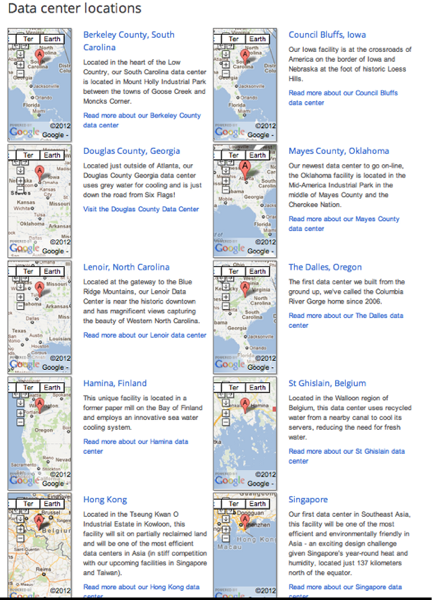
With Google's 12 data center sites you may say why not add another site in my area.  (Note the list has only 11 sites, and I included Dublin where Google has announced expansion.)

NewImage

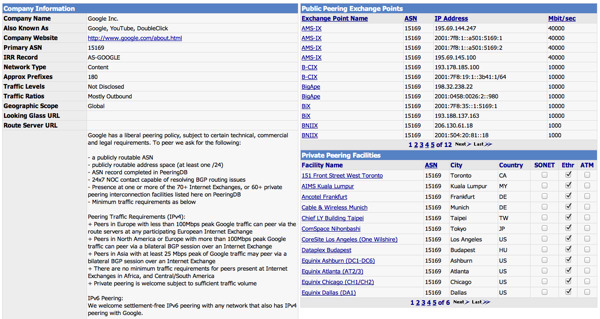
But, the one answer a site selection consultant has difficulty answering is what is the right number of data center sites and how does a new site affect your operations.  Google has 12 main data centers that are bigger than 5MW.  I would assume there are another 120 sites (10X the main data centers) to support lower latency.  Here is a list of the public and private peering sites which gives you an idea of the other Google locations.

NewImage

How a data center site interacts with this system is a question that only Google can answer.  it is useful to have consultants take fresh looks at where data center sites can be.  Given Google has 800 acres in Pryor, OK and hundreds of acres in other sites in the US, you shouldn't hold your breath for a new Google data center site in the US.

In the same way FedEx has a strategy for its site locations, Google has their own.

Why is it news that Google announces a data center expansion?  Because Google articles drive traffic.  The way the news is written it seems like many are not aware that there is a new Google data center project announced every 3-6 months.