Secret of the Innovative Thinkers, a beginner's mind

One of the best parts I like about the data center industry is the friends who are innovative thinkers.  It can difficult to identify the exact characteristics of who these people are.  One thing that I have found is pretty consistent is a beginner's mind.

The classic story of the concept of a beginner's mind is the empty cup.

Empty Your Cup


A university professor went to visit a famous Zen master. While the master quietly served tea, the professor talked about Zen. The master poured the visitor's cup to the brim, and then kept pouring. The professor watched the overflowing cup until he could no longer restrain himself. "It's overfull! No more will go in!" the professor blurted. "You are like this cup," the master replied, "How can I show you Zen unless you first empty your cup."


Another explanation of the beginner's mind is in this video.

I can think a lot of my data center friends who fit the description of a beginner's mind.

Shoshin (初心) is a concept in Zen Buddhism meaning "beginner's mind". It refers to having an attitude of openness, eagerness, and lack of preconceptions when studying a subject, even when studying at an advanced level, just as a beginner in that subject would. The term is especially used in the study of Zen Buddhism and Japanese martial arts.

The phrase is also used in the title of the book Zen Mind, Beginner's Mind by the Zen teacher Shunryu Suzuki, who says the following about the correct approach to Zen practice: In the beginner's mind there are many possibilities, in the expert's mind there are few.

Saadat A. Khan suggests that "Beginner's mind embodies the highest emotional qualities such as enthusiasm, creativity, zeal, and optimism. If the reader reflects briefly on the opposites of these qualities, it is clear to see that quality of life requires living with beginner's mind. With beginner's mind, there is boundlessness, limitlessness, an infinite wealth."

A related term, shōshin (正真), means correct truth and is used to denote a genuine signature on art works or to refer to any thing or person that is genuine.


Dell Data Centers Solutions (DCS) turn 5, congratulations on years of innovation

It is not too long ago that Data Centers were far from people's minds when it came to buying server hardware.  Now, data centers and servers are intertwined in all kinds of ways.  All the OEMs now have data center groups.  And, Dell just turned 5 with its DCS group.

Barton George posts about DCS turning 5.

Can you imagine what things will be like when DCS turns 10?

All the best ideas begin on a cocktail napkin — DCS turns 5

Rate This


A little over a week ago, Dell’s Data Center Solutions (DCS) group marked its fifth birthday.  As Timothy Prickett Morgan explains in his articlesubtitled, “Five years old, and growing like a weed”:

DCS was founded originally to chase the world’s top 20 hyperscale data center operators, and creates stripped-down, super-dense, and energy-efficient machines that can mean the different between a profit and a loss for those data center operators.

This team, which now represents a greater than $1 billion dollar business and has expanded beyond just custom systems to include standard systems built for the “next 1000,”  all started on a simple napkin.

The origin of DCS -- Ty’s Sonic sketch - November 2, 2006

Ty Schmitt explain the start and napkin

Ty Schmitt who was one of the original team and now is the executive director of Dell’s modular infrastructure team within DCS, explains:

This was sketch I made over drinks with Jimmy Pike late one night after visiting a big customer on the west coast.


Green the Data Center with your creative, innovative, passionate team

I am kind of tired of hearing another technology that green the data center.  Why?  Because no one technology can green your data center.  Being LEED certified or a low PUE is old news.

So, if you do want to green your data center what should you do?  You need to empower your team to be creative, innovative and passionate about what they can do.

Mike Manos has a post on the creating a culture of Creativiity.

Creating a culture of Creativity….

image

I came across this talk by John Cleese (of Monty Python fame) from 1991 about the process of building creativity.   I could not help but think of the applicability of building organizations that are creative.  In my opinion getting people out of the grind, the day to day blocking and tackling, into a place where they can begin to solve for things is more about the attitude and engagement of the team.  Its also one of the key cultural things I try to build in an organization.

...

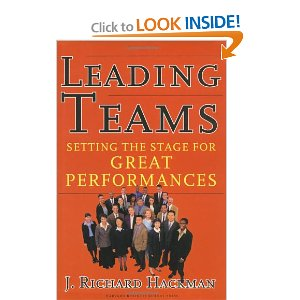
I am reading a book on "Leading Teams" which actually requires me to buy the hardback book as it is not available on the kindle.

NewImage

"Written with exceptional clarity and wit, and teeming with original, down-to-earth advice, Leading Teams is indispensable reading for anyone who works in teams, studies them, or wonders what makes them sink or soar."

-Harvey Hornstein, Professor, Teachers College, Columbia University

"This is the book I have been waiting for on team effectiveness. Based on findings and containing insights from the leading researcher on teams, Leading Teams has everything. It is engaging, highly readable, and full of practical, useful advice."

-Edward Lawler, Distinguished Professor and Director, Center for Effective Organizations, University of Southern California, Marshall School of Business

"Full of rich stories and organized into compelling cases, Leading Teams clearly communicates an elegant analysis of effective team leadership. A gem for practitioners and researchers alike."

-Chris Argyris, James B. Conant Professor Emeritus, Harvard University and Director, Monitor Group

"In Leading Teams Dr. Hackman takes his extensive knowledge of how to effectively lead teams and mixes it with insightful research and humor, providing the reader with a powerful prescription for improving team performance."

-Dave Bushy, Former Senior Vice President of Flight Operations and 747 Captain, Delta Airlines

Mike and I are having fun exchanging ideas, writing blog posts, and discussing all kinds of interesting things.  Some of the stuff we are discussing doesn't fit the typical categories. So, i decided one that is just tagged "Mike Manos"

I'll write more about the Leading Teams book when I finish it.

Open Compute Summit, May 2-3 2012, Rackspace HQ, San Antonio, TX

The next Open Compute Summit will be in San Antonio, Tx at Rackspace HQ on May 2-3, 2012.

A few friends have already reached out to see if I'll be there, and yes I will.

You can register here.

NewImage

Location

Map

Rackspace Headquarters

5000 Walzem Road
San Antonio, TX


Here is the agenda.

May 2, 2012
8:00am - 9:00am
Registration
9:00am - 12:00pm
Keynote presentations from Frank Frankovsky and others from the Open Compute Project community
12:00pm - 2:00pm
Lunch and Exhibit Floor
2:00pm - 5:00pm
Technical workshops (round 1), open sessions, and educational sessions
5:00pm - 6:00pm
Travel to party venue
6:00pm - 10:00pm
Open Compute Party

May 3, 2012
9:00am - 12:00pm
Technical workshops (round 2) and open sessions
12:00pm - 2:00pm
Lunch and Exhibit Floor
2:00pm - 3:00pm
Plenary: a synthesis of each workshop and next steps

Solving the tough problems, Develop the Passion in your Team

Mike Manos wrote a post on DevOps.

This is just lost on so many companies / organizations…

image

Having experienced nearly all of the pain and desire one could have in trying to scale out applications, operations, and infrastructure, I have become a huge proponent of blending efforts between Development with Operations.   Additionally I think the blend should include lower level stuff like facilities as well.  The entire online paradigm fundamentally changes how the problem space should be viewed.

With Concepts like NoOps, DevOps, and the like becoming fashionable in the Development community its probably no surprise that these issues are being addressed from people’s own comfort spaces.  To a development engineer – those Ops folks are crusty and cranky.   To an Operations engineer those darn developers don’t really code for long term operations.   Its always the ‘throw the code over the wall’ and the Ops folks will make it work mentality.   In reality both sides are right.

One other part I would like to add to the problem of DevOps is whether you have a team who is passionate to work on the problems.  The tough problems.

It is so easy to have really smart people who think they know the right thing.  Designing the system, picking the hardware and software, the team that will deploy it, then hand the operations over to people who inherit the smart decisions made.  DevOps changes this approach as the people who make the design decisions operate the system.  This is not the standard practice as there is typically a heirarchy where the higher people make the design decisions and the lower people operate based on the decisions. This system can work, but it can be more expensive than a DevOps model.

DevOps is getting more popular, but what I don't hear many talk about is focusing on finding the people who have a passion for DevOps.  Here is a post that discusses finding top talent, and the role of passion.

As a manager, you can leverage the link between passion and creativity by following two guidelines:

First, hire for passion as much as for talent.If you don’t look for passion in the people you hire, you could end up with employees who never engage deeply enough to dazzle you with their creative productivity. As Conant advises, get to know potential hires for important positions as thoroughly as possible, long before you might have an opening for them. When you talk to them, ask why they do what they do, what disappointments they’ve had, what their dream job would be. Look for fire in their eyes as they talk about the work itself, and a listen for a deep desire to do something that hasn’t been done before. When you talk to their references, watch for mentions of passion.

Second, nourish that passion.Unfortunately, standard management approaches often (unwittingly) end up dousing passion and killing creativity. But keeping it alive isn’t rocket science. We have found that the single most important thing you can do to fuel intrinsic motivation is to support people’s progress in the work that they are so passionate about. This isthe progress principle, and it applies even to the seemingly minor small winsthat can lead to great breakthroughs. You can use the progress principle by understanding what progress and setbacks your people are experiencing day by day, getting at the root causes, and doing whatever you can to remove the inhibitors and enhance the catalysts to progress.

Two of my good friends I talk to almost every day have a passion for DevOps, and I regularly look for people who have a passion for Operations.

I knew looking at Mike Manos's post on the DevOps there is a missing part.  Passion.  Actually, for any of you know Mike there is no lack of passion in Mike.  He just didn't happen to write about it in this post.

Here is a post where Mike discussions Passion in relation to our dear departed friend Olivier Sanche.

As we sat in a room full of  ‘experts’  to discuss the future of our industry, the conversation quickly turned controversial.  Passions were raised and I found myself standing side by side with this enigmatic French giant on numerous topics.  His passion for the space coupled with his cool logic were items that endeared me greatly to the man.  We were comrades in ideas, and soon became fast friends.

Olivier was the type of person who could light up a room with his mere presence.   It was as if he embraced the entire room in one giant hug even if they were strangers.  He could sit quietly mulling a topic, pensively going through his calculations and explode into the conversation and rigorously debate everyone.  That passion never belied his ability to learn, to adapt, to incorporate new thinking into his persona either.  Through the years we knew each other I saw him forge his ideas through debate, always evolving.

Hope this gets you thinking of how some of the best people have passion for their jobs.