Do You Want to Help Build the Next AWS Service?By Werner Vogels on 19 April 2012 02:00 AM | Permalink | Comments (0)
Over the past several years I’ve spent much of my time traveling around the world speaking about distributed systems. From building infinitely scalable data stores, architectures for high performance computing, to the challenges imposed by the CAP theorem, there are wonderful, complex, fascinating problems to be solved in the area of distributed computing. During my travels I’ve met thousands of brilliant engineers who are leveraging the cloud to deliver exciting new products and revolutionize IT as we know it. One thing that’s become obvious to me is that there are innovative, inspiring developers in every corner of the planet from Australia to Iceland and from Israel to Peru.
The specific jobs posts are here.
And that leads me to another distributed problem – finding good engineers to help AWS build the next generation of cloud computing services. We’ve got a big vision and to realize it we need to find qualified engineers to join us on our journey. A quick look at the AWS career web sites reveals that we are hiring hundreds of people around the world.
I often get asked the question of what Facebook will do with the ginormous amount of money it will raise as part of its forthcoming initial public offering that will value the company in excess of $100 billion? I don’t know how they will put all of it to use, but a nice piece of it will go towards maintaining and building out is backend infrastructure. The company on Thursday announced that its second data center in Forest City, N.C., is now serving live user traffic.
I think Gigaom's repeated questions on data centers is what got them to recruit me as an analyst for GigaOm Pro.
Watching the data center industry is sometimes like a Kobayashi Maru scenario, a no-win scenario. So much of what goes on is the same as what was done last year, the year before that, and the year before that. The rules are written to keep things relatively the same with small changes allowing the established players to keep on winning. Name a start-up like Instagram in the data center industry.
One of the most disruptive forces in the industry is Amazon Web Services, but so far it has mostly allowed the established players to modify their offerings to include private clouds. Companies like Zynga start in AWS, and move to wholesale space when they are ready to reduce costs which supports the normal growth of the data center industry.
James T. Kirk beat the no-win scenario by redefining the game.
James T. Kirk took the test three times while at Starfleet Academy. Prior to his third attempt, Kirk surreptitiously reprogrammed the simulator so that it was possible to rescue the freighter. This fact finally comes out in Star Trek II: The Wrath of Khan, as Kirk, Saavik and others appear marooned, near death. Saavik's response is, "Then you never faced that situation...faced death." Kirk replies, "I don't believe in the no-win scenario." Despite having cheated, Kirk had been awarded a commendation for "original thinking."
Which brings me to part of the conversation with Compass Data Center's Chris Crosby. Chris commented.
Professionally, I’m already enjoying the freedom of thinking clearly about building a brand again. I get to figure out my own personalized approach based upon all of my experiences and the input of incredibly bright friends and colleagues. It’s freeing and fun. It’s almost like a disease when you want to have everincreasing responsibilities.
...
I had a whole summer off where I fielded a lot of phone calls and gained a lot of perspective. It was healthy for me. I got disassociated from the personalities of the business and now have a clear refreshed perspective on the business potential.
One way to describe what Chris is trying to do and where we connect on ideas is there are a lot of things that occur that don't make sense. It is like the scene in Moneyball where the scout makes a comment about a players girlfriend.
"Ugly girlfriend means bad eyesight," warned the scout.
Says Pitt, "We put a version of that line in the script, 'Ugly girlfriend means no confidence.' But what he really said was 'bad eyesight.'"
What is needed is a different way to play the game. Play the game to win with much less money.
Slate has an article that goes into a lot more detail of Michael Lewis and Billy Beane.
But “Moneyball” is also a phenomenon, which after changing baseball is now sweeping almost all ballgames, from British soccer to Australian rules football. And it’s a phenomenon that reaches beyond sport. With hindsight, what Lewis captures in his book—the triumph of the highly educated over the lesser educated—is exactly what happened in the American economy.
Changing. Being innovative is hard. And just as the established scouts protested...
Innovation hurts. After Beane began using numbers to find players, the A’s’ scouts lost their lifelong purpose. In the movie, one of them protests to Pitt: “You are discarding what scouts have done for 150 years.” That was exactly right. Similar fates had been befalling all sorts of lesser-educated American men for years, though the process is more noticeable now than it was in 2003 when Moneyball first appeared. The book, Lewis agrees, is partly “about the intellectualisation of a previously not intellectual job. This has happened in other spheres of American life. I think the reason I saw the story so quickly is, this is exactly what happened on Wall Street while I was there. You had the equivalent of the old school…”
The executives were even more shocked.
But the former ballplayers who then ran baseball were even more aghast. The notion that numbers could trump gut outraged them. Unfortunately for them, a year after the book appeared, the Boston Red Sox, with the 30-year-old Yale graduate Theo Epstein as general manager, won the world series of 2004 using Moneyball methods. In 2007 the Red Sox won again. Other teams began hiring Epsteins and Beanes rather than clubbable ex-players. Last season only three of 30 GMs in the major leagues had played professional baseball, none of them very successfully. Beane has ended up restricting job opportunities in baseball for people from backgrounds like Beane’s.
So, what is the secret that Chris Crosby is working on, looking at the numbers. He'll be writing about it on his own blog posts, then we'll discuss it publicly. But, I don't plan on writing a book on the story and turning it into a movie. :-) It is much more fun thinking of ways to help Chris in his vision.
However, the people who make this objection don’t seem to grasp the basic principles of imitation and catch-up. Once all teams are playing Moneyball, then playing Moneyball no longer gives you an edge. Indeed, the richer clubs have the means to play it smarter. The New York Yankees recently hired 21 statisticians, Beane marvels.
There are some interesting people working on the Compass Data Center system. People who don't like to the no-win situation in data centers, and get it how MoneyBall ideas can change the game.
For the past couple of weeks I have received numerous e-mails on Earth Day products, events, etc.
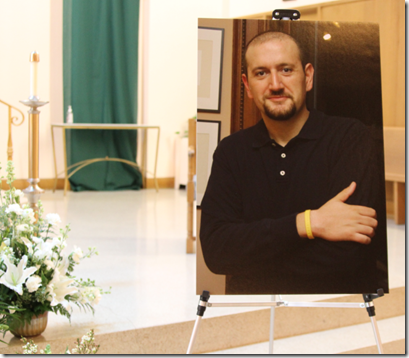
But when I get up in the morning and think of Earth Day and the data center industry the first that comes to mind is my dear departed friend Olivier Sanche.
One of the best memories and experiences in my life is to have spent so much time with Olivier, hanging out at the construction site, hanging out at data center events, sitting in data center meetings, his going away party at eBay, eating meals, meeting his family especially his daughter Emilie, and discussing the way things should be. Olivier had a passion that gave him the vision to do things few thought were important.
Here is Olivier at SLC at the eBay data center site.
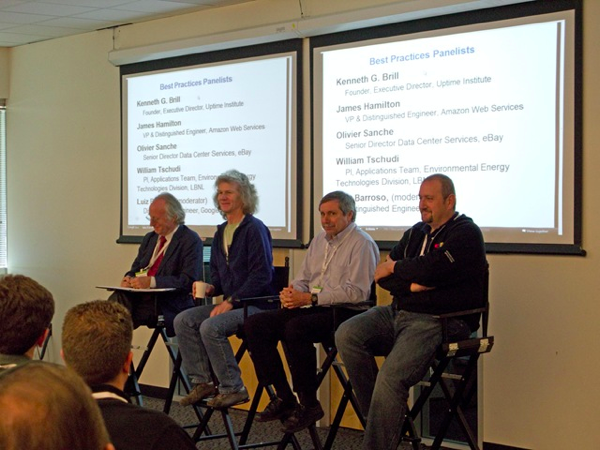
Olivier speaking at Google's 1st data center energy efficiency summit.
When Olivier was on this panel he said the following.
Olivier Sanche starts by telling the story of his child telling him how the polar bears are drowning, then he thinks he is potentially building a data center that will have a bigger impact to global warming than any other action he has as an individual. Olivier tells his team we need to do the right thing, and how we impact the environment is part of the equation.
This last part is why when I think of Earth Day and Data Centers I think of my dear friend Olivier Sanche.
There are others who I also think of who have the same passion of Olivier, and thankfully they are still with us, trying to figure out how to green the data center.
I think today is a good day to think good thoughts and what Olivier would do.
Chris Crosby and I have been keeping in touch over the last 6 months as he comes out of stealth mode. We talked briefly on Tuesday, the company press release went live yesterday, but I was on the road all day yesterday with flights and meetings. Today, I was able to catch up and discuss Compass Data Centers. We had an hour and talked about so many different things, I can't write about all the ideas in one post, and I know we are going to be talking a lot more.
So, let's just create a category for Compass Data Centers.
Compass Datacenters Enters Data Center Market Offering New Direction For The Industry
For Immediate Release
Founded by Former Digital Realty Senior Executive Chris Crosby, Innovative Data Center Provider Poised to Dramatically Expand the Scope of Industry
Dallas – April 18, 2012 – Compass Datacenters, a new data center provider formed by Chris Crosby, the industry visionary who helped build Digital Realty, today unveiled its business strategy which makes dedicated modular data centers a reality for the 98 percent of the market not served by current wholesale data center providers.
DatacenterKnowledge discusses Compass bringing the wholesale market to new markets.
Compass, a new company based in Dallas, is planning to bring turn-key data centers to second-tier markets where demand is growing, but hasn’t yet reached the scale of historic data center strongholds like Silicon Valley or northern Virginia. The company says it is optimizing its data center design to fit the demand profile of smaller markets, while deploying its development capital in an efficient manner.
DatacenterDynamics discusses Compass going after underserved market.
“The bulk of current investment in the U.S. is concentrated in only six markets with data center products that meet the needs of a very narrow set of customers,” Crosby, now CEO of Compass, said.
”That approach ignores 98 percent of the potential overall market, which means there is a huge untapped market for an innovative company that can pioneer a solution aimed at that large segment of underserved customers.”
But, some of the best reasons why I enjoy chatting with Chris is captured in Andrew Lane's post on Mission Critical.
AJL: Chris, given your professional success to date, what’s left on your bucket list?
CC: Professionally, I’m already enjoying the freedom of thinking clearly about building a brand again. I get to figure out my own personalized approach based upon all of my experiences and the input of incredibly bright friends and colleagues. It’s freeing and fun. It’s almost like a disease when you want to have everincreasing responsibilities.
Personally, things have been great with this last summer off. I’ve had time to reflect on the fact I’ve had one blessing after the next in this life. I’ve gotten to see a lot of more of my wife and two kids. I’ve been coaching my kids’ sports teams. I’ve had date nights with my wife. Generally, it has been a much better balance for me, which is what I focused on accomplishing near term.
...
AJL: Our very own “Data Center Genie” (picture Bill Mazzetti?) Arrives in a puff out of a generator and grants you three wishes for the data center industry. What do you wish?
CC: One, humility. We need to realize that our industry behaves like a child in its early teens. You know the times that you think you know everything but you really don’t? Don’t get me wrong; this is obviously a great industry to be in, but think about how many new ideas that have already been done in other industries are being re-created here. We tout all these “new technologies” like we created them and own them. Modularity. Airside economizers is free cold air. Hot- and cold-aisle separation has been done in fab space for years.
Two, recognition. This is an industry that is going to require a different breed of athlete with different skill sets, such as process engineering. We need to promote its growth and success early to professionals as a career in order to keep growing at the rate we can.
Three, transparency. We need to start opening up to customers and facilitating allegiances and alliances. We need to help educate each other.
...
AJL: What do you see going on that you like?
CC: Everything about the space. Lots of capital in love with the fact that it is a high-cash flow, asset-based business. It is becoming mainstream. There is a tremendous energy and vibrancy to it, and it’s great to be a part of it and know why it’s going on. There aren’t too many careers where you get to be a part of something that is completely new.
Here I am getting a chance to go around again. I had a whole summer off where I fielded a lot of phone calls and gained a lot of perspective. It was healthy for me. I got disassociated from the personalities of the business and now have a clear refreshed perspective on the business potential. The result of this will be Compass Data Centers, essentially bringing rapidly deployable, highly customizable wholesale solutions to emerging markets. One thing I have learned is that I’m much more valuable and much happier at the growth stage. I’m not so good nor do I want to be managing the $1B to $3B in revenues stage.
One of the things few people discuss are really big crazy ideas. It can be too hard for some people to think out of the box. It is so easy to talk about big ideas with Chris is he has a Computer Science degree. I spent 26 years surrounded with computer science type of people at HP, Apple, and Microsoft. Being a good engineer, it has been great being immersed in the data center industry. But, some of the concepts are easier to discuss if you spend time developing code.
There will be many more posts coming on Compass Data Centers. Chris has figured out many of the same things I have, and now that he is going to execute them, blog them, we can start discussing them.