Demonstration of what could be done with information sharing, a path to lower costs and less waste

Data Centers almost never share information on its operations.  This is what hospitals used to be like.  But, more and more hospitals are sharing information so they gain insight into best practices.

Seattletimes has an AP article that discusses a discovery on better procedures for knee surgery.

The hospital is part of a national collaborative that's analyzing a range of high-volume, high-cost medical procedures and conditions to see which approaches result in the best outcomes and the lowest costs. Its findings on knee replacements were published last week, but several of the health systems already have made changes based on the results.

For example, Dartmouth-Hitchcock is considering having a dedicated team of anesthesiologists, nurses and technicians assigned to knee replacements after seeing that another hospital with such a team had the shortest average operating time, which is associated with fewer complications.

Wouldn't it be great if data centers could share its procedures and results.  Why is it so secret to discuss maintenance operations on power and cooling equipment?

Modular Data Center is not a guarantee of less cost, time, waste

Some Modular Data Center vendors would lead you to believe that a modular design is a guarantee to lower cost, less time to build, and reduces waste.

Modular uses Prefab construction ideas.  An article written by Postgreen Home's President Chad Ludeman provides some details on what is possible in home construction using Prefab.  The perspective given is prefab used in a modern home.  

Some nuggets that will get you thinking.

Prefab manufacturers and resellers will tell you that prefab is cheaper because of the time and labor savings, but let’s list the key factors that actually make prefab more expensive than site built:

  • Manufacturing Facility Overhead – Prefab manufacturers work in buildings with support staff above and beyond those actually building the houses. They also have facility costs such as equipment, utilities and maintenance … Site built homes, built by most residential builders, don’t have any of these.
  • Manufacturing Company Profit – These manufacturers are making at least as much profit as the average general contractor and often more.  The majority of cost savings resulting from the prefab manufacturing process stays in the pockets of the manufacturer.
  • Delivery, Setting, and Crane Fees - These can easily run $10K per house (cranes aren’t cheap) and can be significantly more if the distance from manufacturer to site is large.  Most manufacturers also dictate who the labor crew will be, and often they won’t be the best value available.
  • Architect or Reseller Fees – In some cases the fees charged by the architect providing the prefab can run as high as $30,000 or more.  Even in cases where no additional site customization or design work is needed, a substantial fee will still be added by the architect or reseller.
...
Less Waste. Since prefab is built in a factory they claim to create much less waste by setting aside their scrap and reusing it in other projects.  What they do not often advertise is that their structures use 20% – 30% more raw materials than stick-built homes in order to withstand transportation.  That’s no small figure in my book, especially considering that even if there is waste on-site with stick-built homes you can now easily hire a waste removal company that will recycle 90%+ of your construction waste.
...
I recently walked through a delivered prefab with the owner and he offered me pallets of free OSB because he had so much extra and had no idea what he was going to do with it.  I’m sure every prefab company is not this sloppy, but it is another indication of waste in an industry claiming extreme efficiency.
I have some friends who are not believers in containers and they say they can stick build a data center cheaper than containers.  How?  They have ideas like this.
Quality Stock Plans
The first place to start when trying to streamline and cut costs from any building project is with high-quality building plans from qualified architects.  If every detail down to the last sheet of drywall and bucket of paint is nailed down and proven out in each set of plans, it becomes much easier for a GC to provide the best price from his crew and any subcontractors that are hired for the job.  This can not be undervalued, since any uncertainty on the part of those bidding on the project will instantly up the quotes.  This is where prefab gets most of the efficiency gains in their process, by building exactly the same home over and over.  They know exactly how much material and how much labor goes into each home plan in their library of options.

 If you don't agree with this author you can rebuttals here.

To Conclude . . . Finally

There are many amazing things being done in prefab, and if it weren’t for my self-imposed ban on mentioning specific companies and architects, I could name a bunch that I personally admire.  However, there are also a large number of misconceptions about the benefits of prefab that need to be discussed, and this post is simply trying to get that discussion started.  Are there points of dispute here?  Certainly. Am I perfectly correct in everything I have said?  Probably not. So, go to the comments and tell me what you think.

Editor Update 9/18/08: Tedd Benson of Bensonwood Homes has a lengthy, articulate response to this article, and Lloyd Alter of Treehugger mentioned a few points to consider as well.  Allyson Wendt of Building Green also added her thoughts on the future possibilities of affordable, green prefab.

One of the posts by Tedd Benson gives you more to think about.

On the other hand, I do understand why costs might be higher. One of the big reasons is that the contractors hired to put the package together often have no motivation to be efficient, and furthermore, have a very convenient excuse if things take longer and cost more: it’s not their fault; they are the solution, the prefab package is the problem. In addition, the subcontractors who bid on the portions of work not accomplished with the prefabrication tend to charge 15-25% more for the same reason. It’s very often not whether the work will be more or less difficult, but just the fact that it’s different. It’s the out-of-my-comfort-zone tax, and it’s one of the hidden costs of any alternative form of construction. Too often, there’s simply an up-charge for having to think.

This last point wakes you up to what a tract home is like.  Actually, there are some data centers that have been built like tract homes too.

My biggest problem with site construction is that it often results in “devalue” engineering. Frequently, the people on the site think they know more than engineers and they reduce the framing schedule, reduce the fastening patterns, don’t install all the clips and tie-downs and otherwise save themselves effort and time by reducing the structural quality of the building. My start in the building industry was with tract home construction in suburban developments. Before I knew anything, the shortcuts and the flimsy buildings were appalling to me. We sometimes forget that the standard of building in America isn’t the custom homes built by the good builders, or the good prefabrication efforts by responsible companies. That vast majority of homes are tract homes built by low-skilled, unqualified labor.


 

Apple Data Centers = Green more and more

ZDNet covers Apple's disclosing more details of its Green Data Center.

Apple discloses more details on green data center plan

By  | May 21, 2012, 9:58am PDT

The reporter makes the observation others have that Apple has been working on its green data center plans longer than Greenpeace has been putting pressure on Apple.

An aggressive public relations campaign by Greenpeace may have forced Apple to disclose this earlier than originally planned, but it is clear that this initiative has been in the works for some time. Seriously, there is so much involved in planning this sort of thing, that is definitely was not in reaction to Greenpeace.

The article continues to cover the steps that Apple is taking to be greener than others.

As the author covers the dynamics between greenpeace and Apple, the author mentions the efforts Apple is taking to disclose its energy use to the North Carolina Renewable Energy Tracking System.

Oh by the way if you haven't heard Apple's Maiden Data Center is LEED Platinum.

The facility has earned the coveted LEED Platinum certification from the U.S. Green Building Council. We know of no other data center of comparable size that has achieved this level of LEED certification.


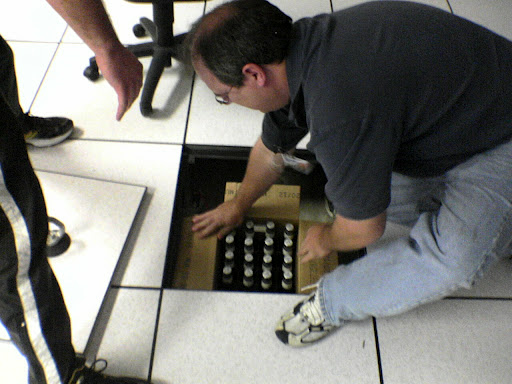
Beer in the data center, it can't be. Drinking on the job documented

No liquids is a rule for data centers in many areas.  And, what few are aware of how many times beer is in the data center.

KomoNews reports on construction workers caught drinking beer during the job.

Hidden camera investigation catches 520 bridge workers drinking on the job

Part of KomoNews shows is the fridge where the beer is.

NewImage

 Don't look for the beer in the fridge in the data center.  The Beer is in the raised floor.

NewImage

As temperatures are raised in data centers we may see less beer under the floor, but given the number of data centers users that still want 68 degree inlet temperatures there will be many data centers that are good chillers.


Coal is decreasing in the energy mix because of economics

Jon Koomey write a great post making the observation that Coal's use is decreasing not due to EPA regulations, but due to economics.

I want to focus on #4 (and on a terrific paper by Susan Tierney on that topic), because it gives interesting insight into the factors that cause utilities to retire power plants.  

The first thing to understand (as I pointed out in Cold Cash, Cool Climate) is

About 15% of existing US coal plants (about 50 GW out of 300 GW total) are old, inefficient, polluting plants that were grandfathered under the Clean Air Act, so they have few or no pollution controls.[1] More than half of US coal plants are 35 years of age or older.[2] The total social cost of running many of these plants is higher than the cost of alternative ways of supplying that electricity (even without counting the damages from greenhouse gas emissions),[3] so they represent an obsolete capital stock from society’s perspective.

These older plants are comparatively inefficient, even though they have few or no pollution controls, so it’s not surprising that they are the ones being retired in the face of the economic forces outlined by Tierney.  That report points to increasing coal prices, decreasing natural gas prices, and declining electricity demand as the main factors thus far in encouraging the retirement of existing coal plants.

The coal economics is an issue in Australia as well reports the WSJ.


Companies are shutting Australian coal mines and questioning whether they should continue with billions of dollars of investments—squeezed between falling prices and rising costs.

Australian coal has been the country's most valuable export for decades. But rising wages and the strong Australian dollar have helped make coal twice as expensive to produce as it was in 2006, according to consulting firm Wood Mackenzie. Higher taxes soon will add to that burden.

The use of coal is declining due to its cost.  And the environment benefits.

Part of what is increasing the cost of coal is labor and taxes.

Emboldened by a shortage of skilled workers, Australian miners have fought successfully for better work conditions and higher wages, driving up labor costs. Exports from BHP Billiton's coal mines in Queensland have been disrupted by rolling strikes. Australia's government estimates that the country's miners earned A$2,207 (US$2,172) a week on average last year. That compares with 1,737 Canadian dollars (US$1,699) for Canadian resource workers, according to an official estimate in that country.

And Australian costs will rise further starting in July, when taxes aimed at cutting pollution and bolstering government coffers go into effect. Canberra's latest budget forecast that revenue from resources will jump to A$7.2 billion in fiscal 2013 from A$1.5 billion this year. Income from the new Mineral Resources Rent Tax was projected to bring in another A$3 billion in fiscal 2014.