Netflix open sources its HW and SW CDN Solution

Open Compute has started the open sourcing of servers and data centers.  Storage is another big area, and Netflix has shared its design.

The home page is here.

Netflix Open Connect Content Delivery Network

Around the world, people are enjoying nearly a billion hours per month of movies and TV shows from Netflix. Now, Netflix is enabling ISPs to get Netflix video data directly from Open Connect, a single-purpose content delivery network we've established.

Most of you want to see the HW.

Objectives

When designing the Open Connect Appliance Hardware, we focused on these fundamental design goals:

  • Very high storage density without sacrificing space and power efficiency. Our target was fitting 100 terabytes into a 4u chassis that is less than 2' deep.
  • High throughput: 10 Gbps throughput via an optical network connection.
  • Very low field maintenance: the appliance must tolerate a variety of hardware failures including hard drives, network optics, and power supply units.
  • Simple racking and installation. Front mounted power and network ports are the only things to connect at install time.
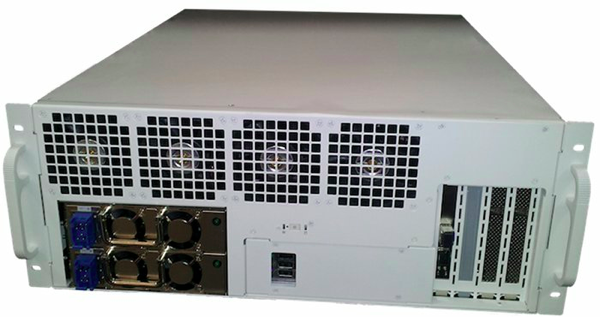
  • NewImage

 Here is the BOM for the HW.


Bill of Materials


DescriptionVendor & ModelQuantity
Chassis TST custom 1
Motherboard Supermicro X9SCM-F 1
Processor Intel E3-1260L 1
Memory 8GB ECC 1333MHz 4
Hard Drive Hitachi Deskstar 5K3000 3TB 36
Hard Drive (alternate) Seagate Barracuda 7200.14 3TB 36
Controller LSI SAS 9201-16i 16 port 2
Network card Supermicro AOC-STGN-i2S 1
Redundant Power Supply Unit (AC/DC options) Zippy MRW-5600V4V/DMRW-5600V4V 1
Misc. 2U active CPU Heatsink, SATA Cables, NIC optics

Then design has AC and DC power supplies.
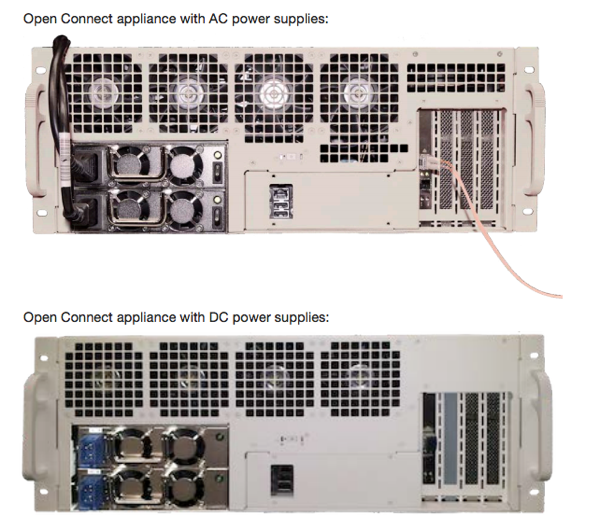
NewImage

There is 1 TB of flash.

We also add 1 TB of flash storage (2 solid state drives) for system files, logs and popular content.

You can get more details on the site.

Open Connect

Change Your LinkedIn Password, 6.5 million leaked, 576 news articles

I've changed my LinkedIn password.  Have you?

There are 576 news articles on the leak.

6.5 million LinkedIn passwords reportedly leaked online


CNET - 6 hours ago
A hacker says he's posted 6.5 million LinkedIn passwords on the Web -- hot on the heels of security researchers' warnings about privacy issues ...
Highly Cited: Millions of LinkedIn passwords reportedly leaked - take action NOW‎ Ars Technica
Blog: 6.5M LinkedIn Passwords Posted Online After Apparent Hack‎ PCWorld (blog)
LinkedIn investigating reports of stolen passwords‎ The Associated Press
All Things Digital Computerworld (blog) 
all 576 news articles »

I received this e-mail through LinkedIn which was suspicious.

LinkedIn

xxxxxx has sent you a message.

Date: 6/04/2012

Subject: How are you?

Dave,

It is good see that you are in a new adventure and I am sure you will do well. Can you say what you are doing? I hope they know they have a quality person like you! All the best to you and your family.

Understanding Data Center Types - Cloud, Hosted, Colocation, Wholesale, Owned

I was having a conversation with a client and it occured that most company executives probably don't understand the different data center types that exist.  It seemed worthwhile to describe the different data center types that exist and how executives should understand the differences.  They hear terms like cloud, hosted, colo, and wholesale all the time, but what does this mean?

Besides doing a few searches, I reached out to Jones Lang Lasalle's Michael Siteman to see what he had on data center types. It was quite thorough.  I needed something simpler.  Something a non-data center executive could understand in one ppt slide.  

I am sure this seems obvious to most of you, but trying to get this into one slide was a good exercise.

Here is my current thinking a slide.

NewImage

The text is here.

•Cloud (VM) – bring your code and data - OS, Server, Network, Storage available for lease; on-site operations and IT services all done by cloud provider

•Hosted (Servers) – Physical servers are unit of delivery within IT environment design – HW for lease

–Similar to an internal IT service group for small scale

–Cloud Hybrids are more common

•Colocation (Racks) – bring your IT equipment, pick your ISP, provide power, space, facility operations

–Lease space and power capacity – for example 10 racks @ 10KW/rack

•Wholesale (MW of capacity) – you rent space, power, cooling and an open floor plan; you decide the layout of your space – power, cooling, network

–Need facility operations as well as IT Operations for your space

–Lease 10,000 sq ft @ 1MW

•Owned DC (everything) – you have everything under your control

–Big things gained vs. the previous steps you pick the site, you pick the design best meets your business needs, and the whole facility is yours

–Problem: if you haven’t built a lot of DC, then you will make mistakes

–2MW plus, the big big guys Google, Facebook, Amazon and Microsoft are building 10 – 30MW

 
I think this works pretty well.  Technical enough with details like power consumption, yet high level to convey the differences.

Microsoft joins SSD movement with an Azure cloud solution

GigaOm's Barb Darrow reports on a new SSD powered Windows Azure service.

New Windows Azure goes all-SSD to one-up Amazon in the cloud

Just when you thought the cloud computing wars couldn’t get more interesting, they do. On Wednesday, Microsoft hopes to prove Windows Azure a worthy adversary to Amazon with new solid-state storage cloud, dramatically revamped REST API, and a console to meld management of on-premises and Azure-based applications on one screen.

Two years ago I predicted SSD in AWS by summer of 2010. I was a bit ahead of the times.  It took longer than expected with AWS launching DynamoDB.  With Microsoft joining the SSD wave.  You can look for more SSD options in the cloud market.

Microsoft partners with Quanta for an integrated server, storage, network cloud solution

Microsoft has a press release for ODM Quanta delivering a cloud solution.

As customers seek more immersive experiences across a range of devices, cloud computing becomes increasingly important. To address this need along with the changing economics of IT, Microsoft has worked with hardware partners to develop the Microsoft Private Cloud Fast Track program. Together with Microsoft, Quanta unveiled their next generation Fast Track hardware that includes integrated server, storage and networking equipment. This solution dramatically accelerates a business’ time to value, while decreasing cost, complexity and risk. With Quanta and so many other device manufacturers in Taiwan, it’s a center of gravity for hardware and device innovation. Microsoft discussed some of the latest design innovations including touch, sensors, glass, hinges and memory that have a huge impact on PC computing experiences.