One of the reasons why a Green Data Center initiative recruits talent, a better night sleep

One of the funniest conversations I would have with the Olivier Sanche is how many people would reference reading my blog post on Olivier wanting to build greener data centers.

Good Luck, Olivier.  I am placing my bets Apple will change the data center industry the way they changed cell phones and media players with the iPhone and iPod.  It is not just the environmental issues, there are huge opportunities to leverage the data center servers with client devices - iPod, iPhone, and Macs.  Photos, Music, and Video and the associated media industry is Apple's strength.  Google focuses on Search.  Microsoft focuses on Windows, Office, and competing against Google.  Apple focuses on consumers.

Who do you think is going to change the data center industry the most Google, Microsoft, or Apple?

Or maybe what individuals will change the data center industry?  Keep your eye on Olivier.

Since I wrote this post about Olivier all three of these companies (Google, Microsoft, Apple) have announced green data center initiatives.

Fast Company has an interview with Srikumar S. Rao.  The following table summarizes well what Srikumar presents.

But I was surprised because the core principles of the Happiness at Work philosophy run counter to the standard profile of the typical top MBA student I’ve encountered both while at school and after (although, there are exceptions for sure).  For example here’s a quick side-by-side comparison to illustrate my point:

Happiness at Work Philosophy

Standard MBA Profile

It’s about the process, not the outcome.  Focus on the action you can take.   Outcome is all that matters—good grade, high profile job, big paycheck.
Paradox—by insisting on your way, you decrease the chance of getting what you want.  Risk and aggressiveness are rewarded.
You are playing a role, but you are not the role. My job, my prestigious MBA, my wealth define me.
It’s not about the money (in fact, if it is, you are in trouble).  It’s about the why and what you are doing.  It’s all about the money, even if I don’t love what I am doing.
The models you operate within are not reality. Prestigious MBA, well-paying job, comfortable life is reality.  And I am angry when it’s challenged. 

The Q&A that follows explains the paradox of this table.

My question is why do you think the MBA students who took your class, many of whom fall within some range of that standard profile, resonated so intensely to what you were teaching?  

SR: Before taking the class, they’d never heard anyone encourage them to get a deep sense of meaning from what they wanted to do professionally.  Many of the students have had the same background.  Some have already worked for McKinsey or Goldman Sachs, the brass ring of what many go to business school to achieve, and hated it because they were treated badly.  They face the sharp dichotomy between what they think the want and what they’d really like to do.

The class gave students the courage to consider doing something different. To question their basic assumptions—what do I want to pursue beyond a paycheck?  The course legitimized those questions and provided the support of a group that was doing the same thing. 

(Srikumar S. Rao’s TED Talk (video)—”Plug into your hard-wired happiness”)

More and more the talented people are looking to work differently than it is all about the money and power.

Thanks to others discussing the green data center topic there are more and more people who have pride in lowering the carbon impact of their data centers, making in greener.

How many of you feel good about saying I saved $10 million in operating expense vs. I reduced the carbon impact of the data center by 15%?  What makes you sleep better at night and wake-up energized?

What happens when your stock doesn't perform? Zynga an as example

Yahoo has had a steady exodus of talent for years.  Why? Part of the reason is the stock performance.

There is a post by a Zynga engineer on why work for Zynga?

Work For Zynga?

Kostadis Roussos, Zynga Chief Engineer

Why I joined Zynga is interesting, because in many ways it explains why I am still at Zynga.

My last employer was NetApp. NetApp is a leader in the enterprise storage space (in many ways they are the #2 or #1 player in the storage market). Not only are they are a leader in storage, they are a great company to work for. The year I left NetApp, NetApp had been named the Forbes #1 place to work. They were and are an extremely well run company, strongly positioned in the market. I loved my team, the place, and the work.

So why leave?


The SJ Mercury news has a post on employees fuming about the declining stock price.  Part of what is fueling the anger is what insiders were able to take advantage of.

Pincus and other executives sold 43 million shares, at $12 each, in the April deal. Limited to senior management and directors, it was explained as an effort to stagger the timing of when stockholders may cash out, preventing a simultaneous sell-off at the expiration of the lock-up.

Vs. the rest of the employees were able to exercise at the end of April.

The Farmville publisher is now barely holding at $6, down 40 percent from a December IPO price of $10, as employees at the end of April were freed from their "lock-up" agreements to sell their stock holdings. Employees past and present told Reuters that morale is ebbing along with the stock price.


Singapore Data Center Market grows

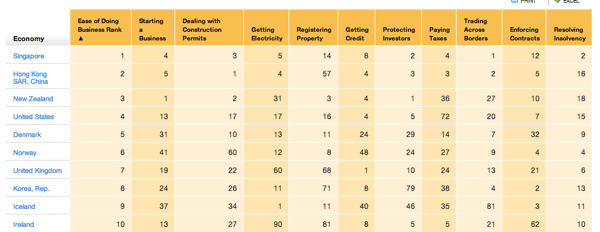
If you look at where to locate data centers a report to consider is the ease of doing business WW.  Here are the top 10.

NewImage

CFOWorld has an article on the Singapore Data Center market.

A million square foot of data centre space

By Zafar Anjum
Share

Is Singapore fast becoming a data centre hub in the region? It seems to be so. Reason: data centres are mushrooming in the city state.

This is happening due to an uptick in the demand for services such as cloud computing and increased consumption of content over the Internet.

For example, in April this year, two brand new data centres started operations in Singapore. One is by Telco operator NTT which unveiled a data centre located at the North Serangoon suburb in Singapore. Built to Tier 3 specifications, the data centre building stands at five floors high and offers 5,000 sq m of rack space, with some 2,500 racks.

Singapore is becoming a data center hub.  Amazon is there,  Google, and many others.

Why Singapore?

"Singapore as a geography is a preferred geography for many multinationals," says Srinivasan CR, vice president, Data Center and Infrastructure Managed Services, Product Management, Global Data and Managed Services, Tata Communications. "Thereby, Singapore market is a fairly international market rather than a local market. I think there is demand for space because of the kind of offering Singapore as a country has to make to international companies. It is a very politically stable country-it has all the infrastructure that is needed for a stable data centre."

Why Dell made a smart move with its ARM Servers, providing a Hosting Service

I've been blogging about ARM in servers for quite a while and have had many conversations with people who think there is a market for little green servers.

Dell announced its ARM Server last week.  The one part that I kept on focusing on is the way Dell is delivering, well not delivering the ARM Servers.

Enabling other customers and developers by providing remote-accessible Copper ARM server clusters deployed in Dell Solution Centers, and through our deep partnership with the Texas Advanced Computing Center (TACC). These clusters will be in place by the end of the year.

Not only does this provide a low cost way to increase the availability of Dell ARM servers, it provides data to Dell on what customers are doing.

A handful of people are getting ARM servers, and I am sure we won't hear anything from these uses for quite a while.  But, it is a safe bet there is an overlap with the Seamicro customer base.

  • Shipping the new Dell “Copper” ARM server through a seed unit program to a select list of customers worldwide. There is no general availability at this time.
  • Delivering Copper seed units to key ecosystem partners to support their development activities.

Here is a video to watch on the server.

The Dell ARM web site is here for more info.

Dell drives innovation for the ARM server ecosystem

Enterprises that run large web, cloud and big data environments are constantly seeking new technology to gain competitive advantage and reduce operations cost. This focus is motivating a dramatic interest in ARM-based server technologies as a way to meet these requirements.

What is ARM?

An advanced RISC machine (ARM) server employs small, low-power ARM processors, typically deployed as systems on a chip (SoC) to reduce space, power consumption and cost. ARM processors are present in billions of client devices, but they have not been previously adopted for use in servers, due to the feature set, performance and limited software ecosystem. 

Moving ARM to the forefront

Now that the processors have grown in capability, and the basic open source software is available, both customers and developers are anxious to test ARM servers to confirm the potential benefits within real-world environments. In response to customer demand, Dell has decided to enable the Dell “Copper” ARM-based server ecosystems, by:

  • Shipping Dell "Copper" ARM servers to a select list of customers and partners, as part of a worldwide seed program. Systems have already begun shipping, but there is no general availability of the Dell "Copper" servers at this time.
  • Enabling developers worldwide through remote-accessible Dell "Copper" ARM server clusters, in Dell Solution Centers and through our close partnership with the Texas Advanced Computing Center (TACC – UT).
  • Delivering Dell ARM-supported solutions to the open source community, such as Crowbar on ARM and Crowbar for Hadoopon ARM.
   

Project Copper chassis and sled

  Dell "Copper" ARM server chassis and sleds
   

Project Copper server sled


Dell "Copper" ARM server sled