Modular Rally Car Design is behind Ken Block's Viral Video

In the data center industry, we all hear about modular data centers.  Some designs are more flexible than others.  Ken Block's Gymkhana 5 video has reached over 3.7 million Youtube views in less than 2 days.  The car behind the video is a modular design.  You can watch this video to see the three different configurations that have suspension, engine, tire, and cooling system changes.

For the mechanical engineers here are some details.

"Many people may not realize this, but despite the fundamental similarities between stage rally, rallycross and gymkhana, in order to be the best at each, you must have specific built vehicles," says Block. "My WRC Fiesta just can't do what my Gymkhana Fiesta can, and vice versa. But having to campaign three separate cars is a nightmare, so we built one car that can be transformed to suit each form of racing I do on the highest level."

The chassis of the H.F.H.V. is based on M-Sport's current 2011 Ford Fiesta RS WRC car, but in order to achieve the power outputs required for both rallycross and gymkhana, the 1.6L engine has been replaced with a Pipo Moteurs-built 2.0L, inline-four cylinder. This mill is based off the power plant found previously in the Ford Focus RS WRC car, a motor that has over 10 years of development. The result is a massive 600hp and 665 ft. lbs. of torque when using the 45mm restrictor required by the Global Rally Cross series. While the 2.0l engine makes the H.F.H.V. ineligible for WRC competition, the addition of a 34mm restrictor will allow the car to compete in the Rally America series. Engine management is handled by Cosworth Electronics.

Mated to the Ford EcoBoost motor is a custom AWD system designed by Sadev. The drivetrain features a 6-speed Sadev sequential transmission and three adjustable Sadev mechanical differentials. Different gear ratios are used for each of the Hybrid's three modes. To handle the varying surface conditions, specific Reiger suspension set-ups have been developed for each of the three modes.

If you don't know the video I am talking about.  Here it is.

Let's see a modular data center that can be this cool.


The World's Undersea Cable Network

There is a race to provide Worldwide services by Google, Facebook, Amazon, Microsoft, and any mature Web 2.0 companies.  Also in this mix are Equinix, Verizon, AT&T, Digital Realty Trust.  

If you want to design your own map. You can got to this site.

NewImage

GigaOm has a post on Undersea Cable Network.  When you look at this below graphic you can see the USA is the hub of the cable network.  The USA has the most bandwidth used.

A visual guide to undersea cables and their $5.5B price tag

The U.S., the Netherlands, France, the UK and Germany are all mega users of bandwidth, using more than 10 terabytes of capacity to feed their web surfing needs.

But the rest of the world is continuing to demand more broadband, and the industry of undersea cables and long haul broadband providers has spent up to $5.5 billion to meet that demand with new cables coming online in 2012 and 2013, according to TeleGeography.

NewImage

Here are a list of some of the top land stations.
NewImage
 
Besides size of the pipe an issue is the speed.
NewImage


(Disclosure: I work for GigaOm Pro as an analyst.)

Wow, Touring North Carolina sightseeing Data Centers of Google, Apple, and Facebook

GigaOm has a post on a tour of Google, Apple, and Facebook's data centers.

Would you take a trip to North Carolina to tour these data centers?  Well it's not really a tour if you don't get to go inside.  This is more like a drive by the gates of the data centers.

The ultimate geek road trip: North Carolina’s mega data center cluster

This article is the first in a four-part series that we’re publishing this week.

One day, one tank of gas, and three data centers – it was a road trip that only a geek would dream up. My destination: a cluster of cutting-edge and massive data centers spread across a few hundred miles north of Charlotte, North Carolina.

If data centers, filled with thousands of servers, are the engines of the Internet, then North Carolina is one of the garages for the Hummers of the tech world: The state is where Apple, Google and Facebook have decided to build their East Coast data centers. It’s a coup for North Carolina to have wooed all three elite Internet brands.


View Road trip: The North Carolina data center corrider in a larger map

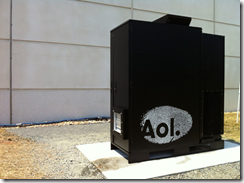
AOL's Mike Manos celebrates the Data Center Independence on 4th of July 2012, freedom via the micro data center

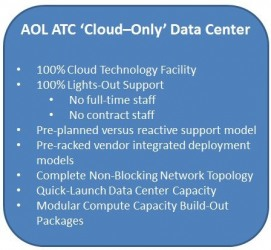
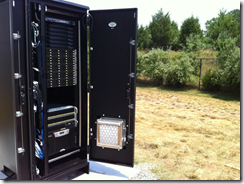
Mike Manos has a post on AOL's Data Center independence.  The micro data center looks like it has a 50KW capacity which could support a configuration like 100 dual proc 128 GB RAM,  dual HD servers, network switch, and storage appliance.  16 processor cores would give the micro data center 1,600 VM cores with 8 GB of RAM.  Slide in some SSD's to make the environment energy efficient and higher performing.  This is a nice cloud environment as modules to deploy.  I think Mike learned that a 40' container is not as flexible.  You can air ship a micro data center and it is much easier to deploy.  Air shipping a 40' container is really really expensive and can be difficult to deploy.

AOL’s Data Center Independence Day

Yesterday we celebrated Independence Day here in the United States.   It’s a day where we embrace the freedoms we enjoy as a country, look back on where we have come, and celebrate the promise of the future.   Yesterday was also a different kind of Independence Day for my teams at AOL.  A Data Center Independence Day, if you will. 

...

NewImage

...

NewImage

...

NewImage

...

NewImage

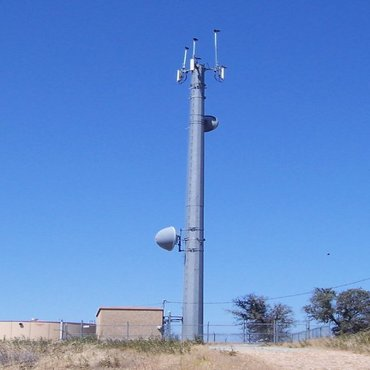
Now you may say where would you put AOL's micro data center.  One place AOL could put them is at cell tower locations.

NewImage

It is reasonable in the future that in major metropolitan areas there will be a local data center presence.  Netflix has been expanding its network WW.  


Open Connect Peering Locations

Private Network Interconnect Sites

CityProviderSite Identifier
Ashburn Equinix DC Campus
Atlanta Telx 56 Marrietta
Chicago Equinix CH1/CH2/CH4
London Telecity Sovereign House
London Telecity Harbour Exchange
Los Angeles Coresite One Wilshire
Los Angeles Equinix LA1
Miami Terremark NAP Of The Americas
New York Telx 111 8th Avenue
San Jose Equinix SV1/SV5

Peering Exchanges

CityExchangeIPv4 AddressIPv6 Address
Ashburn Equinix Internet Exchange 206.223.115.238 2001:504:0:2::2906:1
Atlanta Telx Internet Exchange    
Chicago Equinix Internet Exchange 206.223.119.156 2001:504:0:4::2906:1
London LINX Juniper LAN 195.66.225.101 2001:7f8:4::b5a:1
London LONAP 193.203.5.229 2001:7f8:17::b5a:1
Los Angeles Coresite Any2 206.223.143.215 2001:504:13:0:0:0:0:215
Miami NOTA 198.32.125.71 2001:478:124::1071
New York Telx Internet Exchange    
New York Telehouse NYIIX    
San Jose Equinix Internet Exchange 206.223.116.133 2001:504:0:1::2906:2

One of the top limits for where companies can deploy data centers is the local resource requirement.  Mike's team has an option, where as long as they get power and network, their micro data center will run, managed remotely.

  • It redefines software architecture for greater resiliency
  • It allows us an incredibly flexible platform for driving and addressing privacy laws, regulatory oversight, and other such concerns allowing us to respond rapidly.
  • It further reduces energy consumption and carbon footprint emissions (important as taxation evolves around the world, as well as ongoing operational costs)
  • Gives us the ability to drive Edge Computing delivery to potentially bypass CDNs for certain content.
  • Gives us the capability to drive ‘Community-in-a-box’ whereby we can quickly launch new products in markets, quickly expand existing footprints like Patch in a low cost, but still hyper-local platform, allow the Huffington Post a platform to rapidly partner and enter new markets with minimal cost turn ups.
  • The fact that the technology mix in our SKUs is comprised of compute, storage, and network capacity maximizes the amount of products and services we can deploy to it.  

The race that is going on between the Google, Amazon, Netflix, Microsoft, and Apple is to get the low latency presence to users.  AOL is a player in this game as well.

MacBook Pro Retina vs. Thinkpad T530 vs. Dell M4600, creatives would choose Pro

I just got my MacBook Pro Retina on yesterday and I am so glad I opted for 16GB of memory.  Curious I decided to do a bit of price comparison.

My MacBook Pro Retina is configured with Intel i7 2.6 GHz 4 core, 16 GB of memory and 512 GB SSD with the highest end Retina Display.  These are what I looked for when comparing to a Thinkpad and Dell Laptop. Price $2999

NewImage

NewImage

Dell M4600 Laptop has the enterprise options with multiple drives, etc.  I added equivalent processor, RAM, and SSD.  Price $4,648

NewImage

Lenovo Thinkpad T530 has again many more options, but only allows a 180 GB SSD, so the $3,409 price would be much higher if you could add a 512 GB SSD.

NewImage

Let alone how these machines look.

NewImage

The Dell XPS 15 is $1799, but at this time I could not upgrade the RAM, or SSD.  It's price is $1799 for 8GB and 720 GB HD.

NewImage

The MacBook Pro is being criticized for being too expensive.  It is not for those who the MacBook Air works fine.  Apple was smart in limiting the MacBook Air to 4GB.  

If you want 8-16GB of RAM a 512 GB SSD. And, 4 core i7 is useful, then the MacBook Pro fits.  

NewImage

I used to work at Apple on OS, and Microsoft on Windows.  I run Parallels and Windows 7 on the Macbook Pro which is another reason why 16 GB of memory is nice.