Did you get the advertisement handout at CapRate for the Schneider giveaway? (humor)

At CapRate's NYC event there was the typical data center vendor with swag.

A slang term used to describe free stuff and giveaways offered by vendors at trade shows to encourage attendees to visit their booth. Swag is usually company-branded merchandise and is given away as a form of advertising.

Did you grab the #1 that promotes entering your name in a drawing for a Bose Bluetooth speaker or a noise cancellation headphone from your energy management partner.

NewImage

Can you imagine the marketing person?  I am looking for a big wide one so I can use it for a marketing promotion.

Did you hear that? It was the sound of Samsung shipping a Server, Homesync

Google is even getting scared by Samsung's growth in the Mobile market.

Google executives worry that Samsung has become so big—the South Korean company sells about 40% of the gadgets that use Google's Android software—that it could flex its muscle to renegotiate their arrangement and eat into Google's lucrative mobile-ad business, people familiar with the matter said.

Samsung's latest move is Homesync.

HomeSync will be available from April 2013 in select countries and continue to expand globally.

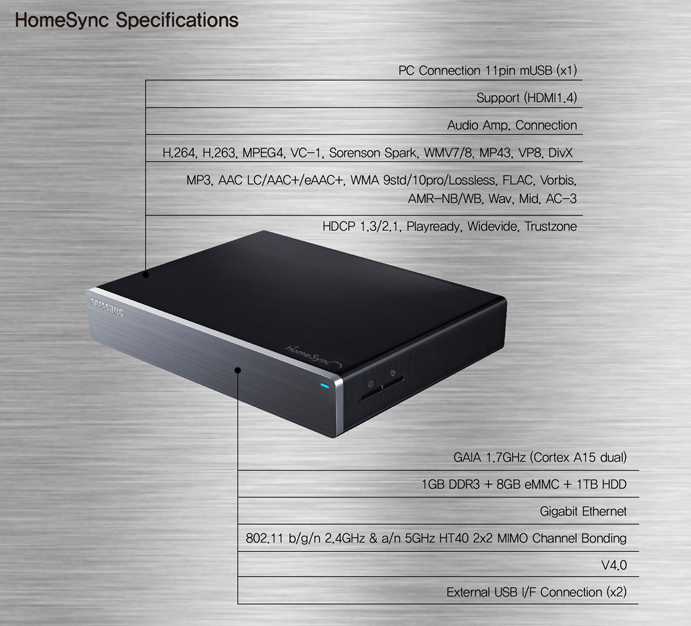
Samsung Homesync Specifications

 Some companies took the move to use hundreds of Mac Minis as servers for a rendering environment. If you squint your eyes and look at the above specifications you can see the start of a server that could fit in a data center.  Throw out the HDMI and media chips.  Add more cores, memory and disk IO and you have a data center server.
 
We'll see what the price point is for Homesync.  Then you can extrapolate a price point for a Samsung server.

The next Cloud Feature - Frequent Flyer program to lock you in

I am participating in a Route to the Cloud webinar tomorrow and one the points I want to make is whether you want to be cloud independent or not is an important decision.  What fool would want to be locked into a cloud?  In fact GigaOm's Barb Darrow just posted on the issue of lock-in preventing movement to the cloud.

Fear of lock-in dampens cloud adoption

SUMMARY:

Data portability — the ability to move your information between clouds (or in and out of clouds) with relative ease — is a key concern of companies considering a cloud move.

It’s become a truism to say that data is the new gold –but that doesn’t mean there are easy answers about where to store this gold. For now, many corporate customers will hold back on full cloud computing adoption until they’re convinced that they can move their data off a given cloud as easily as they put it there in the first place. Face it: fear of vendor lock-in is not limited to the on-premises IT world and it’s time enlightened vendors get this problem in hand.

What would motivate people to accept a lock-in?  Frequent Flyer program.  The human behavior to get points is ingrained in people.  

Can you imagine if AWS launched a point program for the amount of Cloud Services used and gave program owners the ability the redeem points for Amazon.com merchandise?  Users would then have the incentive to have larger AWS bills and loyalty to a cloud provider is common.

No one in the cloud service has a frequent flyer program, and this probably will never happen.  Note: this is a what if AWS launched a frequent flyer program, not they have.  

This may sound crazy, but we have all seen people who go through extreme lengths for Frequent Flyer Points.  You cloud kind of do this already if you set up a Amazon.com Rewards Visa card.  If you spent a $1,000/month on AWS that would be 3 points/$1 = 3,000 points / 100 points/$1 = $30.  You spend $10,000 a month on AWS.  Not hard to do. You get $300 a month in your account.

Companies tried to take away an employees frequent flyer points, but that didn't work.

Welcome Amazon.com Rewards Visa Cardmember


Earn points on every purchase*

  • 3 Points per $1 spent on Amazon.com
  • 2 Points per $1 spent at gas stations, restaurants, drugstores, and office supply stores
  • 1 Point per $1 spent on all other purchases

Redeem your points instantly at checkout with Shop with Points

You can use the points you earn to buy the stuff you want right at checkout.

  • See your points automatically
  • Pay for all or part of your purchase - there's no minimum
  • Every 100 points = $1.00 towards your purchase

Choosing a Path to the Cloud?

Moving to the cloud is assumed for almost all IT departments.  Choosing the path for you and what you take with you is not as clear.

On Feb 27, 2013 10-11a PT, I will be an webinar panel to discuss the routes that people can take.


What’s your best route to the cloud?


As organizations of all sizes make their move to the cloud, they are looking for ways to gain control over the chaos of ad hoc, unplanned and unmanaged adoption of cloud services. No single path is right for every company and thus a growing assortment of services is emerging to suit every use case. These range from direct peering, to one-stop-shops that offer it all, which is great as long as you like their flavor, to cloud services brokerages offering migration to specific cloud apps, to colo and hosting providers creating cloud exchanges or marketplaces where users can connect directly to best of breed cloud services all within the same data center.

Wow, PUE of 1.26 for 120v Nissan Leaf charging system vs. 1.08 for 240v

I have one friend who just bought a Tesla S and he mentioned something that doesn't get widely publicized for the Tesla's that typical charging is 85% of battery capacity.  So keep in mind the typical range of a Tesla is 85% of the stated range.  I asked him what kind of charging system he had and he had the 240V that is similar to an electric dryer circuit.  I told him I had another friend with a Nissan Leaf who was a bit more on the cheap side so he charging his leaf on 120V.  It takes 20 hours for a complete charge and is also recommended to not exceed the 80% battery charge.

What I found interesting in a Nissan Leaf Forum is there is 300 watts of overhead for the 120 Volt and 240 Volt charging. 

The question starts.

7 hours for 240V and 20 hours for 120V. I thought it would be exactly half for the lower voltage?

The answers posted are.

The 120v charging is limited to 12amps (1.44kW). 240v charging is done at 16a (3.84kW). That comes to 2.67 times slower, plus 120v charging is less efficient...there's a fixed overhead for the cooling system that brings the practical difference close to 3 times slower.

2). There is a parasitic load of about 300W that runs during charging. These pumps draw the same power regardless whether the charging is done with 120VAC or 240VAC. This power takes a larger fraction of the available power away from charging when using 120VAC, This further slowing charging. Interestingly, this causes 240VAC charging to be more efficient.

The last comment on 240VAC being more efficient got me curious to calculate the PUE of 1.44kW (120V) vs. 3.84 kW(240V) with a  0.3 kW overhead for the cooling and electrical distribution.

120V had a PUE of 1.26.

240V had a PUE of 1.08.

When you do the math on an individual basis this is not big deal, but add up all the 120V charging of electric vehicles and the numbers add up fast.

Google has a PUE of 1.08 for its Hamina Data Center.  Would it ever want to go back to a PUE of 1.26?

It is painful to think about charging at 120V vs. 240V both from a time perspective and waste of energy.