A Data Center Thought Leadership Social, built on quality of friends

Management and other marketing recognize using the words thought leadership are good, but mistake claiming thought leadership doesn't you a thought leader.

January 09, 2009 

...
January 09, 2009
 
Monday night we had a data center social with thought leaders.  Thought leadership is not how we market what the event is. Thought leaders are the type of people we are looking to invite.  So, why do the thought leaders we invited make time in their  busy schedule and some flying in from Chicago, Atlanta, Austin, NY, and Seattle?  The event works because it is about friends being able to chat in a comfortable environment.  Spending 10 minutes, 20 minutes, sometimes 30 minutes just chatting about whatever they want.  There is no hurry, there is hovering salesman looking to interject.  In fact some of the vendors who we let come in because they wanted to meet with some others who were in town recognized that they need to tread softly as the slightest hint of someone to sell a product, get a business card could set you in a bad light in front of influentials.  
 
People catching up what's up with their kids, their latest vacation or hunting trip, funny data center stories, doesn't fit in with someone who is trying to explain the value of their product/service.
 
So, what is the value of people attending? It's about friends catching up who haven't caught up in months, maybe years, and making new friends in the data center industry.  The #1 type of people we almost always welcome are data center operations people.  These are the people who many times who are so busy running the data centers, they don't go to many conferences.  Also, there are some of the people who make the data center circuit, but want some downtime to just catch up with friends.
 
How valuable are data center friends?  Oprah.com has a post that will help explain the value.
Why do you want authentic, deep friendships? Friends touch your heart, challenge your mind, inspire you to pursue your passions, double the good times, halve the bad times and make your life a happier and more fulfilling place to be.

And that's not just my opinion! Here are the researched facts from Tom Rath, a researcher at Gallup:

  • If you feel close to other people, you are four times more likely to feel good about yourself and life.
  • People who claim to have five or more true friends with whom they can discuss important problems are 60 percent more likely to say that they are "very happy."
  • People with a best friend at work are seven times more likely to be engaged in their work! However, only 30 percent of employees report having a best friend at work!

"Friendships are among the most fundamental of human needs," Rath says. "When we asked people if they would rather have a best friend at work or a 10 percent pay raise, having a friend clearly won."

It is a little corny to read the "friends who touch your heart." In thinking  though, the one friend who touched all our hearts is our departed Olivier Sanche.  One of the best qualities of Olivier is we all remember the first time we met him, and how everyone can recall that first conversation.  Olivier is a true friend and one we all miss so much in the industry.

And a great lesson is the quality of your friends can make life so much better.
NewImage
NewImage


A strategy to have meaningful data center socials, listening to the infuentials

I have known a few people who thought it was a good idea to start a conference.  They thought it was a great way to make money from attendees, exhibitors, and sponsor.  Many of these people were people who didn't have technical expertise in the area of the topic, but worked on many conferences and saw the money flow through.  

Sometimes I think these are the type of people who are running many of the data center conferences.  They are playing around with the sponsorship packages, how much it will cost to exhibit, and how much they will charge attendees.

A different strategy is focus on the dynamics of the groups who attend.  Back in Aug 2010 I wrote about Steve Manos's data center social events in Chicago.

http://www.greenm3.com/gdcblog/2010/8/6/first-reaction-to-lee-tech-on-tap-in-chicago.html

First reaction to Lee Tech on Tap in Chicago,

The energy was high at Lee Tech on Tap in Chicago and I can see why people keep on attending.  Given how much I have written about the event many people were surprised this was my first one to attend and I am glad my first was where it started.

There are some great people I met there and discussed ideas that wouldn't have happened if  I wasn't at the event.  Usually when you go to an event you feel good if you make a couple of good contacts.  In one night, I made at least 7 good connections that I will follow up on.

The benefit of an event is finding people of the same mindset and people who are different who stimulate new thinking.

...

Attending Lee Tech on Tap in Chicago - Aug 5, 2010

Thanks to the folks at Lee Technologies I was extended an invite to attend the Lee Tech on Tap event in Chicago on Aug 5, 2010.  I've written about the event so much, it will be good to see the people and event in person.

I would live blog the event, but I think I'll be too busy talking to people.  I don't expect any press releases surrounding the event so there is no need to hurry and post.

image

Some of the decline of revenue, sponsors, and attendees for some of the data center conferences is caused by event folks focusing on the numbers and not looking at the dynamics of the groups. 

A key set of people to listen to are the influentials.  The people that almost everyone knows or want to know, and listen to whether they find the event useful.  If not, you need to figure out what will get them to attend.

When is the last data center conference you said I am so glad I went.  That hosted reception in the exhibit area was worth the trip.  Not.

Whereas most of those who attend data center socials, see the benefit and will attend again.  

The story behind the 400 ppm CO2 emissions

There was all kinds of news about CO2 level reaching 400 ppm.

National Geographic

Climate Change and CO2 400 ppm

Energy Collective-by Lou Grinzo-May 11, 2013
Climate Change and CO2 400 ppm ... on 400ppm, which is to say, an amount of CO2 in the atmosphere that's 400 parts per million, by volume.
Heat-Trapping Gas Passes Milestone, Raising Fears
Highly Cited
-New York Times-40 minutes ago

 Out of all the hype, National Geographic and The Economist tell the story behind the 50+ years of measurement started by Charles David Keeling.

Here is the National Geographic post.

Climate Milestone: Earth’s CO2 Level Passes 400 ppm

Greenhouse gas highest since the Pliocene, when sea levels were higher and the Earth was warmer.

Two teams of scientists at the Mauna Loa Observatory in Hawaii have been measuring carbon dioxide concentration there for decades, and have watched the level inch toward a new milestone.

Photograph by Jonathan Kingston, National Geographic

Robert Kunzig

National Geographic News

Published May 9, 2013

An instrument near the summit of Mauna Loa in Hawaii has recorded a long-awaited climate milestone: the amount of carbon dioxide in the atmosphere there has exceeded 400 parts per million (ppm) for the first time in 55 years of measurement—and probably more than 3 million years of Earth history.

And here is The Economist post.

Environmental monitoring

Four hundred parts per million

The only good news about the Earth’s record greenhouse-gas levels is that they have been well measured

May 11th 2013 |From the print edition

CHARLES D. KEELING, mostly known as Dave, was a soft-spoken, somewhat courtly man who changed the way people and governments see the world. A slightly aimless chemistry graduate with an interest in projects that took him out into the wild, in 1956 he started to build instruments that could measure the proportion of carbon dioxide in the atmosphere, a scientific topic which, back then, was barely even a backwater. In 1958, looking for a place where the level of carbon dioxide would not be too severely influenced by local plants or industry, he installed some instruments high up on Mauna Loa, a Hawaiian volcano. He found that the level fluctuated markedly with the seasons, falling in northern summer as plants took up carbon dioxide and rising in northern winter as dead foliage rotted. And he found that the annual average was 315 parts per million (ppm).

The Economist honors the effort by Dave.

Scientists involved in other measurements of the Earth, and those who pay for their work, need to build on his legacy. So does anyone taking a position on global-warming, where numbers as clear as Keeling’s are a rarity. Measurements of the temperature of the ocean depths and the acidity of its surface waters, of the volume of the planet’s forests and the mass of its ice sheets (see article), need to be made not just for the few years of a specific research project. Their ceaseless continuance needs to be built into the planet’s infrastructure. A world in which governments claim to be committed to spending trillions of dollars to change the shape of the Keeling curve decades hence, but do not find the funds to produce consistent records of the change going on today, is one that still has lessons to learn from the patient chemist.

And National Geographyic as well.

When the elder Keeling started at Mauna Loa, the CO2 level was at 315 ppm. When he died in June 2005, it was at 382. Why did he keep at it for 47 years, fighting off periodic efforts to cut his funding? His father, he once wrote, had passed onto him a "faith that the world could be made better by devotion to just causes." Now his son and the NOAA team have taken over a measurement that captures, more than any other single number, the extent to which we are changing the world—for better or worse.

Oops, just because you access data doesn't mean it is OK to use it, Bloomberg reporters cross ethical boundaries

It may seem like common sense that if you set up camera to watch what someone surfs on the web it is illegal and unethical to report on those activities. But, when you are a media reporter who is driven to get more traffic, you think it is OK to do what others have been doing.  Crawling through user activity logs of Bloomberg services to ascertain what people are thinking about doing.

The news is spreading over the weekend.

Salon


Bloomberg bars reporters from client log-in data - USA Today

USA TODAY-2 hours agoShare
LOS ANGELES (AP) — Financial data and news company Bloomberg LP said Friday that it had corrected a "mistake" in its newsgathering ...

Even if you are not a reporter, you need to watch out for the same mistakes.  I have repeated said one of the dangers of big data environments is to put a bunch of silo'd data in one area, the problem is it can get you arrested as you may violating privacy laws by putting all the data in one environment where it is open to users to analyze.

Goldman Sachs is the one who is complaining.

A source at Goldman tells us that the firm was dumbfounded and outraged to discover what Bloomberg reporters were doing. The source says that, until recently, Bloomberg News reporters were able to see not just when individual Bloomberg subscribers logged in (and via what device), but what they did while they were logged in.

Specifically, the source says, Bloomberg News reporters were able to see: 

  • When individual subscribers logged in and logged out (and from where).
  • What type of information these individual subscribers looked at and how often they looked at it.


This is not a unique situation, and we'll probably hear more about as people  start to look for the signs of whether people are violating privacy laws.

Open Compute Project History described in a Taxonomy Map

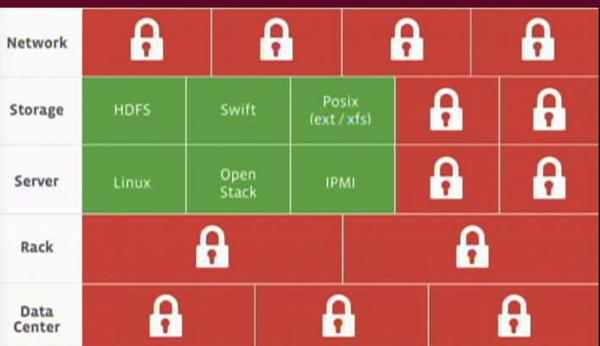
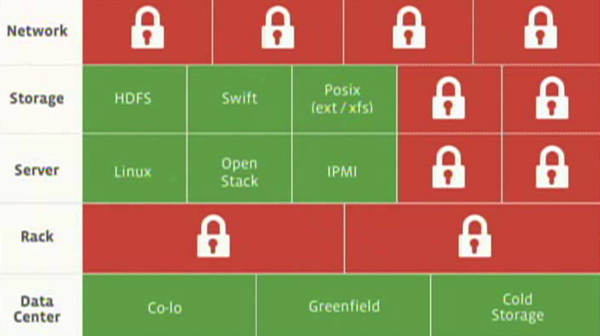
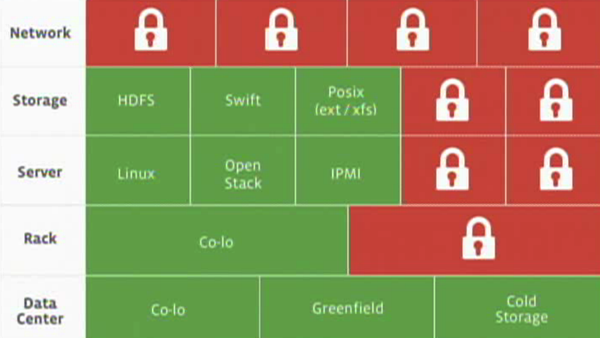
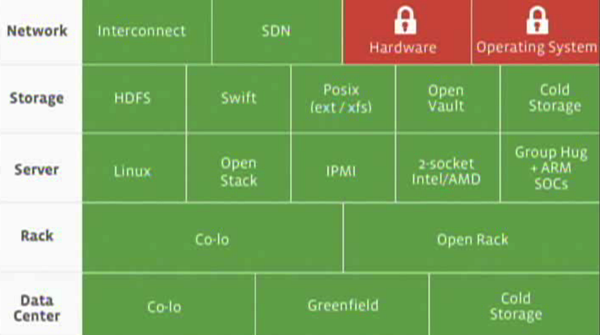
In Frank Frankovsky's keynote at Interop he showed the progression from red to green of the open compute project from data center, rack, server, storage and now network.

Frank started with the open source software used.

NewImage

Then Facebook shared its data center practices.

NewImage

Next came racks in the co-lo

NewImage

Eventually building to the complete taxonomy below.

NewImage

What's next?  The Open Compute Project comment is the one who asks for new things as well as Facebook deciding to contribute in an open source manner.