Intel Ships Brawny Processors to scale up

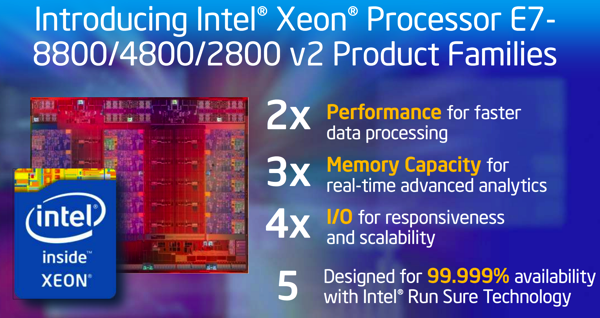
Intel has released the Xeon Processor E7-8800/4800/28000 v2 family.

 NewImage

What comes to mind is Urs Hoelzle’s call to action that not all services can be provided by whimpy energy efficient low clock rate cores.  There is a need for brawny cores.

Brawny cores still beat wimpy cores, most of the time

Urs Hölzle

Google

Slower but energy efficient “wimpy” cores only win for general workloads if

their single-core speed is reasonably close to that of mid-range “brawny”

cores.

At Google, we’ve been long-term proponents of multicore architectures and throughput-oriented

computing. In warehouse-scale systems1 throughput is more important than single-threaded peak

performance, because no single processor can handle the full workload. In addition, maximizing singlethreaded

performance costs power through larger die areas (for example, for larger reorder buffers or

branch predictors) and higher clock frequencies. Multicore architectures are great for warehouse-scale

systems because they provide ample parallelism in the request stream as well as data parallelism for search

or analysis over petabyte data sets.

The Register has a detailed article.

Better late than never: Monster 15-core Xeon chips let loose by Intel

New mission-critical CPUs are mission-critical to Chipzilla's critical money-making mission

1,000 + AWS hiring, How big is the AWS team? Are you paying for features you don't need?

AWS does a great job of promoting how lean it is and continuously drops the price of AWS.  Yet, there are companies who find it is lower cost to move out of AWS and run their own cloud.  How can that be?

Here is a thought experiment.  There are currently over 1,000 job openings in AWS.  Amazon overall has over 100,000 employees.  Let’s just say that the AWS team is 5,000 employees and they are have 20% job openings.  Do you need 5,000 employees to run the AWS services you are using no.  Many of those people are developing new services and new customers.  So part of your payments are the costs to fund the growth of AWS.

We're hiring!

Since early 2006, Amazon Web Services has provided companies of all sizes with an infrastructure platform in the cloud. 
We're looking for talented new members of the AWS team in the following locations:

When you are small this cost is not significant amount and the value of what you get from not having to have infrastructure people is worth it.  As you grow and start  paying $10k a month, $40K a month, then maybe $75K a month, what % of your payments are now going to fund AWS’s growth?

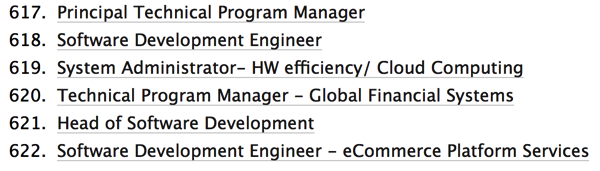
Take a look again at the 1,000 people AWS is trying to hire. Are those people and features you need?  There are 622 job openings just in Seattle.

NewImage

I think part of the reason why companies choose to move out is the features they need are clear and they just need a handful to run their services.

Early days of AWS - Fireside chat Andy Jassy

Here is a Youtube video with 

Published on Oct 21, 2013

As a follow up to his presentation, Andy Jassy, senior vice president of Amazon Web Services, sits down with Michael Skok to discuss the evolution of AWS and its road to success.

Here is a blog post for those of you would like to read vs. watch a 45 minute video.

Revealed: The 4 Reasons Amazon Web Services Got Approved

Screen Shot 2013-12-19 at 9.19.42 AM

In the summer of 2003 Amazon was a fast-growing online bookstore.  Nine years old, it had pioneered many innovative components of e-commerce that we take for granted today: customer reviews, a personalized shopping experience, relevant product recommendations, and frictionless buying.

Jeff Bezos had founded the company in 1994 and began selling books online.  His advantage, he thought, was that he could sell a bigger selection of books than any traditional book store (or chain).  And right from the start he committed to outstanding customer service. Amazon’s mission is “to be Earth’s most customer-centric company, where customers can find and discover anything they might want to buy online, and endeavors to offer its customers the lowest possible prices.”

Which is why it wasn’t an easy decision in the summer of 2003 to hire a team of 50 or so engineers, and set them upon the task of build “the operating system of the internet,” as Andy Jassy, Sr Vice President of Amazon Web Services, likes to call it.

The Leadership team took an assessment of its assets:

“We were doing an assessment ourselves, as a senior leadership team, about what Amazon was really good at.  And initially you can imagine what we were talking about: we were good at retail, we were good at detail pages on our retail site website – all the things that were the primary business at the time.  But as we dug deeper we realized we were really good at running these infrastructure services deep in the stack, and then we were also good at running these reliable, scalable, cost-effective data-centers.  So the first realization we had was that we had a real core competence running infrastructure.”
Got a new Pizza Peel for my Woodstone Oven

On my way to Vancouver last week for the Wavefront Wireless Conference I was driving by myself and getting close to Bellingham.  Bellingham is where Woodstone Oven’s are made that are the same ovens you see in Whole Food, California Pizza Kitchen, many corporate cafeterias, Wolfgang Puck’s restaurants, and my kitchen.  I go to Serious Pie at least twice a month given a construction project I am working on is right next to it, and was able to have bfast with one of my Apple friends who was in town for vacation.

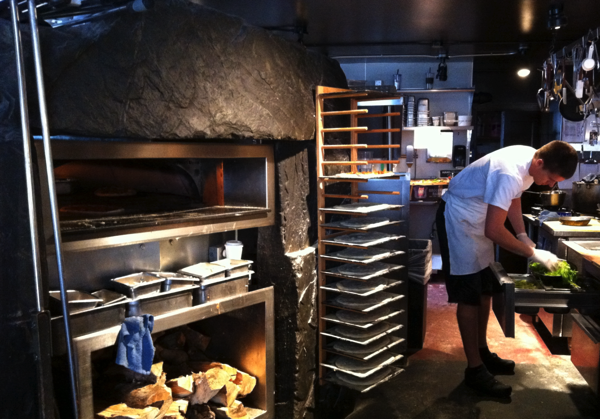
Below is one of two ovens at Serious Pie.  I usually try to talk to the cook’s to get a few tips on how they use their oven.  I am trying to bump the temperature of my over from 550 to 600 to get a better crust on the pizza.

NewImage

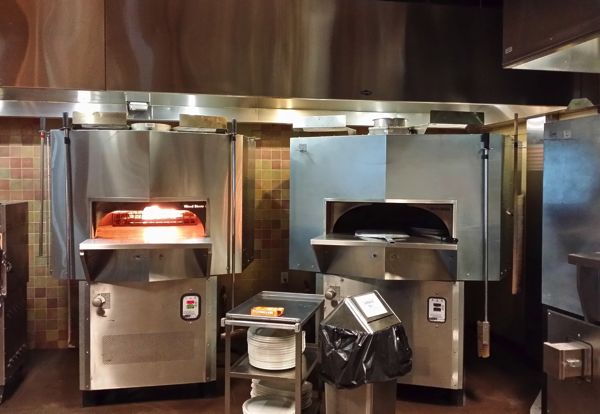
Woodstone Oven has a training room right next to lobby.  And, I went in to check out the latest gear.  My oven is the same as the one on the left which is a 4’ chuckanut model.

NewImage

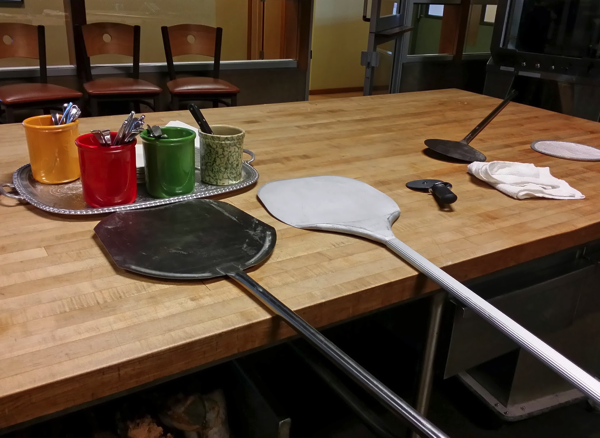
One of the changes Woodstone made is to replace the stainless steel pizza peel (left) with an aluminum one (right).

NewImage

What’s wrong with the stainless steel one?  Even when you put corn meal or semolina flour down, the pizza tends to stick too much.  And I would swap to a wood peel to make the pizza.  The aluminum one is a rough brushed finish that makes it much easier to slide the pizza.

I’ve only made one pizza with the new peel, and it is so much better than the stainless steel one.  Problem is aluminum will dent and bend much easier than the stainless steel.