Work Life Balance, BS make your Health #1

Work Life balance is standard HR language to minimize the litigation exposure.  Here is an article that says the USA’s life work balance is amongst the lowest.

To many tired American workers, this won't come as a surprise. The United States has a pretty abysmal ranking on the list of developed countries for creating a balance between work and life away from work.

Americans work longer hours, have fewer vacation days and leisure hours, and spend as much or more time cooking, cleaning and caring for family as their international counterparts.

This is according to the 2013 Better Life Index, compiled by the Organization for Economic Co-operation and Development, a nongovernmental organization in France that tracks economic and social data from its economically developed member countries.

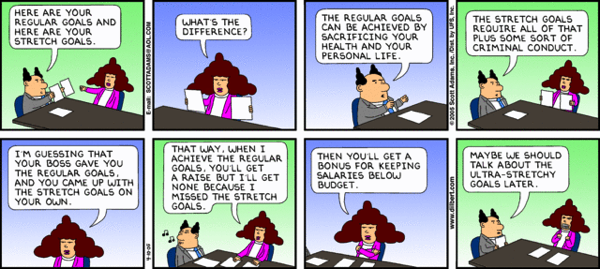
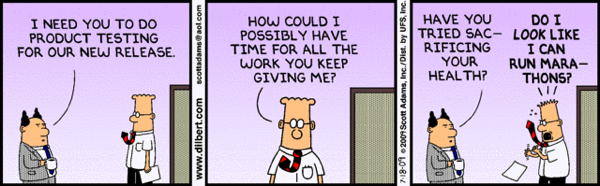
Here are two dlibert cartoons that poke fun at the concept.
 

NewImage
NewImage

Just went to a funeral service for a friend who had a sudden cardiac arrest at the age of 47.  She didn’t make her health #1, and most likely increased the risk of her cardiac arrest.

If any of my data center friends look like they are losing the health vs. work battle, I try to persuade them that making your health #1 is best for you overall.  

(Note: I tried to embed the Dilbert Cartoons, but the html code didn’t work.  

Predicting the future data center by taking Seven Steps back before leaping Seven Steps forward 2006 - 2020

Imagining the future of what data centers will be like in 2020 is hard.  Here is a blog post by LSI’s Rob Ober that takes a look 7 years ago, then predicts 7 years ahead.

Here is a snipped of the 7 years in the past.

And 7 years ago, our forefathers…
It was a very different world. Facebook barely existed, and had just barely passed the “university only” membership. Google was using Velcro, Amazon didn’t have its services, cloud was a non-existent term. In fact DAS (direct attach storage) was on the decline because everyone was moving to SAN/NAS. 10GE networking was in the future (1GE was still in growth mode). Linux was not nearly as widely accepted in enterprise – Amazon was in the vanguard of making it usable at scale (with Werner Vogels saying “it’s terrible, but it’s free, as in free beer”). Servers were individual – no “PODs,” and VMware was not standard practice yet. SATA drives were nowhere in datacenters.

An enterprise disk drive topped out at around 200GB in capacity. Nobody used the term petabyte. People, including me, were just starting to think about flash in datacenters, and it was several years later that solutions became available. Big data did not even exist. Not as a term or as a technology, definitely not Hadoop or graph search. In fact, Google’s seminal paper on MapReduce had just been published, and it would become the inspiration for Hadoop – something that would take many years before Yahoo picked it up and helped make it real.

Which then nicely sets up 7 years out.

7 years from now
So – 7 years from now? That’s hard to predict, so take this with a grain of salt… There are many ways things could play out, especially when global legal, privacy, energy, hazardous waste recycling, and data retention requirements come into play, not to mention random chaos and invention along the way.

Enjoy the post to get you thinking about what could be.

230 people attend 7x24 Exchange Oregon 1st User Group meeting

Many of the data center conferences are finding it harder to get the attendance of end users to their events.  At the same time there is pent up demand for data center users to socialize with their peers.  What to do?

One option is a 7x24 Exchange chapter meeting, but those events tend to be small.  Then some of my Portland friends said they had 200+ people registered for their event on Feb 27, 2014 at Intel’s Jones Farm Campus.

NewImage

I’ve been to the campus and it has a great facility to host 7x24 Exchange.  

Here a couple of pictures from the event which ended up having 230 people attend.

NewImage

NewImage

If the future of Containers is Carbon Fiber, what could be done in a data center with Carbon Fiber

Economist has an article on the possibility of carbon fiber containers.

One idea Dr Lechner proposed is to make containers out of carbon-fibre composites. Such containers would be easier to use, because they would be lighter and also—if designed appropriately—might be folded flat when empty, saving space. Dr Lechner reckons a carbon-fibre container would need to travel only 120,000km (three times around the Earth) to prove cheaper than its steel equivalent. It would also be more secure, because it would be easier to scan without being opened.

Wonder what kind of data center could be built using a carbon fiber container.  It would be lighter.  Drilling holes in carbon fiber would be much more difficult.

Nothing jumps out as why carbon fiber would make sense in a data center.  Unless you go throughout the whole rack and server components and you could probably shave 30 - 50% of the weight which makes shipping a container worth of gear much easier to do.  Carbon fiber could make sense in military scenarios for planes and other areas where weight is a big issue.

A peak into Amazon's approach to servers comes from LSI

here is a blog post by Silicon Angle with Robert Ober.  In this post Robert discusses some of Amazon’s approached to IT hardware.

“The evolutionary direction we’re going in the data center, you can call it many things – you can call it pooling, you can call it disaggregation – but at a large scale, at a rack or multiple racks or a hyperscale data center, you wanna start pulling apart the parts,” he remarks.

Optimizing infrastructure down to the component level has many benefits, both architectural and operational, but Ober considers the improvements in thermal management to be the most notable. The reason, he details, is that processors, DRAM, flash and mechanical disk all have different temperature thresholds that have to be sub-optimally balanced in traditional configurations.

Here is a video you can watch with Robert discussing some of the ideas.  This interview was done at the OCP Summit V.