The Lean Construction Market, Insight into those who practice and those who don't

Many of you are familiar with Lean Construction, and I bet you run into people like I do who don’t know what Lean Construction is.  Your experience figuring who gets Lean Construction and who doesn’t is anecdotal and hard to gauge.  Thanks to folks at Dassault Systemes and McGraw-Hill a survey was conducted in Sept 2013 to understand the Lean Construction Market.  You can get a copy of the study here which requires you to register and will most likely get a call from a sales associate.  I did.
NewImage

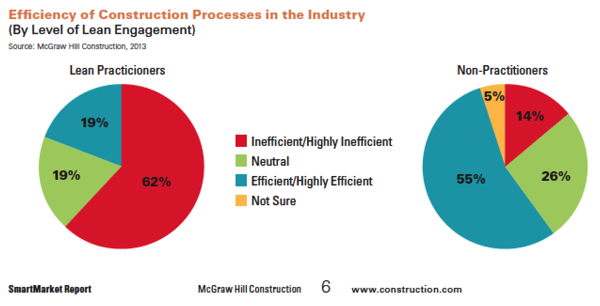
One of the eye opening statistics is that 55% of the market doesn’t know Lean Construction, and those who don’t practice Lean Construction have 4X the amount of people thinking they are “efficient/highly efficient.”  So, as long as you don’t practice Lean Construction you are unaware of how inefficient you are?  How much 4X more the people.  This explains the resistance to go Lean.  People believe they are already efficient, so why would they change.
NewImage

If you are in that group that believes you are already efficient and Lean Construction isn’t for you, then ignore the rest of this post.

There in depth interviews  with insights from talking to those who use Lean Construction.
NewImage

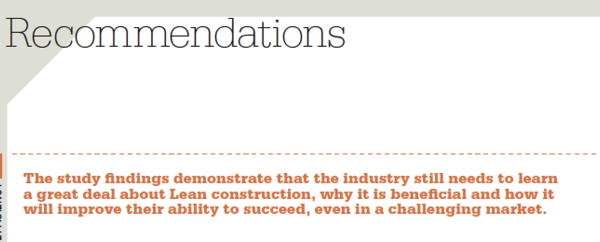
Even if you practice Lean Construction you are always looking to learn more. 
NewImage

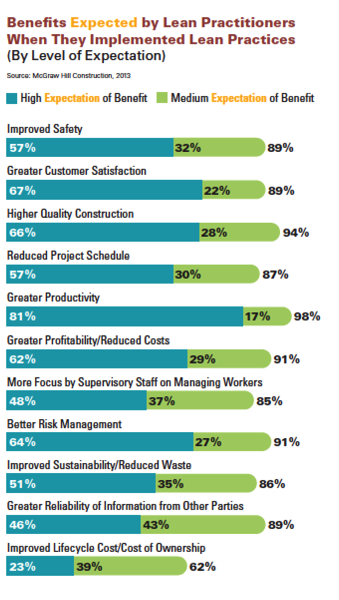
You use Lean Construction for many benefits.  Here is a nice list of benefits.
NewImage

Lean Construction Keynote Video by 2 Second Lean's Paul Akers

I was chatting with Compass Data Center’s Chris Crosby about Lean Construction and we were having a good laugh that the media makes it seem like Lean Construction is something new because Facebook and a few others have seen the light of Lean Construction.  Lean vs. Waste - Simple vs. Complicated.  Chris mentioned the 2 Second Lean book and I went to the website.  The company FastCap which 2 Second Lean’s Paul Akers founded is in Bellingham, WA the same city that my Woodstone Oven is made.

A local friend who works in the construction is active in Lean Construction and I saw that a conference he went to has Paul Akers Keynoting.  Below is his talk at the conference.

)

Some notes I took from the video are:

Paul believes in videos to illustrate points.  Check out this F1 pit stop.

)

Lean is a choice of being Simple vs. Complicated.  Simple & Fun vs. Complicated & Painful.  Most places of work are complicated & painful because management doesn’t believe in being Lean.

Lean is simply to see waste and to focus on the teaching and training of the people to eliminate waste.  This supports more quality and more value which is good for the customer and good for the business.

Paul tells the story of how he thought the answer was to be organized, but he was clueless  compared to the Toyota Production System, Lean Manufacturing, and Kaizen.  Now Paul is a speaker and author on the concept of Lean.

Lean Construction is not new.  There are probably at least 50% of the construction industry who don’t get Lean.  It is a simpler less wasteful way to do work.  Lean is greener and more sustainable.  But, many think a Lean Construction project is innovative.  No it is not innovative.  It is about time.

Seeing the Communication Gap between Data Center Teams - Design, Construction, Operations, and IT

Whenever I heard how DCIM will bridge the gap between facilities and IT I look, but question whether there is really something there that can bridge the gap.

How hard is it to bridge the gap?  Consider this video of the Oracle America’s Cup Race team Wing designer and his challenge to talk to the sailors.  WSJ has a good story on this challenge.

Do you think the answer was to install an Oracle Software solution that both would use.  No.  It took many loses to the New Zealand team to finally get the America team to try something the computer hadn’t modeled


There was little time to experiment with the new technique, and Mr. Ozanne's software indicated Oracle would easily outsail New Zealand upwind even without foiling.

Technology was a problem, not the answer.

Nobody had expected this. Had team Oracle placed too much faith in the technology? Had its enormous budget lulled the team into overconfidence? Had Mr. Spithill gotten away from the lessons he had learned in Elvina Bay?

What especially galled him was the New Zealand team's apparent contempt for Oracle's approach. The managing director of the New Zealand team, Mr. Dalton, was openly disdainful of the costly, high-tech catamaran Oracle had chosen. The Kiwi boat had a similar, but more rugged, design. Dean Barker, the opposing skipper, was the son of New Zealand businessman Ray Barker, who had founded the menswear company Barkers.

The results were achieved by challenging technology and its assumptions made by humans.  What makes me laugh is how many times people will make it seem like Technology is something magical.  No it’s not, it was created by people who just like other people make mistakes and incorrect assumptions which gets embedded in the code.


Disney's Data Centers power changes in Prices and How it Services Guests

Disney has a large Data Center in North Carolina along with Facebook, Apple, and Google.  We can all understand what the latter companies do with data centers.  What does Disney do with a big data center?  One thing Disney does is crank out calculations on its guests and park operations.

Businessweek has a couple of articles on this topic.  One is its RFID tracking system.

The answer was on the electronic bands the couple wore on their wrists. That’s the magic of the MyMagic+, Walt Disney’s (DIS) $1 billion experiment in crowd control, data collection, and wearable technology that could change the way people play—and spend—at the Most Magical Place on Earth.

...

MyMagic+ promises far more radical change. It’s a sweeping reservation and ride planning system that allows for bookings months in advance on a website or smartphone app. Bracelets called MagicBands, which link electronically to an encrypted database of visitor information, serve as admission tickets, hotel keys, and credit or debit cards; a tap against a sensor pays for food or trinkets. The bands have radio frequency identification (RFID) chips—which critics derisively call spychips because of their ability to monitor people and things.


Another is Disney’s raising of ticket prices to $100 for a single day pass.

Walt Disney (DIS) is prying parental wallets open a little wider for that vacation visit to the theme park. The Empire of the Mouse is now charging $99 for a one-day park pass at its Magic Kingdom Park near Orlando, an increase of $4 that comes just eight months after the last price hike.

Behind the steadily rising ticket prices is the small world of supply and demand. People keep flooding Disney’s U.S. theme parks, notwithstanding steeper costs. The company reported a 16 percent increase in operating income, to $671 million, for the most recent quarter at its theme park division as sales rose 6 percent, to $3.6 billion. In Disney’s last fiscal year, theme park income rose 17 percent, to $2.2 billion. The company does not disclose attendance data.

A family enjoys the ease of using MagicBands to get on Jungle Cruise attraction.
Passholder

What Will MyMagic+ Do for Passholders?

From FastPass+ service to the enhanced planning tools of My Disney Experience, MyMagic+ will make it easier than ever to plan, share and enjoy your next visit.

Improvement in Internet Trust, EU Commission VP Neelie Kroes speaks at Cebit, More Regulation Coming

The data center industry is largely unregulated, but with the maturing of any industry comes the eventual regulation as governments are concerned about public safety.

re/code has a post on EU Commission VP Neelie Kroes.

Neelie Kroes Calls Snowden Revelations a Wake-Up Call — “Let’s Not Snooze Through It”

March 10, 2014, 3:19 AM PDT

By Ina Fried


European Commissioner Neelie Kroes said that Edward Snowden’s revelations about NSA spying should serve as a wake-up call that there is a new reality that includes cyber spying and cyber warfare.


Snowden sent the wake up call to the public.  Most of the insiders aren’t surprised by what Snowden has shared.  It just wasn’t public knowledge.

She called on Europe’s political apparatus to create a strong directive around cyber security.

“Snowden gave us a wake up call; let’s not snooze through it,” Kroes said.

Can you see regulations coming?

Joining Kroes in a panel discussion, computer science professor Wendy Hall said that it makes sense that society is struggling to figure out what policies make sense, noting it took centuries to create social norms for the offline world.

“We’ve got to figure out how to live in the digital world in an open society,” Hall said.