Don't Think Social Issues are Important in the work place? Social Threats are close to Physical Threats

The latest book I am reading is Social by Matthew B. Lieberman
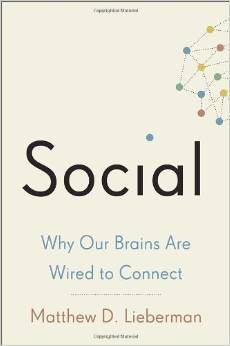
NewImage

Two points made that can open your mind up.

Our brains evolved to experience threats to our social connections in much the same way they experience physical pain .

We intuitively believe social and physical pain are radically different kinds of experiences, yet the way our brains treat them suggests that they are more similar than we imagine.

Lieberman, Matthew D. (2013-10-08). Social: Why Our Brains Are Wired to Connect (p. 5). Crown Publishing Group. Kindle Edition.

So much of work and school thinks being social is bad and a distraction, but you cannot turn off being social.

Based on the latest cutting edge research, the findings in Social have important real-world implications.  Our schools and businesses, for example, attempt to minimalize social distractions.  But this is exactly the wrong thing to do to encourage engagement and learning, and literally shuts down the social brain, leaving powerful neuro-cognitive resources untapped. 

Writing for Your Friends Makes More Friends

A year ago I wrote a post on why I write.  Orwell says that we write for Sheer Egoism, Aesthetic Enthusiasm, Historical Impulse, and/or Political Purpose.  I think there is another reason to write. 

Many years ago I sat next to my dear departed friend Olivier Sanche for the first of many dinners.  One of the people at the table said Dave has a blog.  Olivier said he loves to read blogs.  Can I give him the url for mine?  I gave him my card.  Surprised he said this is you.  You are the writer for the Green Data Center Blog?  I read it every day and I send links all the time to my team.  Months later Olivier and I were chatting and I mentioned a post I had written, and he clarified, “Dave, I read everything you write.”  When I would meet with others on his team we would have speed conversations because they had been reading what I was writing and we were discussing the actions to take.  Sometimes, well many times my head would spin because I needed to remember my past posts, recall them, and then slip back into the conversation.  It is kind of embarrassing that you can’t recall what you had written over the past couple of weeks. :-)

To this day so much of what I write is what I would want to say knowing Olivier would read my posts.  This style, writing for my friends feels natural, and it has many other benefits including making new friends is many times easier as people feel like they know me.

Who are my friends who I think of?  It’s been 34 years in the tech industry.  My friends are all over - Google, Microsoft, Amazon, Facebook, Twitter, Intuit, Apple, Dell, Intel, media companies, PR companies, data center companies, construction, cloud, software. 

Will I stop?  I don’t think I can as long as I have friends who remind me of something I wrote a month ago and how useful it was.  Heck I have people tell me a post I wrote a year ago is helping them educate users.  My memory gets really foggy trying to remember posts over a year old. ;-)


Yevginey Sevlik and others at Data Center Knowledge shift roles

The data center industry has seen changes and the media world shifts as well.  Recent LinkedIn updates show DatacenterKnowledge has a new editor in chief.


Yevgeniy Sverdlik has a new job.
Now Editor in Chief at Data Center Knowledge.
 
 Say congrats
 
Rich Miller has a new job.
Now Editor at Large at Data Center Knowledge.
 
 Say congrats
 

Matt Stansberry used to work for Tech Target, and is now with Uptime.

Kevin Heslin used to work for Mission Critical, and is now with Uptime.

DatacenterKnowledge is part of the iNet Interactive company which includes AFCOM and Data Center World.

AFCOM

AFCOM

AFCOM is the leading association supporting the educational and professional development needs of data center professionals around the globe. Established in 1980, AFCOM currently boasts more than 4,500 member data centers and 40 chapters worldwide, and provides data center professionals with unique networking opportunities and educational forums and resources through its bi-annual Data Center World Conferences, published magazines, regional chapters, research and hotline services, and industry alliances.


DATA CENTER KNOWLEDGE

Date Center Knowledge

Since 2005, Data Center Knowledge has provided senior IT and operations professionals, who build and manage data centers, daily news and analysis about the industry. It covers the latest developments and trends driving the powerful growth in demand for mission-critical facilities, the challenges and opportunities presented by high-density computing and its impact on power and cooling, and the evolution of the industry to include cloud computing and modular data centers.


DATA CENTER WORLD

Data Center World

Data Center World, operated by AFCOM, is the industry’s premier networking and educational conference. Thousands of data center and facility management professionals, from many of the largest corporations, government organizations, and academic institutions in the world attend Data Center World to share, discuss and learn about the latest data center products, trends, technologies, and best practices.

 Uptime Institute has research, publications, and events.  Uptime is owned by 451 Group.

Gartner has its research, publications and events.

The big three in data center media are iNet Interactive vs. 451/Uptime vs. Gartner competing for advertisers dollars who spend money on publications, research, and events.


Confusing Abstract and Concrete makes it hard to figure out things

I had conversation with a mechanical engineer from the East Coast who worked for years on buildings.  I am an industrial engineer from the West Coast who worked for years on software.  We were chatting about some things I am working on and he was providing feedback.  The conversation was good in that it got me thinking about how different people will look at the same situation, identify different problems, and then take different actions.

This took me down the path of thinking of Abstract vs. Concrete.

The abstract/concrete distinction has a curious status in contemporary philosophy. It is widely agreed that the distinction is of fundamental importance. And yet there is no standard account of how it should be drawn.

Reflecting I can think of so many conversations that confused people because i was explaining abstract ideas and the listener was hearing concrete things.  Part of working on software is you get used to working in abstract, and then shift phases to the concrete when need be.  Part of the challenge of user interfaces is some users favor abstraction others favor concretism.

Going back to the conversation I realized that the user interface we created favors a concretism user, the use of the system by analyst, managers, engineers, and others who consume the data are people who can think in the abstract and understand the value of concrete.

Ironically part of what we were discussing is the process tracking in the pouring of concrete.  Now, I am more confused.  The abstraction of processes to pour concrete vs. the concretism of the concrete pour.

Forget the Rice when Drying A Wet Phone/Kindle/Tablet, use desiccant

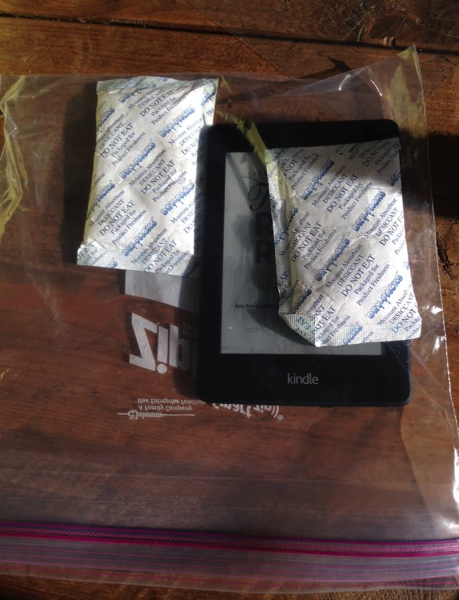
My Kindle Paperwhite got wet when my water bottle leaked on my travel pack.  Luckily nothing else got web except the Kindle Paperwhite.  The Kindle was locking up and the backlighting wasn’t working.  There is a common advice to put the wet device in rice.  Being Japanese-American I have plenty of rice to put the device in, but also being an engineer it didn’t make sense that putting a wet electronic in rice which has been exposed to air is an effective desiccant and the smart particles in rice could cause more damage.  Popular Mechanics has a post on this topic. 

Finally, use a desiccant to wick away any leftover moisture. The most convenient choice is uncooked rice. Just leave the phone (and its disconnected battery) submerged in a bowl of grains overnight. If you're worried about rice dust getting inside your phone, you can instead use the packets of silica gel that often come stuffed in the pockets of new clothes. But acting fast is far more important than avoiding a little dust, so don't waste time shopping if you don't already have a drawer full of silica gel. 

The most important thing to remember is to avoid heat. That means no hair dryers, ovens, microwaves or extended periods in direct sunlight. While heat will certainly evaporate the moisture, it could also warp components and melt adhesives. Those fragile glues are also why you'll want to avoid dunking the phone in rubbing alcohol (an oft­prescribed tip on the Web). Alcohol is a solvent and can dissolve the internal adhesives. (If you drop your phone in the toilet, it's okay to wipe the outside with alcohol to disinfect it.)

Fortunately, I have bags of desiccant to put in bags when I think my camera gear is going to be exposed to moisture.  Cameras (Lens, little motors, and electronics) tend to have much more problems with moisture than phones/tablets.

NewImage

24 hours later the Kindle Paperwhite works fine.