Is Newark's Data Center LLC project a Green Data Center?

The Green Data Center aspect is being debated as many focus on the environmental impact.

Newark City Council reviews report on data center’s environmental impact

Newark Mayor Polly Sierer and City Council presented a report on the potential environmental impact of the proposed data center and its adjoining power plant on the University of Delaware’s STAR campus during a special meeting on Monday night.

The report, produced by Liberty Environmental, concludes The Data Centers’ project is relatively clean, but it’s use of combustion engines and non-renewable fossil fuels in a 279 megawatt, gas-turbine power plant does not make it green.

Here is a post that makes the statement this data center is not green.

City's environmental consultant deems TDC project 'not green'

...


Biebuyck presented Liberty's findings to city council during a special meeting held Monday night in council chambers where he shared several “concerns” regarding TDC's air permit, deeming some of the company's claims “questionable,” “incorrect” and “misleading.”


“This project is to some extent clean but it's certainly not green,” he said.


Google's Data Center Machine Learning enables shaving Electricity Peak Demand Charges

A week ago I was able to interview Google’s Joe Kava, VP of Data Centers regarding Better Data Centers through Machine Learning.  The media coverage is good and almost everyone focuses on the potential for lower power consumption.

Google has put its neural network technology to work on the dull but worthy problem of minimizing the power consumption of its gargantuan data centers.

One of the topics I was able to discuss with Joe is the idea that accurately prediction of PUE and a mathematical model of the mechanical systems enables Google to focus on the Peak Demand during the billing period to reduce overall charges.  The above quote says power consumption is dull. What is focusing on peak power demand?  Crazy.  Or you understand a variable cost of running your data center. :-)

How you get billed is complicated and varies widely dependingUnderstanding Peak Demand Charges on your specific contract, but it’s important for you to understand your tariff. Without knowing exactly how you're billed for energy, it's difficult to prioritize which energy savings measures will have the biggest impact. 

...

In many cases, electricity use is metered (and you are charged) in two ways by your utility: first, based on your total consumption in a given month, and second, your demand, based on the highest capacity you required during the given billing period, typically a 15-minute interval during that billing cycle.

To use an analogy, think about consumption as the number that registers on your car’s odometer – to tell you how far you’ve driven – and demand as what is captured on your speedometer at the moment when you hit your max speed. Consumption is your overall electricity use, and demand is your peak intensity, or maximum “speed.”

National Grid does a great job explaining this: "The price we pay for anything we buy contains the cost of the product plus profit, plus the cost of making the product available for sale, or overhead.” They suggest that demand is akin to an overhead expense and note that “this is in contrast to charges…customers pay for the electricity itself, or the ‘cost of product,’ largely made up of fuel costs incurred in the actual generation of energy. Both consumption and demand charges are part of every electricity consumer’s service bill.”

When you think about the ROI of reducing your energy consumption the business people should understand the overall consumption and the peak demand of its operations.  Unfortunately it is all too common for people to focus only on the $/kWhr.

Google can look at the peak power consumption and see if there are ways the PUE could be improved to reduce the peak power for the billing period.

NewImage

Here are tips that can help you shave peak demand.

Depending on your rate structure, peak demand charges can represent up to 30% of your utility bill. Certain industries, like manufacturing and heavy industrials, typically experience much higher peaks in demand due largely to the start-up of energy-intensive equipment, making it even more imperative to find ways to reduce this charge – but regardless of your industry, taking steps to reduce demand charges will save money.

...

Consider no or low-cost energy efficiency adjustments you can make immediately. When you start up your operations in the morning, don't just flip the switch on all of your high intensity equipment. Consider a staged start-up: turn on one piece of equipment at a time, create a schedule where the heaviest intensity equipment doesn’t all operate at full tilt simultaneously, and think about what equipment can be run at a lower intensity without adverse effect. You may use more kWh – resulting in greater energy consumption or a higher “energy odometer” reading as discussed above – but you'll ultimately save on demand charges and your energy bill overall will be lower.


John Sculley Keynote, History of Disruptive Innovation, The Noble Cause

John Sculley gave the opening keynote at 7x24 Exchange here at Boca Raton on June 2, 2014.

Conference Keynote:
The High Tech Tsunami that is Changing the World


Three explosive high technologies, Cloud, Internet-of-Things, and Unstructured Data Science are converging at an amazing pace. Their derivative effects will be that every major industry will be disrupted, reshaped or even reinvented. Sculley will explain how companies like Amazon are combining exceptional customer experience, disruptive price, and same day delivery by taking advantage of advanced high technology supply chain systems. New business models like Amazon don't require a large number of higher skilled middle mangers that more traditional companies depend on. Sculley will discuss the possibility of middle managers becoming an endangered group as heavy lifting robots are joined by smart robots and the Internet-of-Things. How can corporations adapt to this fast changing world? John Sculley has a unique position as a leader in disruptive high technologies, a global investor and successful entrepreneur who is mentoring CEOs in his own companies in the fields of: the consumer era of healthcare; next generation mobile technologies; IT supply chain; and big data analytics. John will draw on examples from his current experience in the US and South Asia.


John Sculley


John Sculley
Former CEO of Apple and Former President of Pepsi


Let’s start with the end.  John discusses the Disruptive Innovation in The Adaptive Organization with these points.

- The best innovators focus on a “noble cause"

- Focus on best possible customer experience

- Disruptive Innovation is non-linear

- Disruptive innovators … see something others don’t …are passionate and relentless that “there has to be a better way"

- Are willing to commoditize their earlier innovations in order to move to the next era of disruption

NewImage

Let’s go back to some earlier slides.  John describes the Noble causes illustrating Bill Gates vision vs. Steve Jobs, and the passion of Steve Jobs focusing on the customer experience

NewImage

Disruption of non-linear is Kodak going bankrupt hit by the growth of smartphones.

NewImage

Being able to see things others don’t see are lessons learned.

NewImage

John then went into companies he has a role in or is an investor.

John is chairman of Pivot Technologies. http://www.pivotac.com/home/default.aspx

An investor in Misfit Wearables. http://www.telegraph.co.uk/technology/news/10405648/John-Sculley-Apple-Misfit-Shine-and-the-future-of-technology.html and Artemis http://www.fiercewireless.com/tech/story/artemis-pcell-offers-personal-cell-every-device-promises-dramatic-lte-capac/2014-02-19

This post is a bit of cheat to get insight.  I had a chance to talk to John Sculley at Breakfast.  The last time I had talked to John was 20 years in NYC, and we caught up a bit.


Technical Guy who Listens to Customers, Is One of Those Behind Microsoft's Changes

Mark Russinovich joined Microsoft the year I left 2006.  I had a chance to see Mark in action at a Microsoft conference in 2008 and in 2014 Wired has written a story that highlights Mark's role at Microsoft.

The one thing that stands out about Mark is his focus on the customer.

‘Look at what you’re doing through the eyes of the customer, treat the customer with respect, and assume the customer is smart.’

The company’s decision to refashion Azure as a service where businesses could run practically any software, including Linux, says Russinovich, was a direct response to discussions with longtime Microsoft customers. They wanted a way to move their existing software into the cloud, rather than just building new applications to suit Azure’s very specific architecture. “We needed to give them an on-ramp,” he says, and that’s what he helped design. It’s this kind of simple customer interaction, Russinovich explains, that shows how Microsoft is now aligning with his personal values. “It’s really just following some basics that can get lost in the heat of the drive to grab revenue and maximize profits: look at what you’re doing through the eyes of the customer, treat the customer with respect, and assume the customer is smart,” he says.


...

“He has real vision,” says HP cloud chief Bill Hilf, who once worked alongside Russinovich at Microsoft. “And he knows how to listen to customers.”

...

 “Without trust, there is no cloud. You’re asking customers to give you their data to manage, and if they don’t trust you, there’s no way they’re going to give it to you. You can screw up trust really easily. You can screw it up just by showing incompetence. But if you show intentional undermining of trust, your business is done.”

Infrastructure of IoT, Beyond availability and scalability

I wrote this post for Gigaom on what the Infrastructure of IoT is.  My thoughts are it is beyond the typical abilities - scalability, availability, etc.  I included part of what I wrote below.  For the full text go to the Gigaom post.

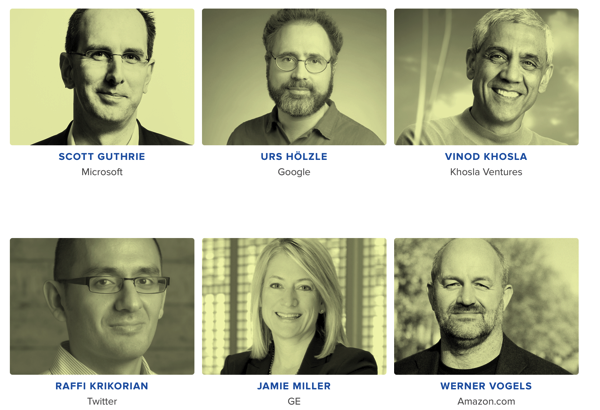
I am moderating panel discussion on the Infrastructure of IoT at Gigaom Structure on June 19.  Please join me there or watch the live stream.  This event should be one the of best here are the headline speakers.

NewImage

Here is my post on IoT.

Infrastructure of IoT, beyond availability and scalability

by Dave Ohara

 MAY. 24, 2014 - 12:00 PM PDT

 Comment

Internet of things, globe, fiber optics
photo: asharkyu
SUMMARY:

To handle the addition of billions more devices — including sensors that talk to each other, not necessarily to us — how must our infrastructure evolve? That’s a big topic on tap for Structure 2014.

Infrastructure is something that people are used to not thinking about. It is normally associated with roads, water, electricity, and telecommunications. Things it takes for a society to function. People just want infrastructure to work when they need it. When roads are being repaired, when the waterline breaks, when the power is out, and the Internet is down — that’s when people pay attention to infrastructure. Most would assume that the Infrastructure for IoT should be the same just like the rest of information technology (IT).

In IT, search, email, finance, social networks are the infrastructure for being connected. When people talk about infrastructure for IT they think of security, availability, scalability, and reliability, as the key capabilities to focus on. Whenever there is a security breach or services go down, teams scramble to remedy the situation. The internet of things is being driven by many of the same technology companies that users are familiar with. Running a Google Search for “IoT” the top three paid advertisers are Microsoft, Cisco, and Intel.

Building IoT Infrastructure the same as other IT Infrastructure

If you take a traditional approach, the IoT is the same infrastructure approach for IT but scaled to work with billions and billions of IoT devices. Servers, network, storage are now at a scale to allow billions of devices to be connected to cloud services. Along with this scale comes millions of failure events, which could be a degradation of device performance or outright failure. One view is users will get another device run setup based on the new device, connect a replacement IoT device, and the old one disappears. Another view is we have the history of your IoT device, we can help you repair it, replace it, or upgrade it. The damaged IoT device is part of a bigger experience and a device failure is an opportunity to build a new and better experience.

Tamar Budec, VP of portfolio operations at Digital Realty

Tamar Budec, VP of portfolio operations at Digital Realty

Some of you may still think I just want to build highly available, secure, and scalable Infrastructure for IoT, that users will expect it to be no different than their existing IT services. But, I would argue, that we need ore than that. we need IoT infrastructure that does more than compete on availability, security, and scalability. We need infrastructure that provides a sort of institutional memory of what you’ve done with your devices. Where do you think the money is in the infrastructure of IoT? A low-cost infrastructure that quickly gets commoditized or a value added service for the Infrastructure of IoT users will stick with?