News coverage on Microsoft's Latest Wind Project

Microsoft made an announcement of its latest wind energy project.

Microsoft Announces Largest Wind Project to Date

  • Comments 0

Microsoft is committed to reducing our environmental footprint, and over the past two years we continue to meet our goal of becoming carbon neutral. Our approach to meeting that goal, however, continues to evolve. Today, we are announcing another move to make our operations more environmentally sustainable by signing a 20-year power purchase agreement (PPA) for wind energy in Illinois that will be funded in part by proceeds from Microsoft’s carbon fee.

This is our second PPA, following the purchase in November of wind energy from the Keechi Wind Project in Texas. This most recent power purchase, the Pilot Hill Wind Project, is our largest wind investment to date. It is nearly 60 percent larger than Keechi, at 175 MW versus Keechi’s 110 MW. This project builds on our commitment to renewable energy and our strategic objective to transform the energy supply chain toward radically greater efficiency and reduced environmental impact.

The media coverage is pretty good.  Here are four articles.

Microsoft Announces New Wind Project To Power Data Center

Forbes - ‎1 hour ago‎
The Project will generate enough electricity to power Microsoft's data center in Chicago – or approximately 70,000 homes in Illinois. The Pilot Hill Wind Project is a 175 MW wind facility 60 miles from Chicago, IL, spanning the border of Kankakee and Iroquois ...
 

Microsoft aims to power Chicago datacenter with wind power

ZDNet - ‎4 hours ago‎
For Microsoft, the Pilot Wind Project energy purchase boils down to power its Chicago datacenter. Pilot Wind is operated by EDF Energy. Microsoft's purchase gives the Pilot Wind project a steady revenue stream and Microsoft gets to offset its carbon output.
 

Microsoft Banks On Wind to Power Chicago Data Center

eWeek - ‎21 hours ago‎
The new "wind farm is on the same electric grid that powers our data center in Chicago," stated Bernard in a blog post. "Because the Chicago data centerdraws power from the Illinois power grid, projects like Pilot Hill help provide a non-polluting source of ...
 

Microsoft to buy wind power for Chicago data center

GigaOM - ‎Jul 15, 2014‎
Google and Apple aren't the only tech giants aggressively pursuing clean energy for their data centers. On Tuesday Microsoft announced that it has signed a deal to buy wind power from a wind farm outside of Chicago for a 20-year term. The wind farm will put ...

Google, Facebook, Microsoft, and Apple regularly announce their renewable energy efforts for data centers.  We’ll see if others catch on.

Data Center Strategic Communications can be your strength or your weakness, Case Example The Data Center LLC

There has been a range of news coverage for the past few months on The Data Center LLC project in Delaware, and it looks the project has been cancelled with the university.

UD expels Data Centers project as 'bad fit'

The News Journal - ‎Jul 10, 2014‎
The University of Delaware has terminated its lease agreement with The Data Centers LLC, halting controversial plans to develop a data-center complex in Newark at the former Chrysler site, now UD's Science Technology and Advanced Research Campus.
 

Data center decision a loss for Markell

The News Journal - ‎Jul 12, 2014‎
In recent months, he was among the most prominent supporters of a plan to build a data center and power plant complex on a corner of the former Chrysler plant in Newark. When the project came under attack by locals, Markell made the debate personal, ...

One of the points media captured was the acknowledgement of how poorly The Data Center LLC communicated.

 "We've done a poor job of verbalizing this project," said Kern, president and CEO of The Data Centers, LLC, the company that made the proposal to the university. "It's very hard to explain to people how we will operate this facility because we haven't actually done it and we don't know our [electrical] load requirements, so we can't communicate it exactly."

...

When the university's working group issued its report last week, it validated Kern's first assertion. Yes, indeed, TDC had done a poor job of explaining its plan to create a $1.8 billion facility crammed with high-powered computer servers run by a 279-megawatt power system that would create its own electricity without relying on the conventional power grid.

And, while the UD team didn't quite say that TDC had come up with a nutty idea that's never going to work, the university made it quite clear that piling vague explanations on top of scant documentation to support a questionable business model is hardly the formula for selling a complex concept to a panel of top-notch, detail-oriented leaders of a major research university.

A strategic communication plan is a rarity in many endeavors.  A strategic communication plan is not just did you hire a PR agency.  Are the efforts you spend in communication and the media’s view of your efforts the battle you are ready to win?  Consider this post on Strategic Communication.

The late Colonel Harry Summers liked to tell a tale familiar to many who

served in Vietnam. In April 1975, after the war was over, the colonel

was in a delegation dispatched to Hanoi. In the airport, he got into a conversation

with a North Vietnamese colonel named Tu who spoke some English

and, as soldiers do, they began to talk shop. After a while, Colonel Summers

said: “You know, you never defeated us on the battlefield.” Colonel Tu

thought about that for a minute, then replied: “That may be so. But it is also

irrelevant.”1

If that conversation were to be held in today’s vocabulary, it would

go something like this. Colonel Summers: “You know, you never defeated us

in a kinetic engagement on the battlefield.” Colonel Tu: “That may be so. It is

also irrelevant because we won the battle of strategic communication—and

therefore the war.”

On a contemporary note, a US officer returning from Iraq said privately:

“We plan kinetic campaigns and maybe consider adding a public affairs

annex. Our adversaries plan information campaigns that exploit kinetic

events, especially spectacular attacks and martyrdom operations. We aren’t

even on the playing field, but al Qaeda seeks to dominate it because they

know their war will be won by ideas.”

Do you want eyes or hearts of followers, or are you in a dialog with their minds

Some people think social media is all about the # of followers you have.  I know some people who will ask how many twitter followers do you have.  I just finished Austin Kleon’s book Show Your Work and one chapter focus on the issue of followers.

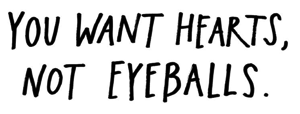
NewImage

“What you want is to follow and be followed by human beings who care about issues you care about. This thing we make together. This thing is about hearts and minds, not eyeballs.” —Jeffrey Zeldman

Stop worrying about how many people follow you online and start worrying about the quality of people who follow you. Don’t waste your time reading articles about how to get more followers. Don’t waste time following people online just because you think it’ll get you somewhere. Don’t talk to people you don’t want to talk to, and don’t talk about stuff you don’t want to talk about.

Kleon, Austin (2014-03-06). Show Your Work!: 10 Ways to Share Your Creativity and Get Discovered (Kindle Locations 543-548). Workman Publishing Company. Kindle Edition.

I don’t know about you but I don’t want someone’s heart.  I am interested in their mind and what they think.  I want minds, not eyeballs.  Now the problem with this is the media industry has convinced you that your heart is the center of emotions and passion.  The heart is the center of your blood circulatory system.  Last I checked the scientific community has not found any brain cells in your heart or blood. 

I hope my readers think and question and don’t just follow what their heart tells them to do. :-)

1341 vs 3100 words, Gassee response to Satya's email, Seems like 300 words should have been enough

One of my friends asked if I had read Jean-Louis Gassee’s post in response to Satya Nadella’s 3,100 word e-mail to employees.  

Microsoft’s New CEO Needs An Editor


Satya Nadella’s latest message to the troops – and to the world – is disquieting. It lacks focus, specifics, and, if not soon sharpened, his words will worry employees, developers, customers, and even shareholders.

As I puzzled over the public email Microsoft’s new CEO sent to his troops,Nicolas Boileau’s immortal dictum came to mind:

Whatever is well conceived is clearly said,
And the words to say it flow with ease.

Clarity and ease are sorely missing from Satya Nadella’s 3,100 plodding words, which were supposed to paint a clear, motivating future for 127,000 Microsoftians anxious to know where the new boss is leading them.

Now what is a bit ironic is Gassee says brevity is advised.  But, don’t you think Jean-Louis could have made his point in 300 words?

One of the most interesting points is Gassee analyzing explanations for the e-mail.

Two possible explanations come to mind.

First, because he’s intelligent and literate, he forgot to use an unforgiving editor. ‘Chief, you really want to email that?’ Or, if he used an editor, he was victimized by a sycophantic one. ‘Satya, you nailed it!’

Second, and more likely, Nadella speaks in code. He’s making cryptic statements that are meant to prepare the troops for painful changes. Seemingly bland, obligatory statements about the future will decrypt into wrenching decisions:

“Organizations will change. Mergers and acquisitions will occur. Job responsibilities will evolve. New partnerships will be formed. Tired traditions will be questioned. Our priorities will be adjusted. New skills will be built. New ideas will be heard. New hires will be made. Processes will be simplified. And if you want to thrive at Microsoft and make a world impact, you and your team must add numerous more changes to this list that you will be enthusiastic about driving.”

In plainer English: Shape up or ship out.

Tortured statements from CEOs, politicians, coworkers, spouses, or suppliers, in no hierarchical order, mean one thing: I have something to hide, but I want to be able to say I told you the facts.

Now, Gassse does include a 200 word version of what Satya’s e-mail says.

BTW, I ran a word count on this post and it is less than 400, but most of the words are what Gassee said, not mine. :-)