How Good is the Cloud? Hiring of Netflix VP for CIO job will change Yahoo's DC Strategy

Yahoo has announced it has hired a new CIO, Mike Kail.  Mike was VP of IT Operations at Netflix, the company who helped to create the momentum that the cloud is better than owning data centers.  ZDNet posts on Netflix being the biggest cloud app.

The biggest cloud app of all: Netflix

Summary: The largest pure-cloud play service of all is based on Netflix's open-source stack running on Amazon Web Services.


Netflix, the popular video-streaming service that takes up a third of all internet traffic during peak traffic hours isn't just the single largest internet traffic service. Netflix, without doubt, is also the largest pure cloud service.

It would seem like Mike Kail would be a person who would push the use of the Cloud at Yahoo.  Here is the press release on the new CIO.

 (YHOO) announced that Mike Kail has joined the company as CIO and SVP, Infrastructure. In this role, Mike will lead Yahoo’s IT and data center operations, reporting to CEO Marissa Mayer.


“The strength of our technical infrastructure is critical as we aim to deliver the best possible user and advertiser experiences. It also ensures that Yahoos have the tools and technology necessary to execute. After an intensive search for the right leader, I am excited to announce that today Mike Kail is joining Yahoo as our new CIO and SVP, Infrastructure,” said Yahoo CEO Marissa Mayer. “Mike has the perfect combination of experience and vision to lead our IT and infrastructure to even greater global reach and scale.”


"I’m extremely excited to be joining Yahoo and to contribute to their focus on building great sites and services," said Yahoo SVP, Infrastructure and CIO. "I'm looking forward to leading Yahoo’s world-class infrastructure teams, which will continue to provide the web scale architecture that enables the many outstanding products of the company."

Mike has 10 slideshare presentations over the past 11 months with none before that.  It would seem Mike has been getting his name out there as part of leaving Netflix.  Many times a sudden increase in executives giving presentation is related to them looking for a new job.

I was looking at the media’s coverage of Mike Kail’s move and didn’t find anything insightful.  Looking through Mike’s presentations provided more information on what he might do.

For example, here is Mike’s presentation on The future of IT infrastructure, a CIO perspective from May 2014.

The Future of IT InfrastructureThe Future of IT InfrastructurePresentation Transcript

  • The Future of IT Infrastructure The CIO Perspective mike d. kail VP of IT Ops :: Netflix @mdkail
  • IT :: Evolution IT Must Enable the Business Embrace Change
  • IT :: Revolution ● Cloud Adoption by CIOs
  • Financial Shift :: CapEx → OpEx ● Spending Efficiency ○ Over/Under Provisioning ● Cash Flow “smoothing” ● Business Agility ● Legacy → Innovative ● No More Write-Downs
  • IT Trends :: Moonshot Thinking ● IaaS / PaaS / SaaS ● Mobile Everything ● API Ubiquity ● Rebirth of SQL / ETL 2.0 ● Data Security ● Cloud Identity ○ AuthN + AuthZ + MFA ● Rich Applications ○ UI/UX ● Big Data Analytics
  • IT :: Roadmap ● Talent -- A+ Players ● Planning -- 10x goal ● Custom Applications Dev ● Data/Metrics Driven Decisions ● Consumerization Effect ● Security, Security, Security

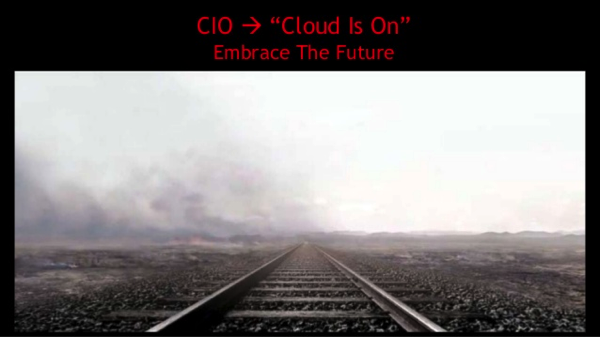
Slide 4 from above gives you tips Mike like to embrace the cloud.

NewImage

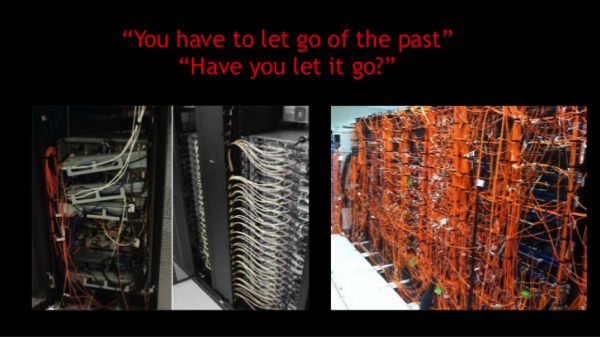
On Mar 2014, Mike preaches more on the benefit of the cloud.
NewImage

NewImage


Who is reading GreenM3 Aug 2014 - amazon.com #1

I have taken a long break from looking at Google Analytics for GreenM3.  In fact I haven’t written on this since 2011.

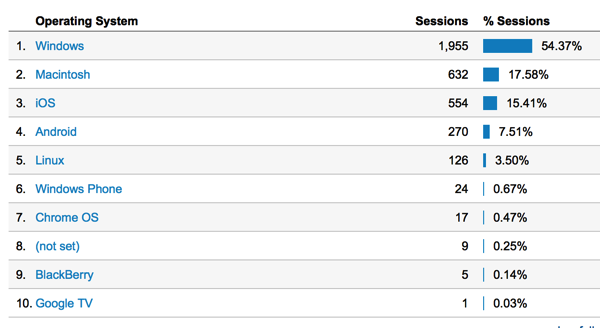
One of the most interesting is the % from various OS.

NewImage

Here is a list of some of the companies visiting GreenM3

  • Amazon.com & amazon technologies
  • Google
  • Microsoft
  • Cummins Engine
  • EMC
  • HP
  • 3M
  • Cisco
  • abovenet communications
  • Samsung
  • DPR Construction
  • Fidelity Investments
  • Kindle Wireless
  • Juniper Networks
  • NTT
  • Rackspace
  • Schneider
  • Tata
  • Centurylink
  • Dean Witter
  • Dell
  • Emerson
  • IBM
  • Boeing
  • ABB
  • Apple
  • Arista Networks
  • AT&T
  • Bechtel
  • Cap Gemini 

Solar is Hot in Britain? Combination of subsidies, public support, and creative finance

Saw this WSJ article that Solar Energy is Hot in Britain.

Britain Is Solar-Energy Hot Spot

Subsidies, Public Support and Creative Finance Benefit Solar

Argus Hardy walks among the fields of his farm in Great Glemham, Suffolk, recently turned into a solar power field by Allianz. Alex Masi for The Wall Street Journal

SUFFOLK, England—Alongside the old airfield here, ripening barley shifts in the breeze. Across the way, a more static crop stretches into the distance: 80,000 solar panels, their silvery surfaces facing south.

We are used to hearing about solar projects in Spain which have crashed due to the end of subsidies.  Other parts of Europe have been known for Solar and you wouldn’t think Britain would due to clouds and rain.

Britain, a land of cloudy skies and reliable rain, is fast becoming the hottest spot in Europe for many investors in solar energy. Germany is overcrowded with panels. A sudden end to subsidies killed Spanish solar. A sluggish economy is dragging on Italy.

Britain has grown substantially.

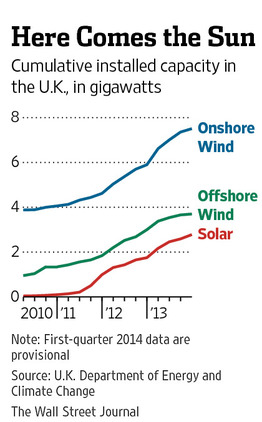
In 2010, there were under 100 megawatts of solar capacity in the U.K.—barely enough to power the homes of a modest town. Now, there is between 3.2 and 4 gigawatts. This year, market-research firm Solarbuzz projects that the U.K. will overtake Germany as Europe's largest installer of solar panels, putting in 6% of the world's new solar.

NewImage

The part that got my attention is the focus on the creative financing to make solar projects work.

"The U.K. solar sector is probably at the forefront of capital innovation in the global renewables sector," said Ben Warren, head of environmental finance at EY. "It's one of the very few areas where institutional investors are looking at making direct investments."

Several developers have also issued "solar bonds" to fund building, with private individuals investing through companies such as Abundance Generation, which adopts acrowdfunding model to connect investors with small projects—among them a plan to put panels on the roofs of schoolhouses.

Exchange-listed funds that offer exposure to solar have also sprung up in the U.K., among them Foursight Solar, Bluefield Solar Income FundBSIF.LN -0.24%NextEnergy Solar Fund and investment company The Renewables Infrastructure GroupTRIG.LN -0.17% which have all listed on the London Stock ExchangeLSE.LN -0.26% in the past two years. Bluefield raised £130 million at its initial public offering and has since raised more money for acquisitions.

Short Blogging Break

Taking a short blogging break.  Today was a day for a hike, a bloody mary, and some sun.  Oh, I admit I did do some work, but when work is fun it doesn’t feel like work.

NewImage

Kids are Skiing.

NewImage

You can see the snow on the mountain in this shot.

NewImage

It is too warm to ski all day, so the kids can go for a swim.

NewImage

NewImage

Some SSDs are not as energy efficient as you think

I was talking to a storage expert the other day and he mentioned a customer that I have worked with has chosen to go all SSD in its data center.  I would assume the logic is SSDs are the most efficient solution and given their purchasing power they can get prices that few others can get, therefore the cost differential vs. HDD can become a non-issue.  I heard this and think I know some of the people behind this and I questioned their assumptions to use SSDs as storage solution that eliminates HDD.

Digital Ocean has a lot of hype with their all SSDs environment and the idea that SSDs are the future can be a “false positive."

Doing a bit of research I found StorageMojo recently posted on SSDs - hot, hungry and slow.

High performance SSDs: hot, hungry & sometimes slow

by ROBIN HARRIS on FRIDAY, 25 JULY, 2014

Anyone looking at how flash SSDs have revolutionized power constrained mobile computing could be forgiven for thinking that all SSDs are power-efficient. But they’re not.

In a recent Usenix HotStorage ’14 paper Power, Energy and Thermal Considerations in SSD-Based I/O Acceleration researchers Jie Zhang, Mustafa Shihab and Myoungsoo Jung of UT Dallas examine what they call “many-resource” SSDs, those with multiple channels, cores and flash chips.

...

The price of performance
Each flash die has limited bandwidth. Writes are slow. Wear must be leveled. ECC is required. DRAM buffers smooth out data flows. Controllers run code to manage all the tricks required to make an EEPROM look like a disk, only faster.

So the number of chips and channels in high performance SSDs has risen to achieve high bandwidth and low latency. Which takes power and creates heat.

Bottom line here are some insights.

Key findings
The many-resource SSD exhibits several characteristics not usually associated with SSDs.

  • High temperatures. 150-210% higher than conventional SSDs, up to 182F.
  • High power. 2-7x the power, 282% higher for reads, up to 18w total.
  • Performance throttling. At 180F the many-resource SSD throttles performance by 16%, equivalent to hitting the write cliff.
  • Large write penalty. Writes at 64KB and above in aged devices caused the highest temperatures, presumably due to extra overhead for garbage collection and wear leveling.

And here is the kicker, a SSD can consume 2X the power of a HDD.

The StorageMojo take
This appears to be the first in-depth analysis of the power, temperature and performance of a modern high-end SSD. The news should be cautionary for system architects.

For example, one new datacenter PCIe SSD is spec’d at 25w – higher than the paper found on slightly older drives. That’s twice what a 15k Seagate requires.

The paper StorageMojo refers to is here.

This paper closes saying many-resource SSDs are 4-5X more power intense than conventional SSD and HDD.

Conclusions

In this paper, our empirical analysis reveal that dynamic power consumption of many-resource SSDs are respectively 5x and 4x worse than conventional SSD and HDD. Many-resource SSDs generate 58% higher operating tem- perature, which can introduce SSD overheating prob- lem and power throttling issues. Based on our analysis, HW/SW optimization studies are required to improve en- ergy efficiency of modern SSDs in many user scenarios.