The inefficient data centers are fading vs. Rapid Growth of the Efficient - Google, AWS, Facebook, Microsoft

The NRDC fired off a blog post this morning that got a bunch of other media to discuss the waste in the data center industry.

Our study shows that many small, mid-sized, corporate and multi-tenant data centers still waste much of the energy they use. One of the key issues is that many of the roughly 12 million U.S. servers operate most of the time doing little or no work but still drawing power – up to 30 percent of servers are “comatose” and no longer needed but still drawing significant amounts of power, many others are grossly underutilized. However, opportunities abound to reduce energy waste in the data center industry as a whole. The technology exists, but systemic measures are needed to remove the barriers limiting its broad adoption across the industry. 

ServerGraphic_R5.jpg

Over the last 5 years the data center growth of Google, Amazon, Facebook, Microsoft and many others has been growing a pace that blows away the rest.  The old dominants of financials has grown slowly or even declined with the exception of the analytics group that has built huge data farms.

Even though the NRDC raises concerns about the waste, the reality is the Cloud is helping to put so many of these old servers out of business.  But, the top issue is IT asset management is too many times poorly executed, making it difficult to identify the servers that can be turned off.

Gigaom Research analyst Dave Ohara said the report brings up valid points, but more factors need to be considered. CPU utilization is just one metric, Ohara said via email. “RAM and hard-disks also use up energy … and can be just as underutilized …  The problem is that IT asset management is mostly done as a bookkeeping exercise, not as part of a technical IT operations team who purchases, owns and operates the servers.”

Too many times the people who operate the servers can’t find the history of who owns the assets and what is on them.

China's Anti-Corruption Drive must have some kind of Effect on Data Centers

WSJ has an article on the anti-corruption drive in China.  What is interesting is a data drive approach vs. testimony.

"The procedures raise questions about denial of human rights," says Maya Wang, China researcher at Humans Rights Watch. In response, Chinese officials say Mr. Wang is encouraging his team to rely less on confessions and more on analysis of data.


The effects that get the notice is on things like luxury goods and the economies.

Lu Ting, a China economist at Bank of America Corp., estimates that the crackdown is shaving somewhere between 0.6 and 1.5 percentage points off China's gross domestic product growth this year, as sales plunge of luxury goods, high-end apartments and other baubles of the rich that could attract the attention of Mr. Wang's investigators. Government investment has also slowed because local officials fear that putting projects out to bid could open them to accusations of kickbacks.

Over the long run, economists argue, tackling corruption produces economic gains because government funds are spent more productively. Jailing powerful officials in state-owned firms may also make executives wary of trying to block Mr. Xi's plans to introduce more competition in state-dominated fields. But all of that can take years.

There are some good moves like recruiting staff from another province to investigate a different one.

Mr. Wang has fielded a dozen investigatory groups and fanned them out around the country. Many are headed by a retired official of ministerial rank who hails from provinces outside the one being inspected.

With all these efforts there must be some effect on data centers in China.  It’s just a bit hard to find where things are documented.

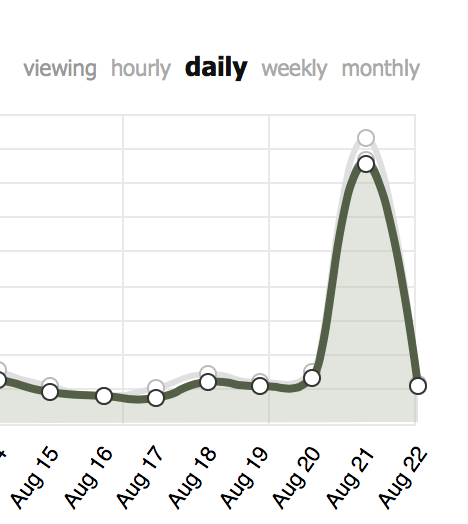
What did I write yesterday that got a big bump in traffic?

In the old days I used to look my blog metrics every day.  Now I look at them maybe once every 1 or 2 weeks.  This morning I checked out the metrics and saw this.

NewImage

What the heck did I write yesterday?

Oh that post on % of Google, Microsoft, and AWS employees recommending their company to friends.

Google-90%, Microsoft-77%, AWS-66%, % employees of who recommend working for their Cloud

Google, Microsoft, and AWS are in fight for the Cloud and recruiting top talent.  One way to judge how good their cloud is based on how good their employees are.  To get a peak into the employees you can use Glassdoor like Forbes did to discover whether employees would recommend working for the company.  For these top guys here are is one set of data.  90% of google, 77% of microsoft, and 66% of AWS employees would recommend to their friends to work there.

FYI, I was inspired to write this post because a friend of mine who works at Google mentioned how a particular executive was focused on recruiting top talent and his insight on what he needs to do to recruit the best in the industry.   I then just so happened to find the Forbes article on the Best Cloud Computing companies to work for.

Google-90%, Microsoft-77%, AWS-66%, % employees of who recommend working for their Cloud

Google, Microsoft, and AWS are in fight for the Cloud and recruiting top talent.  One way to judge how good their cloud is based on how good their employees are.  To get a peak into the employees you can use Glassdoor like Forbes did to discover whether employees would recommend working for the company.  For these top guys here are is one set of data.  90% of google, 77% of microsoft, and 66% of AWS employees would recommend to their friends to work there.

NewImage

You can go through the list to come up with where the rest of the cloud guys show up.

These results can give you an idea of the ability of each of these companies to recruit which allows them to build for the future.

WSJ says Public Library beats Amazon's Kindle Unlimited, yep

Years ago I used to buy 1-2 kindle books a month.  Now I buy a kindle book 2-3 times a year.  Why the change?  Reading less.  No reading more with 4-8 books a month going through my kindle.  I stopped buying books and started checking books out from the Public library.  Not physical books, but kindle books.

NewImage

I can check out a book at no charge for 3 weeks.  I figured if I don’t read a book in three weeks my probability of reading the book in future is less than 10%.

WSJ posts on its own analysis of Amazon Kindle Unlimited and they say the public library is better too.

A growing stack of companies would like you to pay a monthly fee to read e-books, just like you subscribe to NetflixNFLX -0.30% to binge on movies and TV shows.

Don't bother. Go sign up for a public library card instead.

Really, the public library? Amazon.comAMZN -0.34% recently launched Kindle Unlimited, a $10-per-month service offering loans of 600,000 e-books. Startups called Oyster and Scribd offer something similar. It isn't very often that a musty old institution can hold its own against tech disrupters.

But it turns out librarians haven't just been sitting around shushing people while the Internet drove them into irrelevance. More than 90% of American public libraries have amassed e-book collections you can read on your iPad, and often even on a Kindle. You don't have to walk into a branch or risk an overdue fine. And they're totally free.

And guess what the public library has more selection than unlimited.

Though you still have to deal with due dates, hold lists and occasionally clumsy software, libraries, at least for now, have one killer feature that the others don't: e-books you actually want to read.

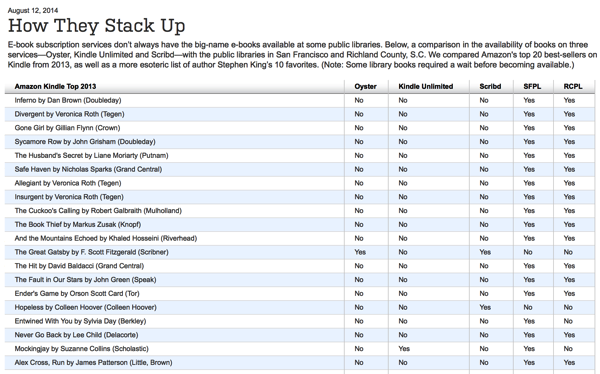
To compare, I dug up best-seller lists, as well as best-of lists compiled by authors and critics. Then I searched for those e-books in Kindle Unlimited, Oyster and Scribd alongside my local San Francisco Public Library. To rule out big-city bias, I also checked the much smaller library where I grew up in Richland County, S.C.

Of the Journal's 20 most recent best-selling e-books in fiction and nonfiction, Amazon's Kindle Unlimited has none—no "Fifty Shades of Grey," no "The Fault in Our Stars." Scribd and Oyster each have a paltry three. But the San Francisco library has 15, and my South Carolina library has 11.

Go to this graph the WSJ created to get the comparison and you can see your public library has a good chance to beat the paid unlimited services.  Oh by the way, you do pay for the library through your property taxes.

NewImage