Is your Data Center Team Arrogant? Do you see the impact?

A data center team has a hard job and almost everyone tries to recruit what they think are the best.  What my friends and I have been noticing is how some of the data center teams have been tipping towards an arrogance of thinking they know more than others.  Curious I ran a Google search on “technical arrogance technology” and the following are 5 articles, all about silicon valley’s arrogance pop up.

Why is arrogance bad?  Check out this article.

“Arrogant people are more
than willing to take credit for
their successes, but not their failures,”

Silverman notes. “They 

get angry when their ideas are
criticized, and they tend to put
their personal agendas ahead of
organizational objectives.”

Being more efficient in the data center by changing how you organize the hardware

So much of IT is governed by self optimizing behavior by different fiefdoms.  Security, Web, Data, Apps, Mobile, Marketing, Finance, Manufacturing most of the time own their own gear.  I had a chance to talk to Gigaom’s Jonathan Vanian to discuss how data center clusters (sometimes called cores or pods) are used to organize IT resources to be efficient vs. a departmental approach.  This has been done for so long it’s been well proven.

Here is Jonathan’s post.

Want a more efficient data center? Maybe it’s time you tried a core and pod setup


AUG. 27, 2014 - 5:00 AM PDT

No Comments

SUMMARY:

In order for companies to improve their internal data centers’ efficiency and improve their applications’ performance, many are turning to using a “core and pod” setup. In this type of arrangement, data center operators figure out the best configuration of common data center gear and software to suit their applications’ needs.

The fundamental idea is to let system architects define systems as resources for departments.

“You need to have some group that is looking at the bigger picture,” Ohara said. “A group that looks at what is acquired and makes it work all together.”

If more companies were using this approach making them more efficient many times they can get better price performance making them competitive with public clouds.

Jonathan wrote about my perspective.

How pod and core configurations boost performance

GoogleFacebook and eBay are all examples of major tech companies that have been using the pod and core setup, said Dave Ohara, a Gigaom Research analyst and founder of GreenM3. With massive data centers that need to serve millions of users on a daily basis, it’s important for these companies to have the ability to easily scale their data centers with user demand.

Using software connected to the customized hardware, companies can now program their gear to take on specific tasks that the gear was not originally manufactured for, like analyzing data with Hadoop, ensuring that resources are optimized for the job at hand and not wasted, Ohara said.

It used to be that the different departments within a company — such as the business unit or the web services unit — directed the purchases of rack gear as opposed to a centralized data center team that can manage the entirety of a company’s infrastructure.

Because each department may have had different requirements from each other, the data center ended up being much more bloated than it should have been and resulted in what Ohara referred to as “stranded compute and storage all over the place.”

And Jonathan was able to discuss with Redapt a systems integrator who has build many clusters/pods/cores.

Working with companies to build their data centers

At Redapt, a company that helps organizations configure and build out their data centers, the emergence of the pod and core setup has come out of the technical challenges companies like those in the telecommunications industry face when having to expand their data centers, said Senior Vice President of Cloud Solutions Jeff Dickey.

By having the basic ingredients of a pod figured out per your organization’s needs, it’s just a matter of hooking together more pods in case you need to scale out, and now you aren’t stuck with an excess amount of equipment you don’t need, explained Dickey.

Redapt consults with customers on what they are trying to achieve in their data center and handles the legwork involved, such as ordering equipment from hardware vendors and setting up the gear into customized racks. Dickey said that Redapt typically uses an eight-rack-pod configuration to power up application workloads of a similar nature (like multiple data-processing tasks).

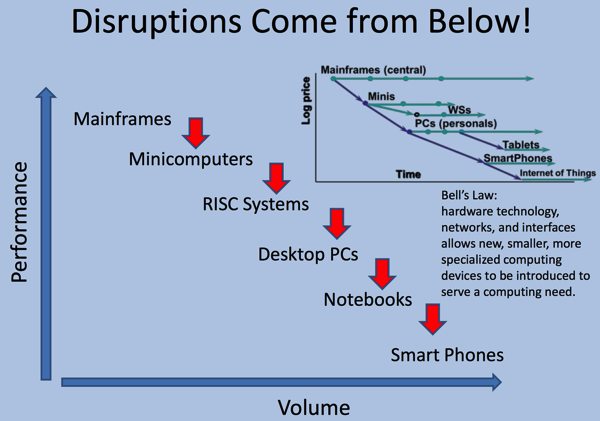
Mainframes, Mini's, Servers, and Mobiles Oh My, Journey through Computer Development

Taking a journey through technology world can be scary to many, causing users to panic.  In the beginning users couldn’t get to mainframes or mini’s.  Millions of servers exposed many more users to the scary use of technology.  Mobiles is in the hands of billions.

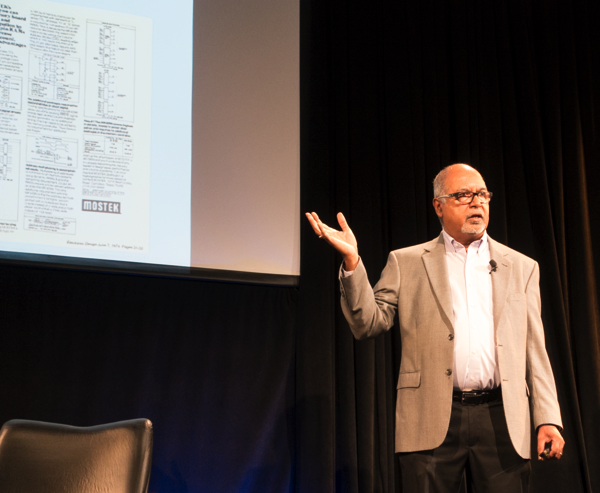
Dileep Bhandarkar gave a presentation at the Computer History Museum on Aug 21, 2014.  Dileep’s slide deck is here.

NewImage

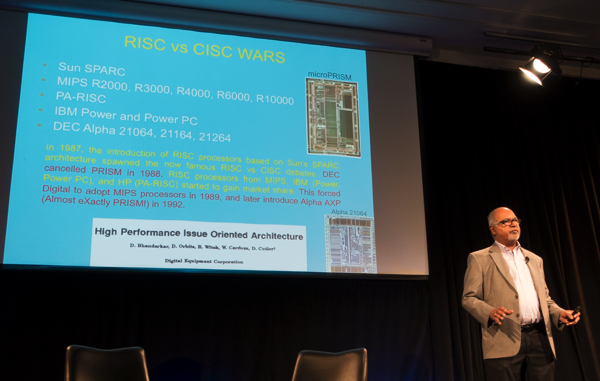
As a product developer you may think you don’t need to be scared.  Well there were wars going on fighting for survival.  Below Dileep covered the RISC vs. CISC wars.

NewImage

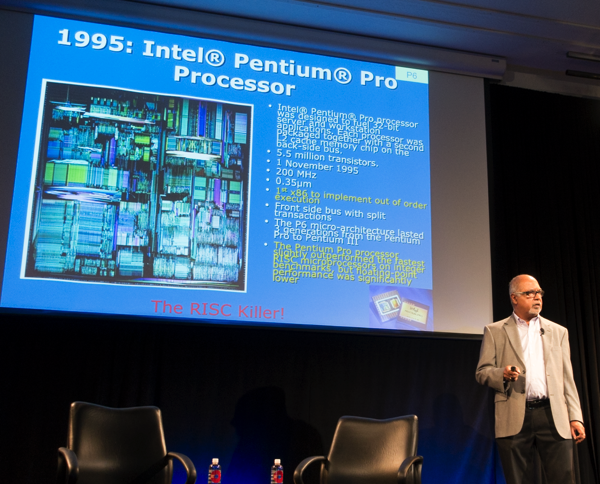
And Intel won the battle with the RISC killer chip.

NewImage

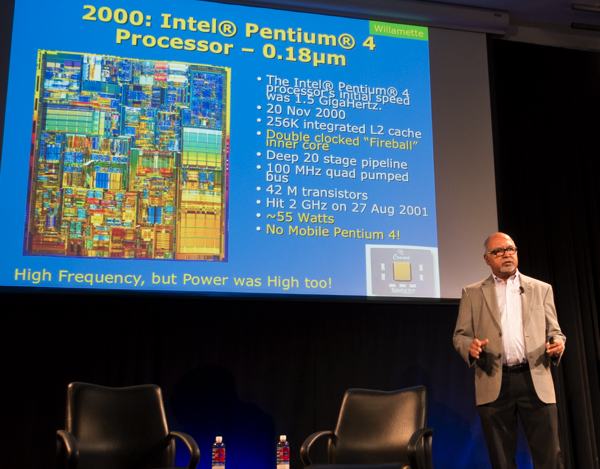
One of the more peaceful battles was the fight for energy efficiency.  The path of clock rate was consuming too many watts.

NewImage

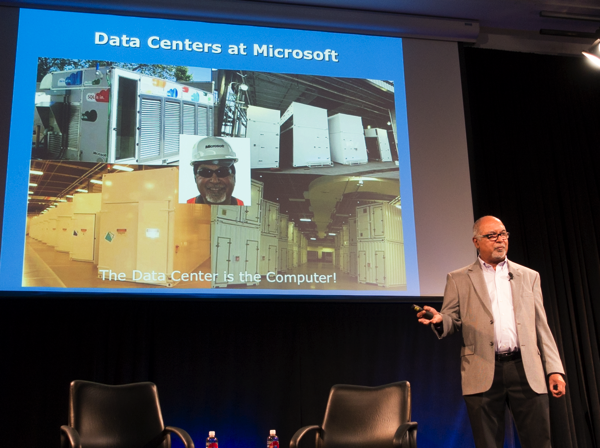
Dileep covered the Data Center as a computer where the battle was/is between Microsoft, Google, and Amazon.

NewImage

One overall theme in Dileep’s talk is how volume was behind so many of the wins.  And Mobile has the highest volumes now.

NewImage