Three years ago I started studying Galois Theory.
Not because I was pursuing a mathematics degree. Because I was trying to understand something specific: how to represent symmetry in complex physical systems with mathematical precision.
Galois Theory is the branch of mathematics that studies symmetry through group structure — why certain equations are solvable, what transformations leave a system invariant, how structure is preserved across changes. It is one of the most powerful tools in mathematics for reasoning about what stays the same when everything else moves.
I was building StructuralTruth. I needed the language.
StructuralTruth is built on symmetry detection. A governing relationship between mechanical assets in a data center is admitted when the same structural pattern holds across multiple independent witnessed closures — same morphism, same conditions, same field, repeated under real operating load. That is symmetry in the physical sense. Galois Theory gave me the mathematical vocabulary to be precise about what I was trying to capture.
Three years of study. No mathematician on the team — not because I didn't want one, but because I didn't think I could find a mathematician who could relate to the structural compiler I was trying to build. So I built it on my own.
Then I watched a video of Ken Ono.
Ono is a Japanese American mathematician who was drawn to Ramanujan as a young man — not just to the mathematics, but to the story. Ramanujan channeled theorems from intuition, from dreams, from a place that could not be fully explained. Ono spent years formalizing what Ramanujan had intuited. His PhD was in Galois Theory.
Carina Hong, founder of Axiom Math AI, recruited him.
When I learned that, I took a serious look at Axiom.
Axiom's core idea is verified AI: a chain where AI proposes, mathematics formalizes, Lean checks, and a proof witness verifies. Most AI systems generate answers. Axiom's tools prove them. The formal proof language Lean 4 is the assayer's scale — a proof is either correct or it is not. No gradient. No confidence score. Binary.
I could read the documents. But it was hard to understand exactly how Axiom's tools work just from reading. So I did what I should have done earlier.
I just tried AXLE and AXPLORER directly.
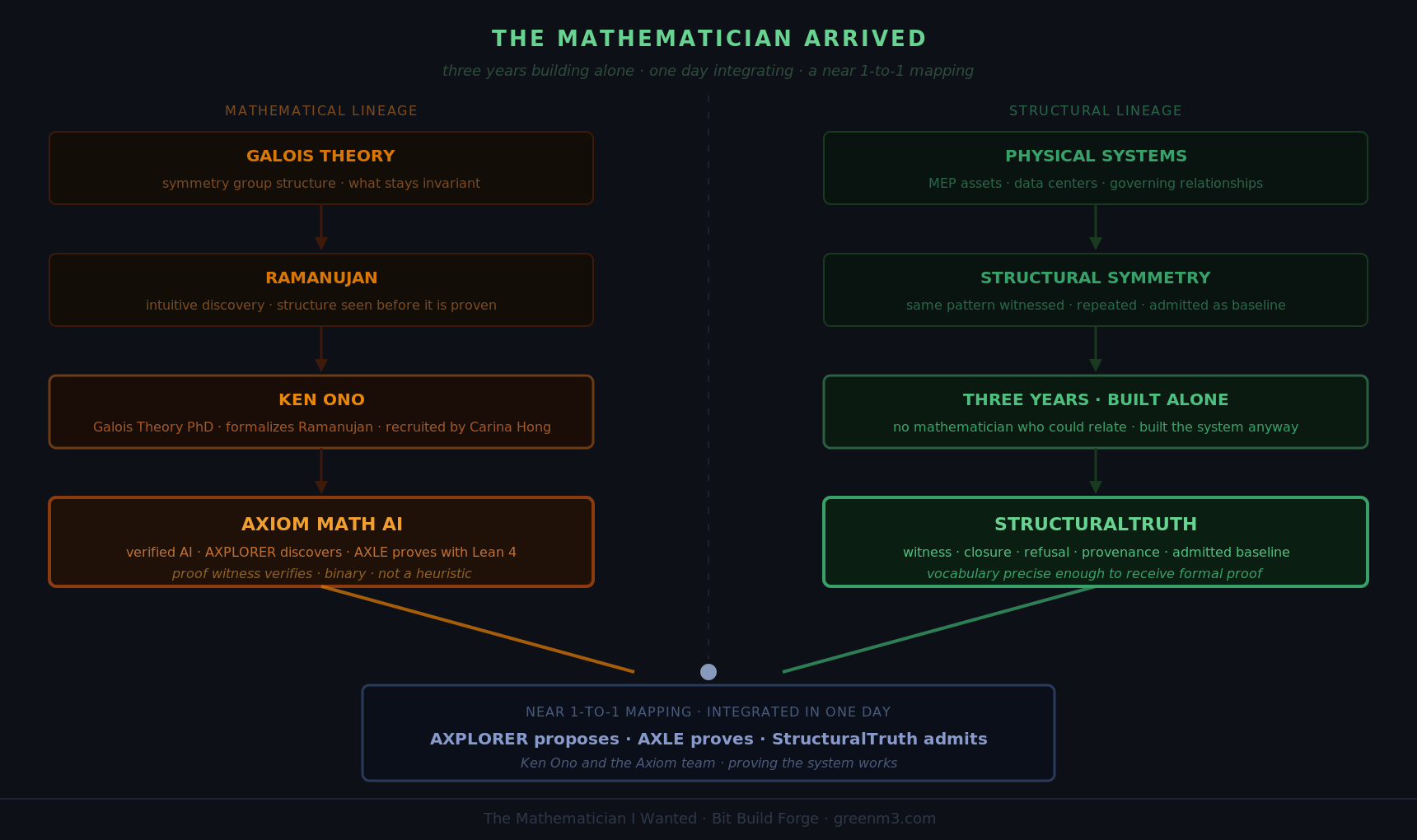
What I found was a near 1-to-1 mapping between Axiom's architecture and StructuralTruth's.
AXPLORER finds candidate mathematical structures worth checking — it explores and proposes. StructuralTruth already had candidate records, status transitions, and admission gates. AXLE submits proofs to Lean 4 and produces proof witnesses. StructuralTruth was already waiting for proof witnesses — the vocabulary of witness, closure, refusal, and provenance was already precise enough to receive them.
The tools snapped in because the grammar was already there. The integration that should have taken months happened in a day.
What emerged was a pattern that runs through both systems:
AXPLORER proposes.
AXLE proves.
StructuralTruth admits and composes.
The first proofs were about data. The more important proofs were about governance — verifying the laws that govern how StructuralTruth itself makes admission decisions. Status transitions that cannot skip required states. Verdict ladders with formally closed classification. Refusal gates that hold before preconditions are met.
The infrastructure checking proofs is now itself being checked.
The Galois thread runs through all of it.
Galois built the mathematical language for symmetry. Ramanujan intuited structure that others couldn't reach. Ken Ono spent his career bridging those two — formalizing Ramanujan's intuitions, working in Galois Theory. Axiom recruited Ono because that combination — intuitive discovery and formal verification — is exactly what a mathematical AI needs.
StructuralTruth detected symmetry in physical systems and built admission gates around it. When Axiom's tools arrived, the symmetry vocabulary was already there. Galois, Ramanujan, Ono, Axiom — they were all working the same problem from different angles.
Three years ago I wanted a mathematician who could work in this space. Someone who could take the structural intuitions built into StructuralTruth and make them formally provable. I didn't think that person existed — someone who could bridge physical systems, structural compilers, and formal mathematics.
I now have that. Not one mathematician — Ken Ono and the team of mathematicians at Axiom Math AI, proving that my system works.
Building the Reasoning Engine at Axiom
