Information completeness at the moment of handoff becomes the baseline the operational system reads for the next three years.
During construction, the information completeness bar is a project instrument. It tells you where the build is healthy, where work is stalling, where phases haven't mobilized. It guides decisions. It surfaces gaps before they become problems. It is valuable throughout the build.
At commissioning, it becomes something else.
The bar at commissioning is not a project management metric. It is the proof that GreenM3DC has a foundation to read from. What it shows at that moment determines how the operational system starts — and how long it takes to reach the standing it needs to do its job with confidence.
Two facilities at commissioning
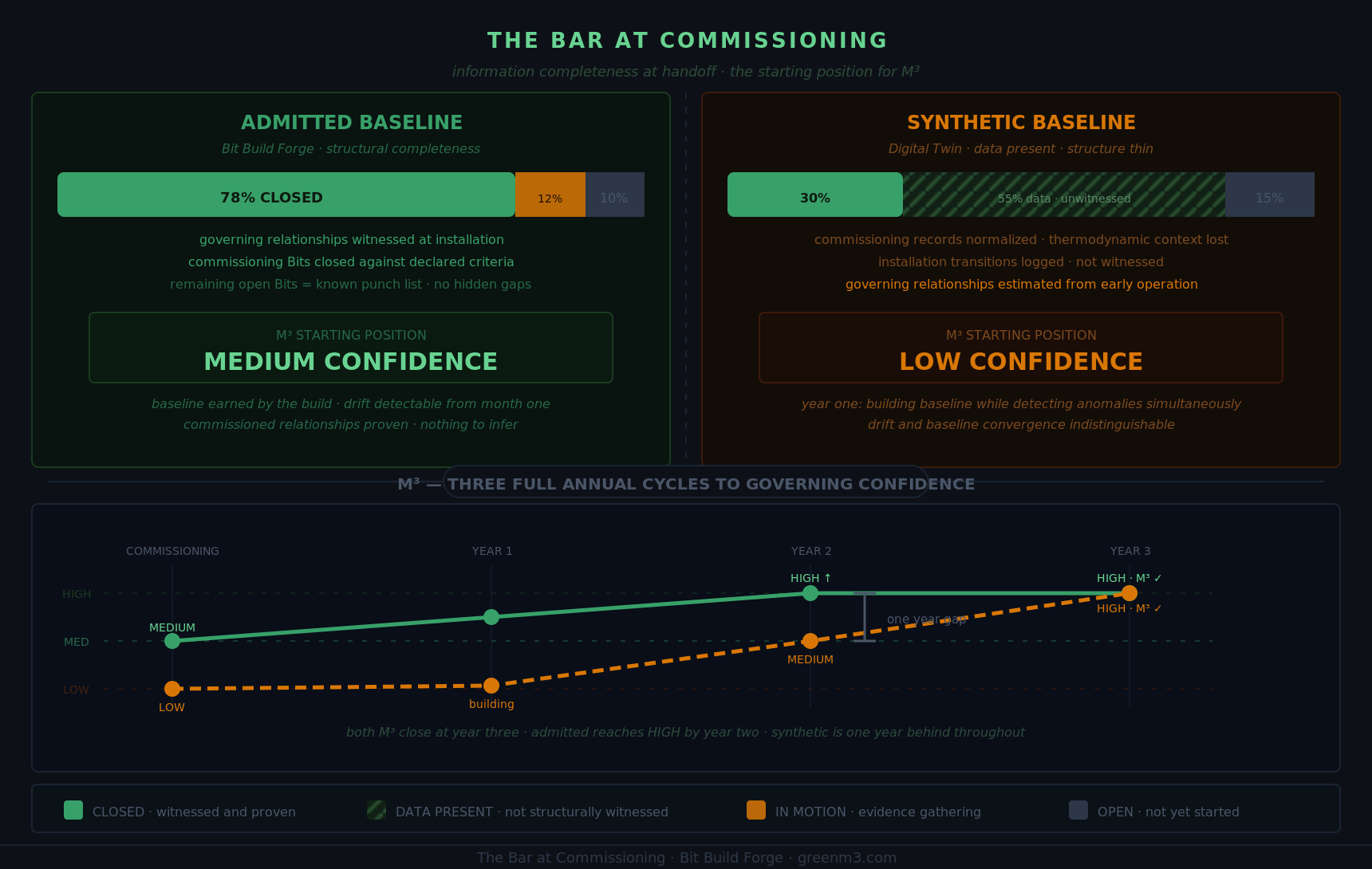
Consider two data center facilities at substantial completion. Both have their MEP systems installed. Both have passed their commissioning tests. Both are ready to go live.
The first facility ran its build through the Bit Build Forge. Installation Bits were witnessed as field work completed. Commissioning Bits were closed against declared acceptance criteria. The information completeness bar at handoff shows high structural completeness — most Bits closed and witnessed, a small known punch list of items in motion. The governing relationships between the chiller and the cooling tower, between the UPS and the IT load, between the generator and the transfer switch — all of them were established under witnessed commissioning conditions, at known load, with recorded performance data.
GreenM3DC reads an admitted baseline from day one.
The second facility managed its build through a Digital Twin. Data is present — procurement records, delivery confirmations, commissioning sign-offs. The model looks complete. But the structural standing is thin. The commissioning records were normalized into the central schema and lost their thermodynamic context. The installation transitions were logged but not witnessed. The information completeness bar, measured structurally, shows a large amber section — data present, evidence not filed, Bits unwitnessed.
GreenM3DC inherits a synthetic baseline. Not because the facility was built poorly — because the build's information was not structurally complete. The monitoring system cannot read admitted governing relationships that were not proven at commissioning. It infers them from early operational behavior instead.
What synthetic costs
A synthetic baseline is not a failure. It is an accurate statement of what the evidence supports. The governing relationships are estimated from the first months of operation — and those estimates improve as operational data accumulates.
But year one under a synthetic baseline is a different kind of year. The monitoring system is simultaneously building the foundation and trying to detect anomalies against it. The first drift signal might be real degradation. It might be the baseline catching up to actual performance. Under a synthetic baseline, those two things are hard to distinguish — not because the system is wrong, but because the evidence hasn't accumulated long enough to tell them apart.
The admitted baseline facility doesn't have that year. Its governing relationships were proven at commissioning. The monitoring system reads against a foundation that was earned by the build. Drift is detectable from the first operational month because there is something proven to drift against.
The starting position for M³
Three full annual cycles — M³ — are required before a governing model reaches its highest confidence class. That requirement does not change based on how the build was managed. Three years of seasonal evidence is three years of seasonal evidence.
But the starting position changes everything.
A facility that enters operation with an admitted baseline starts M³ at MEDIUM confidence. The commissioned relationships are proven. The first seasonal cycle deepens them. By the end of year two, the governing model is ready for HIGH confidence promotion. M³ closes on schedule.
A facility that starts with a synthetic baseline begins at LOW confidence. The first year is spent moving from synthetic to admitted. The second year deepens the admitted relationships. By the end of year three, the facility is where the first facility was at the end of year two.
One year behind. Compounded across the full operational life of the facility.
The bar during construction tells you where the project is. The bar at commissioning tells you where the operational system starts. Both readings matter. The second one lasts three years.
Build the Bits. File the evidence. Close the record.
The bar at commissioning is the one that counts.
— Dave / greenm3
