How GreenM3DC works with project information — and why it matters.
Every data center project generates a significant volume of information. Design documents, procurement records, delivery confirmations, installation reports, commissioning test results, warranty records. The question is not whether to manage that information. The question is how.
Two approaches are available.
Option one: Digital Twin
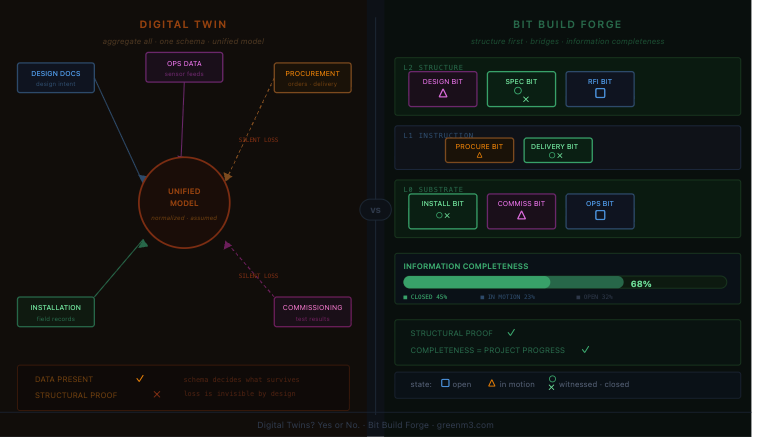
Aggregate all project information into a Digital Twin. A centralized model that consolidates records from every party — owner, designer, contractor, commissioning agent — into one unified view of the project and the facility.
This is a well-supported path. There is a wide choice of companies that provide Digital Twin platforms for data centers. The value proposition is comprehensiveness: everything in one place, one model, one source of truth.
The limitation is what comprehensiveness costs. A unified model requires a unified schema. A unified schema requires every party to either conform to it or export to it. As we have written about, that process produces silent information loss at every boundary where the schema doesn't fit the party's native cognitive model. The model looks complete. The information that didn't survive the translation is simply absent.
For operational monitoring, that absence matters. GreenM3DC reads governing relationships between MEP assets and facility performance. Those relationships were established at commissioning. If the commissioning record lost its structural detail in translation to a unified schema, the baseline GreenM3DC reads is thinner than the build actually produced.
Option two: Bit Build Forge
The alternative is to use the Bit Build Forge — structural information infrastructure built on the principle that information should be integrated by field, not by merging.
Integration by Field — Bit Build Forge Stacks and Layers
Every piece of project work — a design decision, a procurement order, a delivery record, an installation observation, a commissioning test — becomes a Bit: a unit with declared identity, explicit state, evidence requirements, and closure conditions. Each party works in their native environment. Bridges carry structural standing between them without forcing a common schema. The Bit field accumulates as the project progresses.
The result is not a unified model. It is a structural field — every piece of work located, stateable, evidenced, and comparable across roles and phases.
Information completeness as a project metric
Here is what the Bit Build Forge produces that a Digital Twin does not: a compiled information completeness score that correlates directly to the completeness of the project.
As Bits close — as state transitions are witnessed and evidence is filed — the information field becomes more complete. That completeness is not a reporting metric. It is a structural measurement. A project with 40% of its Bits in CLOSED state has 40% of its work structurally proven. The remaining 60% is visible: open Bits, named gaps, known evidence requirements. The completeness of the information mirrors the completeness of the build.
A Digital Twin can hold 100% of the data and still have 0% structural completeness — if that data was normalized, unwitnessed, and untraced to its source.
For GreenM3DC, this is the difference between entering operation with an admitted baseline and entering operation with a synthetic one. The admitted baseline was earned by a build whose information was structurally complete. The monitoring system reads against a foundation that was proven, not assembled from fragments after the fact.
Digital Twins: useful for live operational awareness. Not designed for structural completeness.
Bit Build Forge: designed for structural completeness. The build proves itself as it progresses.
For GreenM3DC, the choice is clear.
— Dave / greenm3
