The number is a reading. The shape is the diagnosis.
The information completeness bar is not a progress report. It is an instrument.
A progress report tells you how much work has been done. An instrument tells you what condition the project is in — not just how far along it is, but whether what's been done is proven, what's in motion, and where the gaps are. Those are different questions. A progress report can show 68% complete while the project is in serious trouble. The completeness instrument shows you why.
What the number means at each phase
At 20%, a project is in early procurement. Most Bits are in OPEN state — declared, with evidence requirements named, but not yet met. The design Bits that are closed represent approved specifications. The procurement Bits in motion represent orders placed but not yet delivered. The completeness is low because most of the work hasn't happened yet, not because anything is wrong. At this phase, low completeness is correct.
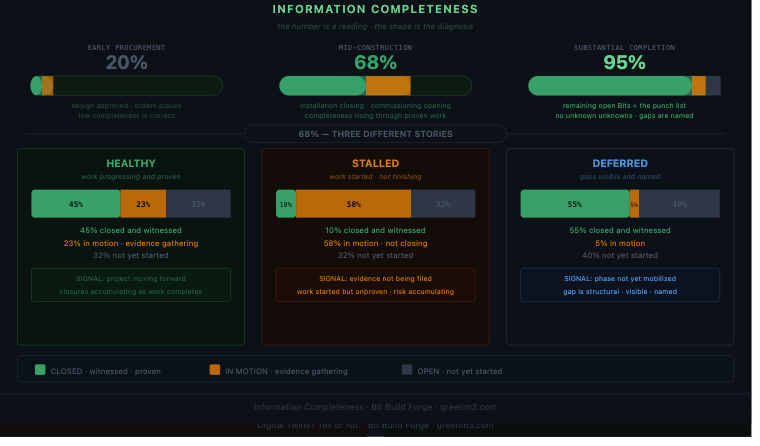
At 68%, a project is mid-construction. Installation Bits are closing as field work is witnessed. Commissioning Bits are opening as systems are ready for testing. Procurement Bits are mostly closed. The completeness score is rising not because more data is being entered — because actual work is being proven. Each closed Bit represents a state transition that was witnessed and filed.
At 95%, a project is approaching substantial completion. The information field is nearly full. The remaining open Bits are the punch list — gaps with names, evidence requirements known, closure conditions declared. The project doesn't have unknown unknowns at this stage. It has a visible list of what still needs to close.
A Digital Twin can show 95% data population at any of these phases — because data population is not the same thing as structural completeness. A Digital Twin at 95% data means most fields are filled. Information completeness at 95% means most Bits are closed, witnessed, and proven.
What the shape tells you
Two projects can both show 68% information completeness and be in very different condition.
A project at 68% with 45% closed and 23% in motion is healthy. Work is progressing and being witnessed as it completes. The in-motion Bits represent active state transitions — work started, evidence being gathered, closure coming. The open Bits are the work that hasn't started yet. The shape says: this project is moving forward and proving itself as it goes.
A project at 68% with 10% closed and 58% in motion has a different problem. Most of the work is in flight but not finishing. Bits have been opened — work has started — but closures are not accumulating. Evidence requirements are not being met. State transitions are being initiated but not completed. The shape says: there is a lot of unresolved work in the system. Things are started but not proven.
Same number. Completely different project health. The shape is where the diagnosis lives.
A third pattern is also visible: a project at 68% with 55% closed and 5% in motion and 40% open. Most of what's been started is finished. But a large portion of work hasn't been started yet. That is a sequencing signal — a phase of the project that hasn't mobilized, or a category of Bits that is being deferred. The gap is structural and named. It does not hide.
What GreenM3DC reads from this
GreenM3DC enters a data center facility at the moment of operation. What it reads from day one depends entirely on what the build produced.
The information completeness threshold for an admitted baseline is not 100%. It is the level at which the governing relationships between MEP assets have been structurally proven — witnessed at installation, closed at commissioning, filed in the substrate. That threshold is where the operational system stops working with a synthetic baseline and starts working with an admitted one.
A facility that reaches that threshold at commissioning starts M³ from a position of earned standing. The completeness bar isn't a project management metric at that point. It is the proof that the build produced what the operational system needs to do its job.
The bar doesn't lie. The shape doesn't hide. That is what information completeness is for.
— Dave / greenm3
