Will CUE be as popular as PUE? Don't think so

Today the Green Grid announced the CUE metric, Carbon Usage Effectiveness metric to help measure the carbon impact of IT equipment.

CUE is defined as

image

The carbon emissions divided by your IT load. Provides a ratio of kg/CO2/kWHr where the best is 0.  Note you can be near zero with hydroelectric or nuclear power sourcing.

I think a simpler way to understand the metric is.

image

image

You can pick your CEF by site selection.

You can pick your PUE by data center design.

Multiple them and you get the CUE.

But I think this is a metric that will not be popular.  Why? Because what is really important to many people is the total number of metric tons of CO2.  That's an easy number for people to understand.

PUE is an easy metric for people to grasp as the closer to 1.0 the better.  PUE is discussed much more than DCiE.

The news is being spread by the Green IT press.

James Niccolai at PC World.

Green Grid Creates Metrics for Carbon and Water

By James Niccolai, IDG News

The Green Grid consortium, which developed the widely-used PUE metric for measuring energy efficiency in data centers, is developing two more metrics to address carbon emissions and water usage, it said Thursday.

Rich Miller at Data Center Knowledge.

Green Grid Creates Metrics for Carbon, Water

December 2nd, 2010 : Rich Miller

Expanding its focus on sustainability, The Green Grid today announced the creation of two new metrics to measure carbon and water use in data centers. The new metrics, Carbon Usage Effectiveness (CUE) and the upcoming Water Usage Effectiveness (WUE), are designed to build upon the momentum of The Green Grid’s widely-used Power Usage Effectiveness (PUE) metric.

Penny Jones at Data Center Dynamics.

The Green Grid gives birth to two new metrics

Carbon and water are the next targets of the standards body

(12/2/2010)

Penny Jones

The Green Grid is going beyond PUE, unleashing two new metrics on the data center industry it said it hopes will gain the same amount of global traction – CUE and WUE.

Power usage effectiveness (PUE) is now used around the world to measure the amount and effectiveness of power used within the data center. It is hoped that CUE (carbon usage effectiveness) and WUE (water usage effectiveness) will create some more particular challenges in the data center.

One way to view metrics is to change behavior.

Is CUE a ratio of carbon emissions for power going to drive changes in behavior?

Or

Is the total Carbon impact a number people can understand?

You could have a low CUE with horrible IT utilization and a high total carbon impact.  Or you could have a high CUE, high utilization IT with lots of private cloud type of technologies and a low total carbon foot print.

What behavior do you want to drive?

I think the intent is right, the question is whether it will change behaviors.

Read more

A more enlightened approach to change

To Green the Data Center with lasting sustainable value requires change.  Measuring PUE adds a metric.  Meeting a LEED certification creates a requirement.  Small changes are made to accommodate these needs.  But, many times there is not a fundamental change.

Why change?  Because, if you don't change you do the same things you have done in the past.  Many learn to change labels of what they do, picking up new acronyms and buzz words, but don't fundamentally change.

So, if you are going to change you can take the approach of pick your number, define a timeline, make a plan, get a budget, execute, promote how you were successful, but ultimately fail in making a lasting change that feels good.

Why?  Because you weren't open to ask the tough questions.  You went for the easy answers.  A lower PUE and a LEED certification.

Twitter's Kevin Weil put it well.

image

If you want to change, think about how to ask the right questions.

I think most people are changing to conform to accepted changes.  It's safe.  Which brings up an issue of whether conforming to norms is consider change?

If you want to change to be more competitive you most likely want to innovate.

Are you changing to innovate or changing to conform?

Read more

US companies building Data Centers in other markets

US based companies build some of the biggest data center portfolios in the world.  The rate of expansion in markets outside the US will grow faster than the US data center market.  Digital Realty Trust announced their Asia expansion.

Jim Smith, chief technology officer (CTO) of the U.S.-based Digital Realty Trust, said the company had been thinking of entering the region earlier in 2008, but the recession in the latter half of that year proved to be a "distraction". Since then, many of its existing customers have been after the datacenter operator to branch out into this part of the world, he noted.

The CTO, who was in town for a conference, told ZDNet Asia during an interview Thursday that as Asia-Pacific has not experienced the "datacenter boom-and-bust" cycle that afflicted the U.S. during the dotcom years at the turn of the century, there are no legacy IT systems to contend with.

Furthermore, there is pent-up demand for more datacenter space and capabilities as companies in this region got out of the 2009 recession pretty quickly and are growing fast, he said. Increasing interest in cloud computing and virtualization technologies by businesses here are the other demand drivers mentioned by the executive.

To address the demand, Smith named four countries, namely Singapore, Australia, Hong Kong and India, which the company will be looking to work out of. Elaborating, he noted that Digital Realty Trust focuses on financial centers globally and has a presence in cities such as London and Paris. The Asian markets that the company is targeting are a natural extension of its business strategy, he said.

HP announced their 6 Global Service Hubs.  IBM has their international strategy.

Yahoo announced its Switzerland data center.  Many have gone to Dublin.

It will be interesting to see what plays out in Asia.  One huge advantage HP and IBM have vs. a Digital Realty Trust is their hiring of thousands employees in the country.

Just like any smart data center site selection process looks at the tax incentives.  The tax incentives for international are important.  HP has the tax incentives for its Malaysia global cent. 

CIO.com: Although these six hubs are not all new to HP, you will be staffing up in these locations. How many and what types of professionals are you hiring in each country?

Rasmussen: We did have a presence in these hubs already, but not at the scale we currently have or with the government approvals and tax benefits. We are aggressively hiring and building them out today. We don't disclose [employment] numbers at the location level or the "best shore" level.

Those who only want data center space like Digital Realty Trust are at a disadvantage to companies like HP, Google, and IBM that can negotiate with their local employee numbers which creates the support for the data center build out.

A more sustainable/green data center strategy requires understanding the environment., not just the environmental issues in an Asia country which includes the social, economic, and political issues.

Growth outside the US is huge.  Many of my best friends are people I worked with on developing products for Asia markets and purchasing products/services from these markets as well. 

Many people fall in love with a culture and want to immerse themselves in it and try to be a local, adopting local customs and business methods.  One good friend in
Japan said you are good at knowing the Japanese, but your advantage is you don't care about doing things the Japanese way, you just want to do the right thing.  They can't control you by telling you, "Sorry Ohara-san we just don't do things that way here."  which gets most Westerners to back off.

One of the funniest things to watch was big 6ft 5in Americans talk Japanese like a woman as he takes Japanese lessons at work from a woman who doesn't do business in Japan.  if you never knew there are gender differences in speaking Japanese.

Gender differences in spoken Japanese

From Wikipedia, the free encyclopedia

The Japanese language is unusual among major languages in the high degree to which the speech of women collectively differs from that of men. Differences in the ways that girls and boys use language have been detected in children as young as three years old (Tannen).

Such differences are sometimes called "gendered language." In Japanese, speech patterns peculiar to women are sometimes referred to as onna kotoba (女言葉, "women's words") orjoseigo (女性語, "women's language"). The use of "gender" here refers to gender roles, not grammatical gender. A man using feminine speech might be considered effeminate, but his utterances would not be considered grammatically incorrect. In general, the words and speech patterns considered masculine are also seen as rough, vulgar, or abrupt, while the feminine words and patterns make a sentence more polite, more deferential, or "softer" (countering abruptness). Some linguists consider the rough/soft continuum more accurate than the male/female continuum – for example, Eleanor Harz Jorden in Japanese: The Spoken Language refers to the styles as blunt/gentle, rather than male/female.[1]

There are no gender differences in written Japanese (except in quoted speech), and almost no differences in polite speech (teineigo), except for occasional use of wa (and except for the fact that women may be more likely to use polite speech in the first place).

I get around this whole issue when I was in Japan by never speaking Japanese.  I learned on my first trip to Japan in 1987, speaking Japanese doesn't work for me as the people expect my Japanese to be perfect because I look so Japanese.

I should think of these old Asia trip stories more, they are funny. Smile

Read more

Oregon's offense as a Speed Advantage, should data center support be faster?

College football is more fun to watch given the creativity coaches try for a competitive advantage.  This got me thinking after talking to a data center executive and how some of the most difficult changes can be caused by people who want to keep things the same as the status quo protects their jobs.

WSJ has an article analyzing the speed of the Oregon Duck offense.

Oregon's Offense: Gone in 23.2 Seconds

Top-Ranked Ducks Hustle Between Plays to Tire Opponents; the Next Great Innovation?

By DARREN EVERSON

[Sports_Oregon]Getty Images

LaMichael James (center) of Oregon runs the ball against UCLA last week in a game that the Ducks won 60-13.

Like any endeavor, college football has a number of traditions and standard practices that don't make perfect sense.

Take, for instance, the pace at which most teams run their offenses. On average, it takes about 34 seconds from the end of the previous play for a conventional college team to start the next one—an interlude in which players walk to the line of scrimmage, catch their breath and convene a short staff meeting known as the huddle.

Here is a video clip that shows the speed of Oregon offense.  Watch the play clock in the background.

The speed of football is something that seems like a constant.  But, what happens if you challenge the status quo and prioritize speed and agility.  The ability to keep the defense off balance.

Based on a sampling of recent games, Oregon's average time between plays is 23.2 seconds—32% faster than the norm. And for them, that's just third gear.

In their most recent game at home against UCLA on Oct. 21, the undefeated Ducks were doing 23 seconds between plays during their first possession until they reached the Bruins' eight-yard line. Then they ripped one off in 14 seconds, while UCLA's players were still getting set. The result: an eight-yard touchdown run that met almost no substantial resistance.

The Oregon coach even distracts from his strategy.

Oregon coach Chip Kelly was coy this week when asked about the thinking behind his team's frenetic pace. "It's just for television," he said. But as the 7-0 Ducks roll through their schedule, exhausting the opposition with their running game and their tempo, it's becoming apparent that Oregon's fast-paced style of play is potentially the next great evolution in the sport.

Look who is fast

[oregon]

Many will say you can't do this in data centers.  But, think about this.

And for the man in charge, Oregon's style has further benefits. "As a playcaller, you can call a lot of really bad plays and people will forget about them," Mr. Kelly said, "because we're on to the next one."

Think about who are the most innovative and whether they are willing to make more decisions, understanding the risk.  Look how many data centers have problems and they move slowly with a consensus to minimize risk.  Being the slowest is not necessarily the best, but it can be the safest to protect the jobs of the team.

How many companies are thinking like this?

"We're playing at a pretty good clip now because our players have a pretty good idea what we're trying to do," said Mr. Kelly, the Oregon coach. "We just try to eliminate that time between plays. Just go play."

Can you imagine a data center support team who moved as quickly as the Oregon Duck Offense?

Read more

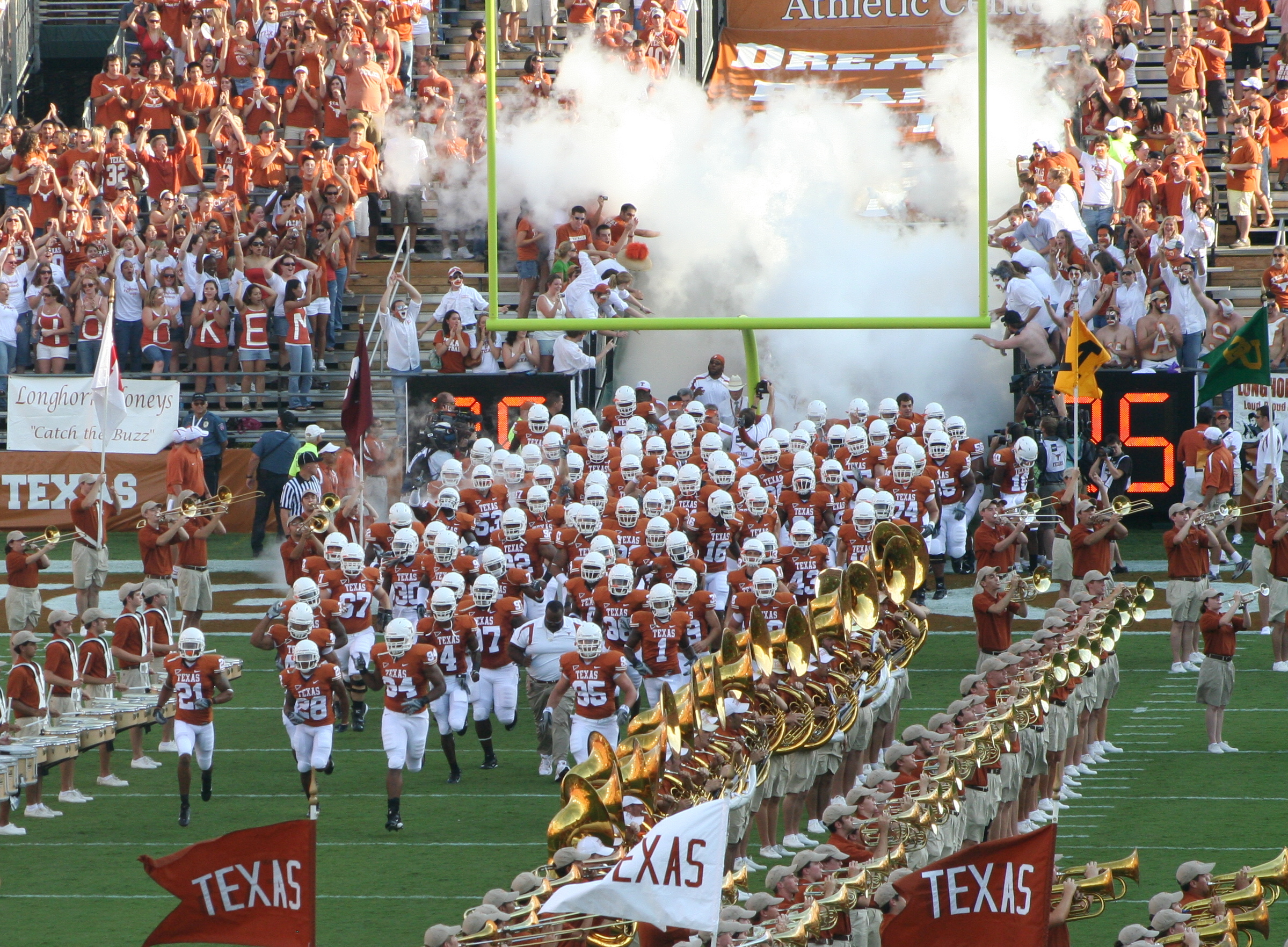
Taking a short blogging break, Go Longhorns!

I have been in heavy research mode working 7 days a week for the last month, and for the next few days I am going to attempt to unplug.  To restrict my ability to blog I am taking my daughter to her first Texas Longhorn Football game.

I am a UC Berkeley alumni, but have more fun cheering for friends and families alma mater. One of our best family friends are Oregon Ducks who are #1.

There are distractions in Austin, TX.  Smooth-Stone is HQ in Austin.  Dell is Round Rock.  And, the University of Texas has a new data center.

On the other hand, my cousin I am visiting in Texas was an-American swimmer for UT, so we will be busy with his swimming friends.  We could talk about water, but I don't expect many data center discussions.

I'll be back researching data centers on Monday, and I am sure I'll have a bunch more to discuss.

Checking my own metric on whether the break is good my blood pressure dropped back to 117 over 78 a day after I made the mental break.

Read more