CIOs postpone HP IT purchases, as we all know CIOs don't like Risk

WSJ has an article describing how CIOs are postponing HP HW purchases.

H-P's Customers Backing Off

Hewlett-Packard Co.'s recent strategic moves have shaken the confidence of investors. Now customers of the technology giant are also getting nervous.

That applies to Ray Barnard, chief information officer of Fluor Corp., an engineering and construction company that spends around $25 million a year on new hardware and software. Fluor was recently considering buying high-end computers capable of displaying 3D graphics from H-P, as well as doing a pilot project involving tablets with the tech company.

Now, however, "I've put that all on hold" and won't buy from H-P, he said. "It appears that they're lost right now."

HP has created risk in purchasing their equipment by self-inflicting their own damaging situation.

Several H-P customers said they are most concerned about what they see as a lack of a clear direction from the world's largest tech company by revenue, signaled in part by H-P's decision to exit the PC business. H-P is currently the world's biggest maker of PCs by shipments and revenue.

Compare this situation to IBM's Lenovo partnership.

IBM and Lenovo

IBM has engaged in an historic alliance with Lenovo. To bring long-term value for clients, companies need to continually reinvent themselves. IBM's multi-year agreement with Lenovo is broad-based and allows IBM to continue to provide end-to-end solutions to our clients. Lenovo is now the preferred provider of IBM-branded personal computers to our clients, and IBM will continue to provide financing and maintainance services for those PC solutions.

This alliance is consistent with IBM's strategy to be the world leader in providing technology and transformation solutions, for you, our enterprise and our small and medium business clients, in all industries and countries worldwide.

Working with leaders

Lenovo has the leading position in the fastest growing market in the world. Their acquisition of IBM's PC business makes them the third largest PC supplier in the world. In addition, the people of ThinkPad® notebooks and ThinkCentre™ desktops are now part of the Lenovo team -- the award-winning engineers, the manufacturing teams, the sales representatives, the business partners. In short, the people you know. The ones you count on.

This sale moves our PC business from an element in the IBM portfolio to a key element in IBM's network of alliances. It extends IBM's reach and capabilities in areas where you, our IBM clients, are better served through this alliance. Lenovo shares our passion for innovation, quality and service. IBM's strategy is clear. Lenovo's strategy is clear. Together we're a powerful combination for your business and we are committed to your success.

 

Attending Intel Developer Forum, Sept 13 - 15, 2011

Summer is almost over, and it is time to get back on the road.  My first trip is to Intel Developer Forum.

NewImage

I last went to IDF 2 years ago, and I know I'll see some great people at the event.

Here are a few of the tracks that look interesting.

Cloud Computing: Evolution of the Data Center

Cloud computing is an important transition and a paradigm shift in IT services delivery–one that promises large gains in efficiency, agility, and flexibility at a time when demands on data centers are growing exponentially. In this track, get the latest insights into Intel’s Cloud 2015 Vision. Hear about advancements in compute, network, and storage for the cloud data center that provides greater security, efficiency, data center simplification, and enabling client-aware clouds. Plus, get the latest on industry-enabling activities, reference architectures, and proven solutions for cloud computing.

Data Center Performance

In today's world of space and power constrained data centers a new class of servers and solutions is emerging that allow users an additional level of flexibility and control over their data centers as well as alleviating many traditional data center concerns.  At the foundation of these new technologies are Intel® server platforms, which fuel the world's businesses while delivering breakthrough levels of performance and efficiency.  In this track we’ll discuss Intel's unique way to address data center performance needs by implementing Intel® technology.

Eco-Technology: Environment and Productivity at its Best with Energy-Efficient Products and Technologies

Getting the best environmental impact, performance, and return from your computer system investment requires consideration of material resources, energy efficiency in design, procurement, asset power management, and deployment. This track offers an overview of Intel’s Eco-Technology strategy. Topics include: developing software that can instrument applications for productivity and efficiency; a case study on designing low-power servers; regulatory issues surrounding energy efficiency; and a look into the future of materials restrictions and positioning strategies.

Intel Labs: Innovating for the Future

Researchers at Intel Labs are innovating today for the new and advanced compute experiences of tomorrow. Learn what our researchers are doing across the computing spectrum to create technology that is more secure, more efficient, and highly adaptive to an ever-changing environment.

Storage Technologies for Tomorrow's Data Center

This track covers data center storage challenges and how Intel® storage technologies enable breakthrough, energy-efficient performance, data protection, and scalability for public and private cloud storage solutions. You'll hear about the key cloud storage usage models and reference rack solutions for the usage models. Also included is Intel's converged storage server technology, including updates on small business/home storage systems and the Intel® Intelligent Storage Acceleration Library (Intel® ISA-L).

Is HP dumping PC business like McDonald's Dumping Hamburgers?

I worked at the HP Personal System Division (PSD) 20 years ago when the division grew out of the data terminals business, and haven't spent much time thinking about the impact of that division.  The news of HP considering spinning off the PC business has a variety of views.  The WSJ has an intense critique of HP's business practices.  The one comment that most caught my eye was comparing the PCs to Hamburgers.

Never mind the years of effort H-P spent -- including a controversial merger with Compaq -- becoming the world's largest PC maker. Never mind that the PC business feeds H-P's more profitable businesses. Dumping it is a beautiful absurdity that one analyst, Jayson Noland of Robert W. Baird & Co., described as "like McDonald's getting out of the hamburger business."

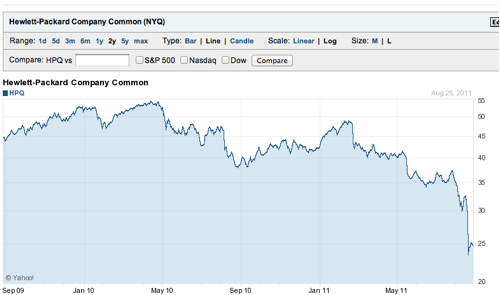
You can make a variety of arguments whether HP was right or not, but the market definitely did not agree.

NewImage

Here are a few more summaries of HP's move over the past year.

Let's say you were given a year to kill Hewlett-Packard. Here's how you do it:

Fire well-performing CEO Mark Hurd over expense-report irregularities and a juicy sexual-harassment claim that you admit has no merit. Fire four board members, as publicly as possible. Foment a mass exodus of key executives who actually know how to run the giant computer company.

Hire new a CEO from German competitor, SAP, which sells business software, not consumer products. Tell the new CEO, Leo Apotheker, that Mr. Hurd "left H-P in great shape."

...

Provoke partners Microsoft and Oracle by threatening to put H-P's own operating software on PCs. Then decide not to. Remember that promising webOS software H-P bought in a $1.2 billion acquisition of Palm last year? Sideline it.

Bristle when Oracle's Larry Ellison tells the New York Times: "The H-P board just made the worst personnel decision since the idiots on the Apple board fired Steve Jobs." And file lawsuits when Mr. Ellison hires Mr. Hurd.

Boast that you're going to attack Apple's iPad with your $499 TouchPad. Then dump your TouchPad in a $99 fire sale and announce you're just not going to offer it anymore.

Telegraph to the world that you are just too dumb to make smartphones.

...

Announce plans to maybe sell the PC business. Or maybe spin off PCs as a stand-alone company. Uncertainty will damage the price.


Currently 70% of Dell’s Enterprise Hardware is ready for running @ 113 F

I had the pleasure of chatting with a group of Dell and Intel employees on Dell’s leadership move to support “chiller-less” data centers with Fresh Air Cooling.  The people I spoke to were.

· Rich Percaccio – Enterprise Marketing Manager, Dell Global Commercial Channel

· Eric Wilcox – Power and Cooling Portfolio Manager, Dell Product Marketing

· Dave Moss – Engineering Strategist, Dell Data Center Cooling Infrastructure

· Jay Kyathsandra – Marketing Manager, Intel Datacenter and Connected Systems Group

After listening a bit to the discussion what came to mind is the problem of storage or network gear that can support these conditions.

To meet the needs of a broader range of companies interested in employing more efficient and economical facility designs, Dell has validated a portfolio of servers, storage, networking, and power infrastructure that deliver short-term, excursion-based operation with limited impact on performance across a larger environmental window. In line with the new, more stringent ASHRAE A3 and A4 classifications, Dell systems have been developed for sustained operation at temperature ranges from minus 23 F (5 C) to 113 F (45 C) and allowable humidity from 5 percent to 90 percent. This level of design robustness has been validated by recent tests indicating that the products can tolerate up to 900 hours of 104 F (40 C) operation per year and up to 90 hours at 113 F (45 C)

So I asked what % of Dell’s product line can currently run at 113 F?  The answer 70%.  Which is a good number, and we can expect that within 6 months it will rise another 5 – 10%.  But, what about the rest of the industry?

What I admire Dell for is they took a risk to be in a leadership position.  And, now the rest of the IT hardware vendors are in a defensive position.

What is also brilliant is Dell can change the TCO conversation as Fresh Air Technology can save a company money.

This can result in more than $100K of operational savings per megawatt (MW) of IT and eliminate capital expenditures of approximately $3M per MW of IT[2]. In addition, IT systems that can tolerate higher temperatures can reduce the risk of IT failures during facility cooling outages

Facebook's Open Compute discusses HDD Power Savings

Facebook's Open Compute Project has a post by Eran Tal on HDD Power Savings.

SAVING DATA CENTER POWER BY REDUCING HDD SPIN SPEED

THURSDAY, AUGUST 18, 2011 | Posted by  at 20:40 PM

Many data centers sit on a lot of “cold storage” — servers containing terabytes of user data that must be retained but is rarely accessed, because users no longer need that data. While the servers are considered cold because they are rarely utilized, their hard drives are usually spinning at full speed although they are not serving data. The drives must keep rotating in case a user request actually requires retrieving data from disk, as spinning up a disk from sleep can take up to 30 seconds. In RAID configurations this time can be even longer if the HDDs in the RAID volume are staggered in their spin up to protect the power supply. Obviously, these latencies would translate into unacceptable wait times for a user who wishes to view a standard resolution photo or a spreadsheet.

Reducing HDD RPM by half would save roughly 3-5W per HDD. Data centers today can have up to tens and even hundreds of thousands of cold drives, so the power savings impact at the data center level can be quite significant, on the order of hundreds of kilowatts, maybe even a megawatt. The reduced HDD bandwidth due to lower RPM would likely still be more than sufficient for most cold use cases, as a data rate of several (perhaps several dozen) MBs should still be possible. In most cases a user is requesting less than a few MBs of data, meaning that they will likely not notice the added service time for their request due to the reduced speed HDDs. What is critical is that the latency response time of the HDD isn’t higher than 100 ms in order to not degrade the user experience.

One of comment responses is from a Western Digital employee.

Brandon SmithAug 20

I work at Western Digital, the largest disk drive producer in the world on motor control, and this is already being implemented. I am not sure how many drives this has already been shipped with, but we definitely have low RPM standby modes. I believe it might take a few hundred ms to get back up to speed and load the heads to get to the data, so if the latency requirement is less than 100 ms, I am not sure this strategy is the way to go for data centers. Also, a spindle motor designed to spin at 7200 RPM will not spin efficiently or consistently at 3600 RPM. 4500 to 5000 RPM is a more realistic number.

For this type of storage, SSD's are not the answer, because they are not even close to cost competitive. HDD's are the way to go, but we need to be realistic about the time it will take to access the data if we want to save energy.

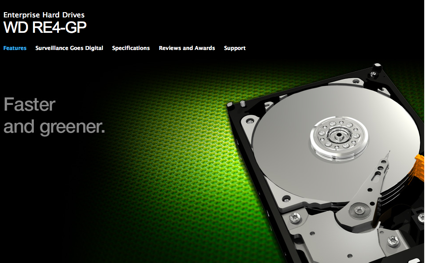
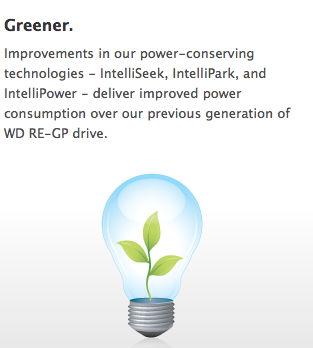
So what Green Technologies does WDC?

NewImage

NewImage


IntelliSeek.
Calculates optimum seek speeds to lower unnecessary power consumption, noise, and vibration. View demo
IntelliPower.
A fine-tuned balance of spin speed, transfer rate, and caching algorithms designed to deliver both significant power savings and solid performance. Additionally, drives with WD GreenPower Technology consume less current during start up allowing more drives to spin up simultaneously resulting in faster system readiness.
IntelliPark.
Delivers lower power consumption by automatically unloading recording heads during idle to reduce aerodynamic drag, and by disengaging read/write channel electronics.
Active Power Management.
Drives with WD GreenPower Technology monitor the work load and automatically invoke idle mode whenever possible to further reduce unnecessary power consumption. Drive recovery time from idle mode is less than one second, providing seamless power management between the drive and the host controller.
Ideal for:
Large data centers, web service providers, commercial grade surveillance systems and organizations requiring huge amounts of storage with limited budget and power allotment.