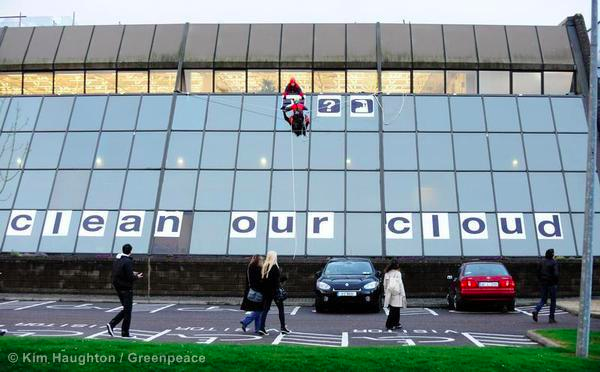
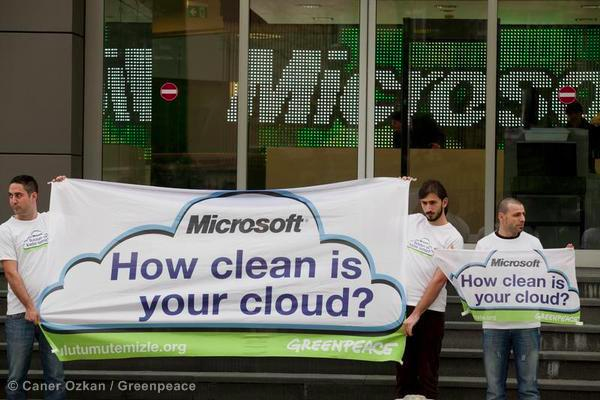
It looks like Greenpeace is pretty serious about the Dirty Cloud campaign. They have created the following videos and have put banners up at data centers.

Your Custom Text Here
It looks like Greenpeace is pretty serious about the Dirty Cloud campaign. They have created the following videos and have put banners up at data centers.
Many data centers have video cameras taking on site filming the construction project. I've seen plenty, but normally these videos are only for the project team.
If you want to see a project, here is a Microsoft MSN data center video that shouldn't probably be posted. Check it out before before it gets pulled down. It is only 2 minutes.
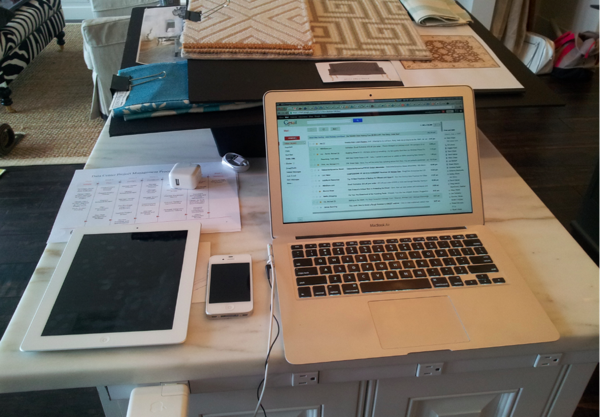
Below to the left is my new 64GB wifi iPad next to my iPhone 4S and MacBook Air. It's been about 6 years since I left Microsoft and it is now 20 years since I left Apple. I use Parallels and Windows 7 on the Mac when i need to run Quickbooks or other Windows apps. But, I am amazed at how much I just stay on OSX.
When I was in Austin with other data center people attending SXSW, we all had Macs.
I am getting back into Apple thinking, not to use Apple products, but it reminds me of how we did things at Apple. Microsoft was great too, but many things were based on iterating on past products. Not creating something brand new.
After 5+ yrs blogging on green data centers, I've figured out a lot of things, and it is time to help some of my friend do things differently. A lot of what I have been studying lately are checklists, habits, workflow, and bouncing lots of ideas off of my friends. There is no market data that supports the ideas, but that's OK. One of the things we learned at Apple is marketing data is useful for looking at the past, but not useful for creating the future.
Off to LV for a day to see more friends. I think I'll use my new iPad to review some of the drawings and diagrams, and leave the MacBook Air at home.
On Mar 1, I met with an out of friend guest in Bellevue and one of the other people who joined us was an visiting Microsoft MVP. In the conversation, he brought up the outage on Feb 29 of Windows Azure, and he shared his views on what had gone on, and how could Microsoft make a leap year mistake. How? Human error is an easy explanation.
Here are a few of the media posts.
Microsoft tries to make good on Azure outage
GigaOm - 1 hour agoIn his post, Bill Laing, corporate VP of Microsoft's server and cloud division, said the outage affectedWindows Azure Compute and dependent services ...Microsoft Offers Credit for Azure Cloud Outage Data Center Knowledge
Microsoft details leap day bug that took down Azure, refunds customers Ars Technica
Microsoft Azure Outage Blamed on Leap Year CloudTweaks News
A high level description is provided by GigaOm's Barb Darrow.
Microsoft tries to make good on Azure outage
- in Share17
Microsoft is issuing credits for the recentLeap Day Azure outage. The glitch, which cropped up on Feb. 29 and persisted well into the next day, was a setback to Microsoft, which is trying to convince businesses and consumers that its Azure platform-as-a-service is a safe and secure place to put their data and host their applications.
But, I want to point out some interesting details in Bill Laing's blog post.
There are three human errors that could have prevented the problem.
Prevention
- Testing. The root cause of the initial outage was a software bug due to the incorrect manipulation of date/time values. We are taking steps that improve our testing to detect time-related bugs. We are also enhancing our code analysis tools to detect this and similar classes of coding issues, and we have already reviewed our code base.
- Fault Isolation. The Fabric Controller moved nodes to a Human Investigate (HI) state when their operations failed due to the Guest Agent (GA) bug. It incorrectly assumed the hardware, not the GA, was faulty. We are taking steps to distinguish these faults and isolate them before they can propagate further into the system.
- Graceful Degradation. We took the step of turning off service management to protect customers’ already running services during this incident, but this also prevented any ongoing management of their services. We are taking steps to have finer granularity controls to allow disabling different aspects of the service while keeping others up and visible.
Another human error is the system took 75 minutes to notify people that there was a problem.
Detection
- Fail Fast. GA failures were not surfaced until 75 minutes after a long timeout. We are taking steps to better classify errors so that we fail-fast in these cases, alert these failures and start recovery.
Lack of communication made the problems worse.
Service Dashboard. The Windows Azure Dashboard is the primary mechanism to communicate individual service health to customers. However the service dashboard experienced intermittent availability issues, didn’t provide a summary of the situation in its entirety, and didn’t provide the granularity of detail and transparency our customers need and expect.
...
Other Communication Channels. A significant number of customers are asking us to better use our blog, Facebook page, and Twitter handle to communicate with them in the event of an incident. They are also asking that we provide official communication through email more quickly in the days following the incident. We are taking steps to improve our communication overall and to provide more proactive information through these vehicles. We are also taking steps to provide more granular tools to customers and support to diagnose problems with their specific services.
One of the nice thing about Cloud Service is the need for transparency on cause of outages. This is a marketing exercise that needs to make sense to a critical thinking technical person.
Conclusion
We will continue to spend time to fully understand all of the issues outlined above and over the coming days and weeks we will take steps to address and mitigate the issues to improve our service. We know that our customers depend on Windows Azure for their services and we take our SLA with customers very seriously. We will strive to continue to be transparent with customers when incidents occur and will use the learning to advance our engineering, operations, communications and customer support and improve our service to you.
The Feb 29th outage was like a Y2K bug that caught Microsoft flat footed. There was little to point blame on a hardware failure. What caused the problems were human decisions made in error.
About 3 months ago I bought a MacBook Air and posted on my transition. Disclosure: I am biased. I worked on the MacOs at Apple from 1985 - 1992, and Windows OS at Microsoft from 1992 - 2001. In 2001, Windows XP was my last client OS, and I switched to work on servers and enterprise management from 2001 - 2006, and refused to use Windows Vista Beta. :-)
So, am i religious on the Mac vs. Windows? i understand and appreciate the different perspectives
Think Different switch back to the Mac from Windows
WEDNESDAY, AUGUST 17, 2011 AT 11:43AMI worked at Apple from 1985 to 1992. The Mac was introduced in 1985 and 1991 Apple shipped System 7. I spent much of time working on Mac OS 6.0.x and System 7 was years of being immersed in Mac development. When I moved to Microsoft to work on Win3.1 my coworkers and I spent much of time using Macs as we were working TrueType and the vast majority of tools where on the Mac.
Even though many of my friends used Macs I didn't take the time to switch. But, yesterday I switched to a 3rd generation MacBook Air and the Lion OS.
Back when I made the switch I was loyal to Windows Live Writer as my blogging tool.
I have written a few blog entries with MarsEdit. Downloaded photos from my Canon 7D. Installed Office, Aperture, Lightroom as well.
I was much faster writing with Windows Live Writer, but it's only my second day switching back to the Mac after almost 19 years.
I have Parallels installed on the MacBook Air with Windows 7 and Windows Live Writer, and guess what I have not fired up Windows 7 with Live Writer for the last month. Marsedit is not perfect as a blogging tool and there are some features that I like on Windows Live Writer, but they are not worth the time to switch to Windows 7.
I'll write another post on the specifics of using Marsedit vs. Live Writer.
It took me about a 6 weeks to get really comfortable with the MacBook Air and OSX Lion, but keep in mind again I worked at Apple so I was a loyal religious Mac User before.
One thing I am quite pleased with on the MacBook Air is the 256GB SSD integration.


Quisque iaculis facilisis lacinia. Mauris euismod pellentesque tellus sit amet mollis.