EBay SW Developer Discusses Energy Efficient Applications

Redmond Developer has an interview with Dan Pritchett, Technical Fellow at EBay who thinks about transactions per second per watt (TPS/W).

It's no secret that power consumption is a worrying issue among datacenter managers. As system hardware becomes cheaper and energy costs continue to rise, IT managers might find that they'll spend more to power and cool a system over its lifetime than to actually buy it.

Which is why guys like Dan Pritchett, a technical fellow at eBay, has moved beyond thinking about transactions per second (TPS) with his applications to focusing on transactions per second per watt (TPS/w).

"One of the primary challenges we started to face in 2006 was power. The datacenters were maxed out and we were still running at capacity," said Pritchett, who noted that local municipalities were often physically incapable of delivering enough power to meet eBay's growing energy needs.

Ideas discussed are database design and threaded code for parallel processing.

Virtualization has played a huge role in datacenter operations, enabling companies like Google and eBay to maintain ample hardware redundancy while driving up utilization -- a key for energy-efficient design.

But dev shops can do more, Pritchett said. He urged dev managers to look to established best practices and to focus on efficient, scalable designs. At eBay, for instance, databases are always sharded -- split into smaller pieces -- to produce. "Those things definitely come at a cost," Pritchett said. "But if you are wanting to move into hundreds of millions of entities in your system, and you're wanting to deal with tens or hundreds of millions of transactions per day, that's what you are going to move to."

He also urged developers to work toward parallel programming, so that fully threaded code can work efficiently across multicore processors. "I think going forward this is definitely going to be a huge issue. We are going to start having to leverage the parallelization of the hardware into the app space," he said.

Read more

Staycations are In, My Project Featured in Sunset Magazine

It is interesting reading how Staycations are popular with high energy prices and the economic conditions. MSNBC has an article on Staycations.

Get away on vacation — at home

Forget the chores on your 'staycation', and return really rested

UPPER ST. CLAIR, Pa. - Like a suburban stalker, I have watched from my front window as various neighbors packed body boards in their SUVs and headed to the Jersey shore, set off for a week at a North Carolina mountain resort, and jetsetted to Las Vegas.

I admit it. I suffered from vacation envy.

But after spending a relaxing two-week vacation at home with my family — with no packing, no airport delays, and no backseat chants of "Are we there yet?" — I was refreshed. It was just the vacation I needed. I recommend it to anyone who sighs with that sad Sunday night feeling each weekend when it's clear daily living requires more time and energy than a typical week can offer.

10 years ago, I wanted to build my staycation space, and this month in Aug '08 Sunset Print Magazine our "Backyard Beach House" is featured. The article is not online yet, but here are some images from the article.

IMG_0002 IMG_0006

IMG_0004  IMG_0005

The one problem hard to avoid is getting away from the office as my office is at home as well. I'll write a post about my office as well, but a quick summary is it is 500 sq ft, with 208 3 phase power in my office with air side economizers (I open the windows) as well as air conditioning for those rare hot days to keep the  computers cool.

image

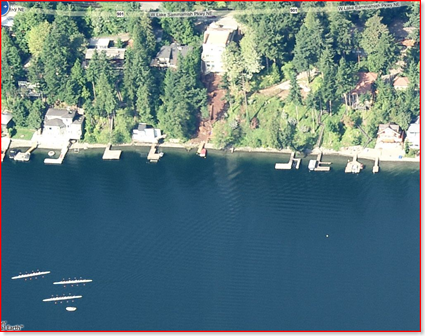
Our Beach House is the right structure with a small dock in front of it. My Office is the small structure above and our home is the next structure near the road.

Read more

Oct '08, Same Month for Microsoft's Container Data Center and PDC, Convenient Timing?

Franklin Park Herald of Northlake has an article about Microsoft's Container Data Center being completed in first half of October.

Microsoft building slated for fall completion

July 23, 2008

Recommend

By MARK LAWTON mlawton@pioneerlocal.com

Construction on Microsoft's data center in Northlake is on schedule to tentatively be finished in the first half of October.

The 550,000-square-foot building at 601 Northwest Avenue will house thousands of servers used to control Microsoft's online services.

» Click to enlarge image

The Microsoft data center in Northlake will contain equipment that supplies power, water and networking capabilities.

The outer shell of the building is complete. A "significant portion" of the building electrical and mechanical work has also been completed, said Mike Manos, general manager of data center services.

The building will be a "container data center" and constructed in a manner that resembles an erector set or Lego toys.

"Literally, a truck will put up with a container on its back," Manos said. "The container has the computer equipment and cooling and electrical systems. It plugs into what we refer to as the spine, which gives it power and water (for cooling the equipment) and networking capabilities. Then the truck pulls away."

When the electrical and mechanical work is done, Microsoft will start the commissioning process. That's when they start testing out all the computer network servers -- "tens to hundreds of thousands," Manos said.

That process will take one to two months. Then the center will start being used.

Microsoft's PDC (professional developer conference) is scheduled for Oct 28 -30 where we will see if rumors of Microsoft's cloud services are true.

Microsoft Mum On 'Red Dog' Cloud Computing

The Windows-compatible platform can be seen as Microsoft's counterpart Amazon's Elastic Cloud Computing service, known as EC2, and to the Google App Engine.

By Richard Martin
InformationWeek
July 23, 2008 12:00 PM

Attempting to respond to cloud computing initiatives from Google and Amazon (NSDQ: AMZN), Microsoft (NSDQ: MSFT) is apparently in the process of preparing a cloud-based platform for Windows that is codenamed "Red Dog."

Though reports of the project have been circulating in the blogosphere for months, Microsoft has not publicly described the service. Microsoft did not respond to repeated requests for comments for this story.

Providing developers with flexible, pay-as-you-go storage and hosting resources on Microsoft infrastructure, Red Dog can be seen as Microsoft's counterpart Amazon's Elastic Cloud Computing service, known as EC2, and to the Google App Engine, according to Reuven Cohen, founder and chief technologist for Toronto-based Enomaly, which offers its own open-source cloud platform.

"It seems that Microsoft is working on a project codenamed 'Red Dog' which is said to be an 'EC2 for Windows' cloud offering," Cohen wrote on his blog, Elastic Vapor, last week. "The details are sketchy, but the word on the street is that it will launch in October during Microsoft's PDC2008 developers conference in Los Angeles."

Convenient Timing?  Or planned execution?

Read more

Little Green Server Ideas Starting

ExtremeTech has an article building an Intel Atom based PC.

Intel's Atom has generated a lot of attention. Some of that attention has been positive: Intel building an x86 CPU whose primary design goal is very low power usage while maintaining good performance. On the other hand, Atom has been criticized for given up some key performance features, such as speculative, out-of-order execution.

Still, Atom has garnered some interesting design wins, including appearing in some of the tiny laptops first pioneered by the ASUS EeePC. Atom's most recent appearance has been in MSI's latest sub-laptop, the Wind.

What about Atom on the desktop?

First, you might ask why you'd want Atom in a desktop configuration. Its very nature suggests that performance would be limited. At 1.6GHz, and lacking out-of-order execution, performance might be pretty low. Other aspects of Atom, such as simultaneous multithreading (Hyper Threading) and a fast SSE2 floating point unit, might mitigate some of that.

in their conclusion, they get to some of the ideas for a Little Green Server.

In the end, a PC built around an Intel D945GCLF makes for a fine, light duty Web-oriented PC. It could even serve as a light duty home server, with the right storage gear. It is not, however, well-suited for even casual gaming, and we'd hesitate to run a full-bore office suite on it. Still, at 46W running flat out, it won't break your power budget.

Intel is really just dipping its toes into this market. We'd love to see more home-server oriented boards, with onboard RAID and no parallel ATA ports, for example. The system is also pretty noisy; the tiny CPU cooler isn't exactly quiet. Still, the D945GCLF will make an interesting test bed for anyone wanting to explore Atom's capabilities.

Another interesting review is from AnandTech and Asus's EEE Box.

Tom's Hardware has a review of the Intel Atom chip.

Intel is rumored to be  releasing dual core Intel Atom's in Q4 '08.

Read more

$2,600,000 UC San Diego Energy Efficient Computing project, Heavily Instrumentation & Monitoring to Calculate Performance/Watt

UC San Diego has an article about their new Energy Efficient Computing project, GreenLight.

UC San Diego’s GreenLight Project to Improve Energy Efficiency of Computing

July 28, 2008

By Doug Ramsey

The information technology industry consumes as much energy and has roughly the same carbon “footprint” as the airline industry. Now scientists and engineers at the University of California, San Diego are building an instrument to test the energy efficiency of computing systems under real-world conditions – with the ultimate goal of getting computer designers and users in the scientific community to re-think the way they do their jobs.
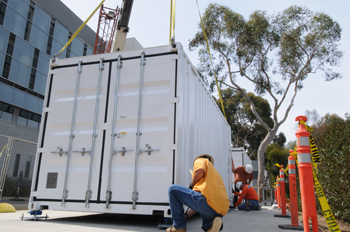
Photo of Sun Datacenter

This Sun Modular Datacenter deployed on the UC San Diego campus will be instrumented for the GreenLight project to offer full-scale processing and storage in order to test how to make computing more energy-efficient.

The National Science Foundation will provide $2 million over three years from its Major Research Instrumentation program for UC San Diego’s GreenLight project. An additional $600,000 in matching funds will come from the UCSD division of the California Institute for Telecommunications and Information Technology (Calit2) and the university’s Administrative Computing and Telecommunications (ACT) group.

The GreenLight project gets its name from its plan to connect scientists and their labs to more energy-efficient ‘green’ computer processing and storage systems using photonics – light over optical fiber.

The goal of GreenLight is to under computational performance per watt.

The GreenLight Instrument will enable an experienced team of computer-science researchers to make deep and quantitative explorations in advanced computer technologies, including graphics processors, solid-state disks, photonic networking, and field-programmable gate arrays (FPGAs). Jacobs School of Engineering computer science professor Rajesh Gupta and his team will explore alternative computing fabrics from array processors to custom FPGAs and their respective models of computation to devise architectural strategies for efficient computing systems.

“Computing today is characterized by a very large variation in the amount of effective work delivered per watt, depending upon the choice of the architecture and organization of functional blocks,” said Gupta. “The project seeks to discover fundamental limits of computing efficiency and device organizing principles that will enable future system builders to architect machines that are orders-of-magnitude more efficient modern-day machines, from embedded systems to high-performance supercomputers.”

The computing and systems research will yield new quantitative data to support engineering judgments on comparative “computational work per watt” across full-scale applications running on full-scale computing platforms.

This is a big win for Sun Microsystems and their containers.

“Using the Sun Modular Datacenter as a core technology and making all measurements  available as open data will form a unique, Internet-accessible resource that will have a dramatic impact on academic, government and private-sector computing,” said Emil J. Sarpa, Director of External Research at Sun Microsystems, Inc. “By placing experimental hardware configurations alongside traditional rack-mounted servers and then running a variety of computational loads on this infrastructure, GreenLight will enable a new level of insight and inference about real power consumption and energy savings.”

According to DeFanti, the project decided to build the GreenLight Instrument around the Sun Modular Datacenter because, “it’s the fastest way to construct a controlled experimental facility for energy research purposes.” The modular structure also means the GreenLight Instrument can be cloned – unlike bricks-and-mortar computer rooms that cannot be ordered through purchasing.
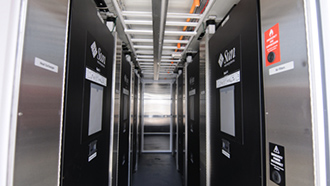
Photo of Sun Modular Datacenter

Interior of the Sun Modular Datacenter prior to deployment of up to 280 servers and other equipment that will turn the shipping container into the GreenLight Instrument.

And to make things a bit sexy, they plan on using a virtual environment to visualize inside the containers..

Rather than give scientists physical access to the GreenLight Instrument, OptIPortal tiled display systems will serve as visual termination points – allowing researchers to “see” inside the instrument. Users will also be able to query and visualize all sensor data in real time and correlate it interactively and collaboratively in this immersive, multi-user environment.

Once a virtual environment of the system has been created, scientists will be able to walk into a 360-degree virtual reality version in Calit2’s StarCAVE. Users will be able to zoom into the racks of clusters as well as see and hear the power and heat, from whole clusters of computers down to the smallest instrumented components, such as computer processing and graphics processing chips.

Read more