Small Nuclear Reactors, Future Energy for Green Data Centers?

With all the attention on carbon emissions, cap and trade, and other government programs, Nuclear Reactors are getting more momentum.  Many environmentalist are against nuclear, but the reality is nuclear plants are one of the few 24 x 7 carbon neutral power sources that can work for a data center.

The World Nuclear Association has a good article on Small Nuclear Reactors.

Today, due partly to the high capital cost of large power reactors generating electricity via the steam cycle and partly to consideration of public perception, there is a move to develop smaller units. These may be built independently or as modules in a larger complex, with capacity added incrementally as required - see final section of this paper. Economies of scale are provided by the numbers produced. There are also moves to develop small units for remote sites. The IAEA defines "small" as under 300 MWe.

The most prominent modular project is the South African-led consortium developing the Pebble Bed Modular Reactor of of 170 MWe. Chinergy is preparing to build a similar unit, the 195 MWe HTR-PM in China. A US-led group is developing another design with 285 MWe modules. Both drive gas turbines directly, using helium as a coolant and operating at very high temperatures. They build on the experience of several innovative reactors in the 1960s and 1970s.

A list of small-medium nuclear reactors in development follows:

VK-300
300 MWe PWR
Atomenergoproekt, Russia

CAREM
27 MWe PWR
CNEA & INVAP, Argentina

KLT-40
35 MWe PWR
OKBM, Russia

MRX
30-100 MWe PWR
JAERI, Japan

IRIS-100
100 MWe PWR
Westinghouse-led, international

SMART
100 MWe PWR
KAERI, S. Korea

NP-300
100-300 MWe PWR
Technicatome (Areva), France

PBMR
165 MWe HTGR
Eskom, South Africa, et al

GT-MHR
285 MWe HTGR
General Atomics (USA), Minatom (Russia) et al

BREST
300 MWe LMR
RDIPE (Russia) 

FUJI
100 MWe MSR
ITHMSO, Japan-Russia-USA

Russia is already building floating nuclear power plants for Arctic operations.

Given that we are already supposed to be facing the twin threats of terrorism and environmental meltdown, you might think the last thing the world needs is a fleet of floating nuclear power plants (NPPs). Russia disagrees, and confirmed this week that construction has started on the first of seven ships carrying a 70MW nuclear reactor. The ships will provide power to remote coastal towns, or be sold abroad, with 12 countries, including Algeria and Indonesia, said to have expressed interest.

Read more

Who is Reading Green Data Center Blog?

The following is a list of top 25 companies reading the Green Data Center blog in order of highest to lowest.  I have not included hits from broadband provides like Comcast, Verizon, Charter Communications, etc, even though there may be some traffic from those companies corporate offices.

The list is based on Google Analytics stats from July 8 – Aug 7.

1. Microsoft

2. VMware

3. Cisco

4. Hewlett Packard

5. Intel

6. Performance Systems International

7. Sun Microsystems

8. IBM

9. DPR Construction

10. Google

11. Amazon

12. Ebay

13. University of Cambridge Laboratory

14. Apple Computer

15. Liebert

16. SAP

17. Computer Sciences Corp

18. Data General

19. Lockheed Martin

20. APC

21. Dell

22. Deutsche Bank

23. Executive Software

24. Oak Ridge Laboratories

25. AOL

Reflecting on this list, I know someone at 15 of the companies, and helps me think of who my readers are.

Read more

Living Data Center, Skanska's Tool

A great book to read to think about Green Data Center principles is The Living Company. It has 5 stars from 21 customer reviews on amazon.com

Here is an excerpt from a BusinessWeek post.

After all of our detective work, we found four key factors in common:

1. Long-lived companies were sensitive to their environment. Whether they had built their fortunes on knowledge (such as DuPont's technological innovations) or on natural resources (such as the Hudson Bay Company's access to the furs of Canadian forests), they remained in harmony with the world around them. As wars, depressions, technologies, and political changes surged and ebbed around them, they always seemed to excel at keeping their feelers out, tuned to what-ever was going on around them. They did this, it seemed, de-spite the fact that in the past there were little data available, let alone the communications facilities to give them a global view of the business environment. They sometimes had to rely for information on packets carried over vast distances by portage and ship. Moreover, societal considerations were rarely given prominence in the deliberations of company boards. Yet they managed to react in timely fashion to the conditions of society around them.

2. Long-lived companies were cohesive, with a strong sense of identity. No matter how widely diversified they were, their employees (and even their suppliers, at times) felt they were all part of one entity. One company, Unilever, saw itself as a fleet of ships, each ship independent, yet the whole fleet stronger than the sum of its parts. This sense of belonging to an organization and being able to identify with its achievements can easily be dismissed as a "soft" or abstract feature of change. But case histories repeatedly showed that strong employee links were essential for survival amid change. This cohesion around the idea of "community" meant that managers were typically chosen for advancement from within; they succeeded through the generational flow of members and considered themselves stewards of the longstanding enterprise. Each management generation was only a link in a long chain. Except during conditions of crisis, the management's top priority and concern was the health of the institution as a whole.

3. Long-lived companies were tolerant. At first, when we wrote our Shell report, we called this point "decentralization." Long-lived companies, as we pointed out, generally avoided exercising any centralized control over attempts to diversify the company. Later, when I considered our research again, I realized that seventeenth-, eighteenth-, and nineteenth-century managers would never have used the word decentralized; it was a twentieth-century invention. In what terms, then, would they have thought about their own company policies? As I studied the histories, I kept returning to the idea of "tolerance." These companies were particularly tolerant of activities on the margin: outliers, experiments, and eccentricities within the boundaries of the cohesive firm, which kept stretching their understanding of possibilities.

4. Long-lived companies were conservative in financing. They were frugal and did not risk their capital gratuitously. They understood the meaning of money in an old-fashioned way; they knew the usefulness of having spare cash in the kitty. Having money in hand gave them flexibility and independence of action. They could pursue options that their competitors could not. They could grasp opportunities without first having to convince third-party financiers of their attractiveness.

I've been meaning to write about some of these ideas and yesterday at Data Center Dynamics Seattle, I met Jakob Carnemark from Skanska who embraces these ideas with tools they are developing for the Green Data Center by enabling the Living Data Center in the same principles used in "The Living Company".

Skanska's approach of continuous process improvement fits what I have written in the past on being Green is not a binary decision, but a commitment.

I am going to follow up with Jakob to get more details on how they create metrics, monitoring and modeling. His 3M's vs my M3 (monitoring, metering, managing).

Read more

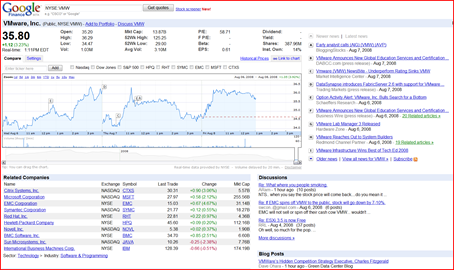
Blogging Tip, Adding a Stock Quote Reference Increases Probability to Get Listed in finance.google.com

In today's post /2008/08/vmwares-hidden.html, discussing VMware's Hidden Competition Executive, I purposely added the stock link to VMW in my post,

One friend said Charles joined Pi Corp, Paul Maritz’s company one week before it was acquired by EMC, reporting directly to Paul. Charles had to have known he was joining EMC’s cloud computing efforts, and I wouldn’t be surprised if he know at the time that there were plans to make big changes at VMware (NYSE: VMW) like Paul’s CEO role.

I write the Green Data Center blog as my own research notebook, and it is more efficient for me to share ideas with friends than writing emails. About twice a month I am running into friends who are thinking about blogs and can use help getting started.  I am going to start adding to my blog, tips for bloggers.

I did this knowing I would get index'd by google finance's blog search in http://finance.google.com/finance?q=NYSE:VMW 

image 

This popped me up to #1 in blog posts for VMW.

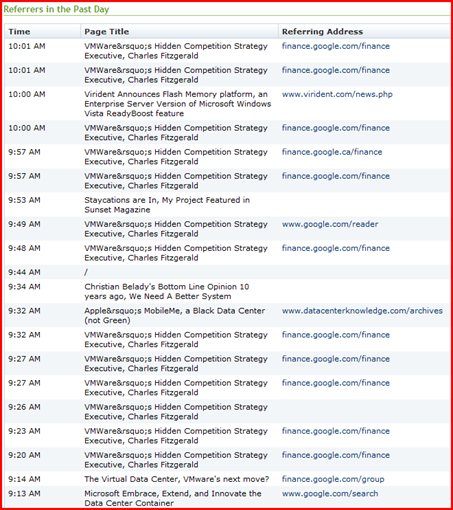
image

I can see the click stats in TypePad's tools.

image

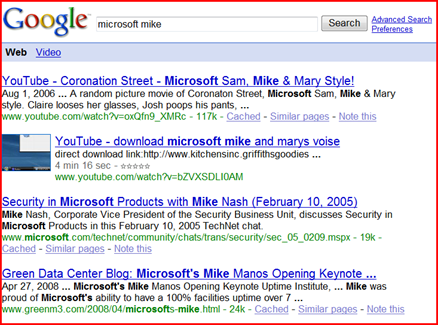
Now let me preface this with I have been blogging for a 10 months on Green Data Center, and I have been watching carefully how well my posts get index'd. One of the interesting Google Webmaster tools shows I get a high search click for "microsoft + mike"

image

Showing up #4 is my blog with Microsoft's Mike Manos.  I have no idea what Microsoft Mike people are searching for, but the fact I show up #4 feels weird.

Another strange one is I beat Dell in Google search for Dell XS23. Maybe I need to get the Dell guys to post a banner ad on my site.  :-)

image

Read more

VMWare’s Hidden Competition Strategy Executive, Charles Fitzgerald

This week was a lot of face to face networking and not much time on the Internet and blogging. One of the nuggets of data found is what happened to Microsoft’s Charles Fitzgerald, a general manager who was a big thinker in planning Microsoft’s competitive strategy. As Mary Jo Foley writes.

Charles Fitzgerald, Microsoft’s General Manager of Platform Strategy, is leaving the company to join a startup.

Fitzgerald was Microsoft’s primary spokesperson for Microsoft Java back in 1996. Ever since, he’s been helping Microsoft position itself against its enterprise competitors. On Fitzgerald’s Platformonomics blog, he skewered regularly IBM, Sun, Oracle, Google and other Microsoft competitors.

Most recently, Fitzgerald was focused on explaining Microsoft’s Software+Services strategy to the press and analyst masses. While he was mostly a behind-the-scenes strategist, Microsoft trotted out Fitzgerald whenever the company needed to justify a new strategy/product plan or set the big-picture scene for company critics.

Microsoft officials confirmed that Fitzgerald will be leaving Microsoft “shortly” and declined to name the startup he will be joining. I e-mailed Fitzgerald, asking him about his decision to leave Microsoft. If and when he responds (not holding my breath here), I’ll add his comments.

One friend said Charles joined Pi Corp, Paul Maritz’s company one week before it was acquired by EMC, reporting directly to Paul. Charles had to have known he was joining EMC’s cloud computing efforts, and I wouldn’t be surprised if he know at the time that there were plans to make big changes at VMware (NYSE: VMW) like Paul’s CEO role.

Add up Charles Platform Strategy skills, his lack of visibility to the external world, and VMware’s changes, I place bets he is Paul Martiz’s Competition Strategy Executive. Paul Maritz’s public statements of having no fear of competing against Microsoft is backed by a trusted executive he has planning the strategy.

How good is Paul Maritz?  Valleywag has a post.

Once a high-flyer at Microsoft, Maritz was ousted in one of the software giant's typically obscure internecine battles back in 2000. Since then, he's quietly stewed in exile, starting a small software company which was bought by EMC, VMware's parent.

A lucky break for EMC to have Maritz on its bench. Ignore his cuddly-programmer looks; he is fearsome, and deservedly hated by enemies. Antitrust superlawyer David Boies couldn't make a dent in Maritz's armor when the executive took the stand in Microsoft's 1990s antitrust trial. VMware is up for a bruising battle with Microsoft for its software niche, which involves tools to let a computer server act like several separate ones — but I'm thinking Microsoft is the one we should feel sorry for.

Maritz's generation of leaders has mostly retired at Microsoft, yet most of their replacements' freshly scrubbed faces are still familiar to him. He knows all of Microsoft's dirty tricks, and he will enjoy serving them back at the young ones he once taught them to. This will be fun.

Take 2 executives who were frustrated at Microsoft and put them together in an opportunity to compete, and watch out.  Microsoft now not only has to compete on technical and marketing with VMware, they need to compete against their executive team on strategy.

I’ve searched for Charles’s presence in VMware, but he is hidden which means either he is busy inside VMware or my facts are wrong. If I had to place a bet, Charles is staying under the radar not telling anyone what he is planning at VMware.

Update 9:19a, Aug 7, 2008.

I missed Mary Jo’s post that had the tip of Charles at PiCorp.

According to a few different sources who asked not to be named, Maritz has hired Charles Fitzgerald, Microsoft’s former head of Platform Strategy, to work at Smart Desktop, a division of Martiz’s Pi Corp.

Fitzgerald resigned from Microsoft in January 2008 and neither Microsoft nor Fitzgerald himself would comment on where he was going.

(I tried contacting Smart Desktop to see if Fitzgerald was hired, to no avail. I also tried e-mailing Fitzgerald, but so far, no reply.)

Read more