8 Million Gallons/mo Recycled Water Used in Microsoft's San Antonio Data Center

San Antonio Business Journal reports on Microsoft's latest data center opening.

Microsoft Corp. fired up its data "nerve center" in Westover Hills on Monday.

"With what's going on in the economy, it's great to be able to make a half a billion investment in San Antonio," said Debra Chrapaty, Microsoft's corporate vice president for Global Foundation Services. "I hope you all out there are Live users. None of that Google stuff – not in San Antonio."

The 470,000 square foot building alone costs $550 million, Chrapty said. In addition, Microsoft will spend hundreds of millions of dollars on computer servers, network equipment and more to run the "brain" behind serving up data online, she said.

A few hundred people gathered under a tent outside Microsoft's new data center at 5150 Rogers Road to celebrate its opening. Earlier in the morning, Microsoft gave a select group of government, state and city leaders a tour of the highly secure facility. They were the only ones allowed inside.

Ironically, I actually went to San Antonio this weekend and was able to visit my cousin, Derek Howorth in San Antonio who is a big Texas Longhorn sports fan, and was an all-american swimmer for Texas.  Chatting he asked how much water does the Microsoft San Antonio Data Center use, I guessed a couple of 100,000 gallons a day which is close to actual of 267,000 gallons (267,000 x 30 days = 8,000,000).

The San Antonio data center is the second build to suit Microsoft building and the most technologically advanced, Chrapty said. Its also Microsoft's "greenest" project to date, she said. It will use more than eight million gallons of recycled water per month for its data center cooling needs. It is also planning on putting solar panels on its roof to harness the sun’s energy, Chrapty said.

It was a smart move made for Microsoft to use recycled water now that they are letting everyone know their water use.

I met a bunch of Derek's swimmer friends going to Rice vs. Texas football game. And being a football game we drank beers before the game for about 4 hours, went to game, left before the half then went to the alumni tent and drank more beers.  Derek's fiends apologized for the random walk as their super organized tail gate party organizer was out of town with his girl friend, Kristy Coventry on a promotional tour for the London 2012 Olympics.

Hanging around all these swimmers, and talking about some ideas for a blog on swimming my cousin could run, got me thinking.

All great swimmers know their personal best times, and when they broke them throughout their career.  They know the personal best times of their competitors as well.

Wouldn't it be great if the Data Center team knew the energy efficiency metrics for their data center?  And, each individual had numbers they felt they owned, and are competing against their peers.  This is how competitive swimming works. I've heard the Microsoft guys base bonuses on energy efficiency improvements.

Know of anyone else?

Read more

8 Million gallons of Recycled Water For Microsoft's San Antonio Data Center

San Antonio Business Journal reports on Microsoft's latest data center opening.

Microsoft Corp. fired up its data "nerve center" in Westover Hills on Monday.

"With what's going on in the economy, it's great to be able to make a half a billion investment in San Antonio," said Debra Chrapaty, Microsoft's corporate vice president for Global Foundation Services. "I hope you all out there are Live users. None of that Google stuff – not in San Antonio."

The 470,000 square foot building alone costs $550 million, Chrapty said. In addition, Microsoft will spend hundreds of millions of dollars on computer servers, network equipment and more to run the "brain" behind serving up data online, she said.

A few hundred people gathered under a tent outside Microsoft's new data center at 5150 Rogers Road to celebrate its opening. Earlier in the morning, Microsoft gave a select group of government, state and city leaders a tour of the highly secure facility. They were the only ones allowed inside.

Ironically, I actually went to San Antonio this weekend and was able to visit my cousin, Derek Howorth in San Antonio who is a big Texas Longhorn sports fan, and was an all-american swimmer for Texas.  Chatting he asked how much water does the Microsoft San Antonio Data Center use, I guessed a couple of 100,000 gallons a day which is close to actual of 267,000 gallons (267,000 x 30 days = 8,000,000).

The San Antonio data center is the second build to suit Microsoft building and the most technologically advanced, Chrapty said. Its also Microsoft's "greenest" project to date, she said. It will use more than eight million gallons of recycled water per month for its data center cooling needs. It is also planning on putting solar panels on its roof to harness the sun’s energy, Chrapty said.

It was a smart move made for Microsoft to use recycled water now that they are letting everyone know their water use.

I met a bunch of Derek's swimmer friends going to Rice vs. Texas football game. And being a football game we drank beers before the game for about 4 hours, went to game, left before the half then went to the alumni tent and drank more beers.  Derek's fiends apologized for the random walk as their super organized tail gate party organizer was out of town with his girl friend, Kristy Coventry on a promotional tour for the London 2012 Olympics.

Hanging around all these swimmers, and talking about some ideas for a blog on swimming my cousin could run, got me thinking.

All great swimmers know their personal best times, and when they broke them throughout their career.  They know the personal best times of their competitors as well.

Wouldn't it be great if the Data Center team knew the energy efficiency metrics for their data center?  And, each individual had numbers they felt they owned, and are competing against their peers.  This is how competitive swimming works. I've heard the Microsoft guys base bonuses on energy efficiency improvements.

Know of anyone else?

Read more

Avanade's Green IT Part 3, Power Calculators vs. Excel Document

I don't know about you, but I don't trust the on line power calculators out there from vendor websites. And, after meeting with Steve Fink a senior infrastructure architect from Avanade, it hit me why I don't trust the power calculators.  There is limited or no transparency as to how the calculators work and what assumptions are made.  Steve was showing the excel document Avanade uses with its customers to calculate Green IT projects. We could look at any cell and see the math behind a calculation, and Avanade gives its customers the excel document so they can work on their own Green IT calculations.

If the online power calculators provided the option to download an excel document, then you could see the math behind the calculator, but I am sure the vendor marketing team wants to keep you on their web site, and collect data (which they'll probably never look at) as to what values are entered and try to use it for lead retrieval.

If you are working with a consulting firm ask for the excel document, and if  you are up on a vendor's site, provide feedback you want an excel document.

image

Read more

Who Are You Listening To?

After spending a great week networking with folks at Data Center Dynamics Chicago, I caught TechHermit's post on the latest anti-PUE post by Ken Brill.

A Controversy of lunacy

September 19, 2008

I have been sidelined for the past few weeks with a rooftop air handler replacement project.  As a result I have not been very active here, but the growing lunacy in our industry around efficiency metrics has pulled me out of my long hours to post a slight commentary. 

Data Center Journal posted a video on the growing controversy which attempts to get at the heart of the issue.   Personally I don’t feel that this post is very even handed and it gives Ken Brill and the Uptime Institute a lot of air time with his buffoonish rebuttals of PUE.  The flip side has barely a rebuttal from the Green Grid.  In effect his issues are nomenclature.   Additionally the schizophrenic ramblings has him taking credit for developing the metric 5 years ago, and then publicly flogging the same metric with a different name.  Does anyone else see the utter lunacy in this?

As TechHermit points out I don't want to draw more attention to Ken Brill, and it is not worth fighting Ken as it seems like he is the only one out there fighting the Green Grid and users of PUE, rounding up his believers for the next Uptime Institute Meeting.

Ken has way too much energy and connections in the data center industry to ignore what he is doing. Being an Aikidoist, I've learned to think of how to use the attacker's energy to your advantage.

Aikido (合気道, aikidō?) is a Japanese martial art developed by Morihei Ueshiba as a synthesis of his martial studies, philosophy, and religious beliefs. Aikido is often translated as "the Way of unifying (with) life energy"[1] or as "the Way of harmonious spirit."[2] Ueshiba's goal was to create an art that practitioners could use to defend themselves while also protecting their attacker from injury.

Aikido is performed by blending with the motion of the attacker and redirecting the force of the attack rather than opposing it head-on. The aikidōka (aikido practitioner) "leads" the attacker's momentum using entering and turning movements.

Aikido training is mental as well as physical, emphasizing the ability to relax the mind and body even under the stress of dangerous situations.[42] This is necessary to enable the practitioner to perform the bold enter-and-blend movements that underlie aikido techniques, wherein an attack is met with confidence and directness.[22] Morihei Ueshiba once remarked that one "must be willing to receive 99% of an opponent's attack and stare death in the face" in order to execute techniques without hesitation.[6] As a martial art concerned not only with fighting proficiency but also with the betterment of daily life, this mental aspect is of key importance to aikido practitioners.[43]

TechHermit closes with the following.

I am not giving Ken Brill more airtime on this subject.   Just talking about it feeds this goofy controversy. He is single-handedly splintering the data center community and the tools of media are turning a blind eye.   Wise up.  The Tiering System is out of date, and Ken Brill is in full brand protection mode.  Even Microsoft is more “open source” to ideas than the Uptime Institute.

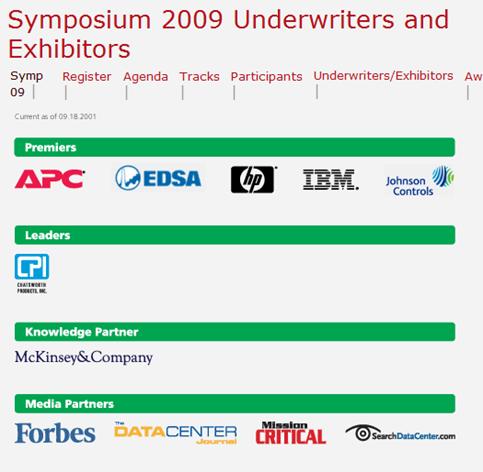
Using Ken's energy he will splinter the data center community in those who look to Uptime Institute for guidance, and those that do not. I've heard rumors many of the top data center vendors are questioning sponsorship for Uptime's Symposium 2009. image


Personally, I am making great connections with those who question Ken Brill's motives.

Who are you listening to? Ken Brill or the rest of the industry?

If you worship Ken Brill's words, you may want to start listening to the other side. But, don't expect the other side to come from Ken's media partners - Forbes, Datacenter Journal, Mission Critical, and SearchDataCenter.com. 

Read more