Smart Grid Issues for Electric Vehicles looks like Data Center Power Monitoring Complexity

Like fractals, complex system can be self-similar.

Fractal

From Wikipedia, the free encyclopedia

For the 2009 recording by Skyfire, see Fractal (EP).

The Mandelbrot set is a famous example of a fractal

A fractal is generally "a rough or fragmented geometric shape that can be split into parts, each of which is (at least approximately) a reduced-size copy of the whole,"[1] a property called self-similarity. Roots of mathematical interest on fractals can be traced back to the late 19th Century; however, the term "fractal" was coined by Benoît Mandelbrot in 1975 and was derived from the Latin fractus meaning "broken" or "fractured." A mathematical fractal is based on an equation that undergoes iteration, a form of feedback based on recursion.[2]

A fractal often has the following features:[3]

Because they appear similar at all levels of magnification, fractals are often considered to be infinitely complex (in informal terms). Natural objects that approximate fractals to a degree include clouds, mountain ranges, lightning bolts, coastlines, snow flakes, various vegetables (cauliflower and broccoli), and animal coloration patterns. However, not all self-similar objects are fractals—for example, the real line (a straight Euclidean line) is formally self-similar but fails to have other fractal characteristics; for instance, it is regular enough to be described in Euclidean terms.

Gigaom has an article about the complexity of a smart grid electric vehicle system.

Report: IT and Networking Issues for the Electric Vehicle Market This content requires a paid GigaOM Pro subscription

Summary:

This Pike Research report focuses on the IT and networking requirements associated with technology support systems for the emerging Electric Vehicle (EV) market. Key areas covered include vehicle connection and identification, energy transfer and vehicle-to-grid systems, communications platforms, pricing and billing systems and implementation issues.

The new generation of mass-produced EVs (including both plug-in and all-electrics) that will start arriving in 2010 will be able to charge at the owner’s residence, place of business, or any number of public and private charging stations. Keeping track of the ability of these vehicles and the grid to transfer energy will require transmitting data over old and new communications pathways using a series of developing and yet-to-be-written standards.

Industries that previously had little to no interaction with each other are now collaborating, determining new technologies and standard protocols and formats for sharing data. Formerly isolated networks must be able to handshake and seamlessly share volumes of financial and performance data. EV charging transactions will, for the first time, bring together platforms including vehicle operating systems and power management systems, utility billing systems, grid performance data, charging equipment applications, fixed and wireless communications networks, and web services.

When you look at the complexity of the system, it looks amazingly like the issues to put in a real-time energy monitoring system in the data center.

  1. Executive Summary
  2. Vehicle Connection and Identification
    1. Building Codes
    2. Battery Status
    3. Managing Vehicle-Grid Interaction
    4. Power Transfer
      1. Timed Power Transfer
  3. Communications Between Charging Locations and the Grid
    1. Home Area Networks
      1. Smart Meters
    2. Communications Channels
      1. Broadband
      2. ZigBee
      3. Powerline Networking
      4. Cellular Networks
  4. Utility Interaction with Customers
    1. Real-time Energy Pricing
    2. Enabling Vehicles to Respond to Grid Conditions
    3. Renewable Energy
    4. Future Vehicle to Grid (V2G) Applications
  5. Implementation Issues
    1. Cost
    2. Standards in Flux
    3. Clash of Multiple Industries
      1. Control
    4. Privacy
Read more

New Vacancy in Microsoft’s Data Center Team, VP Debra Chrapaty Reportedly Leaving for Cisco

news.com has reports that Microsoft’s VP of Global Foundation Services (aka, Data Center Team) is leaving Microsoft.


Microsoft's data center chief headed to Cisco

by Ina Fried

Debra Chrapaty, who has been leading Microsoft's data center charge, is reportedly heading to a product role at Cisco.

(Credit: Dan Farber)

One of the top executives in charge of Microsoft's data center operations is leaving the company for a product role at Cisco, according to a report on All Things D.

Debra Chrapaty, who as vice president of global foundation services is among a small number of women in Microsoft's top technology ranks, is said to be taking a role at Cisco heading collaboration products, according to All Things D. A Microsoft representative declined comment, while Chrapaty and a Cisco representative were not immediately available for comment.

Microsoft has confirmed the move by Chrapaty.

Update 4:05 p.m. PT: A Microsoft representative confirmed Chrapaty is leaving Microsoft for Cisco, but was not immediately able to provide further details.

The original source for the news came from All things Digital.

BoomTown

Top Microsoft Infrastructure Exec Chrapaty Heads to Cisco

by Kara Swisher
Posted on September 20, 2009 at 10:39 PM PT

PrintPost to TwitterShare

chrapaty-4_web

One of Microsoft’s top execs, Debra Chrapaty (pictured here), who heads its infrastructure business, is leaving the software giant to take a top job at Cisco (CSCO), sources said.

Chrapaty–whose title is corporate VP of Global Foundation Services–is also one of increasingly few top women tech execs at Microsoft (MSFT), where she has worked for seven years.

Read more

California’s Future Renewable Energy Target, Requires Imports

NYTimes Green Inc has a post on Gov Schwarzenegger’s position on renewable energy.

Green Inc. - Energy, the Environment and the Bottom Line

September 16, 2009, 1:58 PM

Debating Protectionism on Renewable Energy

By KATE GALBRAITH

ArnoldGetty ImagesGov. Arnold Schwarzenegger of California has blasted renewable energy “protectionism.”

One of the most notable elements of Gov. Arnold Schwarzenegger’s executive order on Tuesday increasing California’s renewable energy requirements was his blunt stand against protectionism. Clean energy imported from other states was welcome, the governor said, to keep down electricity prices.

“I am totally against protectionist policies because it never works,” Mr. Schwarzenegger said, later adding:

You have to understand that we get our water from outside California. We get it from the Colorado River, for instance. Why can we get the water from the Colorado River but we can’t get renewable energy from outside the state? We get most of our cars from outside the state; why can’t we get renewable energy?

This is probably a smart move as the California environmental groups fight renewable energy projects.

Disputed solar project in Calif. desert dropped

By Elisabeth Rosenthal
The New York Times

A proposed solar-energy project in the California desert that caused intense friction between environmentalists and the developers of renewable energy has been shelved.

BrightSource Energy had planned a 5,130-acre solar power farm in a remote part of the Mojave Desert, on land previously intended for conservation. The company, based in Oakland, Calif., on Thursday said it was instead seeking an alternative site for the project.

Seattletimes.com writes that California’s renewable energy targets will drive up energy prices in Washington state.

California's appetite for green power could boost rates here

California may come hunting soon for large amounts of wind power from the Pacific Northwest, and that has many Washington utilities worried about increased competition and higher electric bills for consumers.

By Andrew Garber

Seattle Times staff reporter

With a new renewable-energy mandate, California may look to the Northwest.

Wind turbines spin near Ellensburg. The impact of California's rising demand for green energy could depend on how much Northwest electricity that state tries to actually import and how much it uses renewable-energy credits instead.

Enlarge this photo

Related

California may come hunting soon for large amounts of wind power from the Pacific Northwest, and that has many Washington utilities worried about increased competition and higher electric bills for consumers.

Gov. Arnold Schwarzenegger signed an executive order last week requiring California to get 33 percent of its energy from green sources such as wind, solar and geothermal by 2020. That's up from an earlier 20 percent mandate.

Given California's population of about 38 million people, the move is expected to create a major shift in the world of renewable energy.

"This is really going to be felt from the tip of northern British Columbia down to Mexico and all across the West," said Steve Ernst, editor of the Northwest energy-policy newsletter Clearing Up.

One government estimate says California would need an additional 5,700 average megawatts of renewable energy — enough to power more than 3.7 million homes. Washington utilities, by comparison, are projected to need an additional 1,000 average megawatts of renewable energy by 2020 to meet their own requirements mandated by Initiative 937. An average megawatt is 1 megawatt of electricity delivered continuously for one year.

Does this mean the electricity gets imported?  Not necessarily, the “unbundled renewable energy credits could be purchased.”

Some Northwest utilities are particularly concerned about something the industry calls "unbundled renewable energy credits."

Basically, California power companies could purchase green-energy credits from Northwest wind farms, but not pay to transmit the electricity to California. In other words, they'd leave the electricity here but still get credit for the green energy.

It is not going to be easy to calculate your carbon footprint in a California based data center.  Do you assume in 2020 33% of your energy is carbon free?

Read more

Best Possible Conditions for a Green Data Center, Intel & T-Systems launch DataCenter2020

Intel and T-systems have launched DataCenter2020.

Bavaria's Silicon Valley: DataCenter 2020

Sep 18, 2009

  • T-Systems and Intel join in researching the efficient data center of the future

Opening in Munich: At DataCenter 2020, T-Systems and Intel are working on the industrial implementation and automation of ICT services. Their goal: bringing them to market with maximum energy and cost savings. In an initial phase at Euroindustriepark, the two companies are researching how to create the best possible conditions for a green data center. Initial findings will be published this year. They will serve as the basis for ecological improvements to new and existing data centers.

Some of the technical details for the below pictures are:

Highlights of DataCenter 2020 include a ceiling height that can be adjusted from 2.50 meters to 3.70 meters and a smoke generator that makes air flows visible. The test environment, roughly 70 meters square, and an equipment room of the same size are located in the T-Systems data center. Intel is providing about 180 servers for the project, while the corporate customer arm of Deutsche Telekom is supplying the infrastructure necessary to operate them.

20090918_DataCenter2020_008

20090918_DataCenter2020_002 

20090918_DataCenter2020_005

Read more

Adobe Greens Content Publishing, Closes Loop with Omniture Acquisition

Adobe announced its acquisition of Omniture to measure the effectiveness of published content.

Adobe acquires Omniture

On Sept. 15, 2009, Adobe Systems Incorporated (Nasdaq:ADBE) and Omniture, Inc. (Nasdaq:OMTR) announced the two companies have entered into a definitive agreement for Adobe to acquire Omniture in a transaction valued at approximately $1.8 billion on a fully diluted equity-value basis. Under the terms of the agreement, Adobe will commence a tender offer to acquire all of the outstanding common stock of Omniture for $21.50 per share in cash.

Adobe’s acquisition of Omniture furthers its mission to revolutionize the way the world engages with ideas and information.

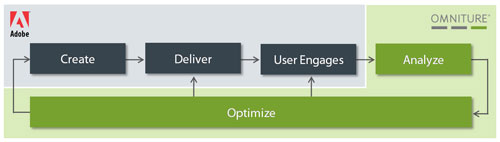
Adobe and Omniture

For the data center the significance is in closing the loop in published content.

By combining Adobe’s content creation tools and ubiquitous clients with Omniture’s Web analytics, measurement and optimization technologies, Adobe will be well positioned to deliver solutions that can transform the future of engaging experiences and e-commerce across all digital content, platforms and devices.

This is an important part of a strategy to understand the value of information in the data center.

Greening the data center is easier if you can understand what information systems are high value and which are low value.

The more advanced companies are thinking of a strategy for greening the data center accounting for the business value of the systems.  You can save more by segmenting the IT loads than by treating them all the same.

Read more